
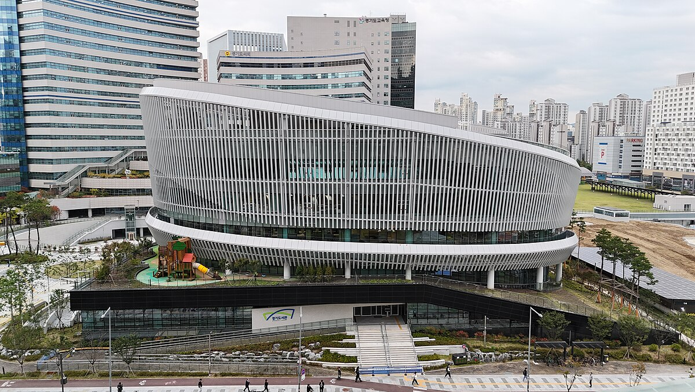
Gyeonggi Provincial Library, opened last October / Photo: Gyeonggi Province
After nine years
of preparation, the Gyeonggi Provincial Library has officially opened. It is a
space that cannot be fully defined by the phrase “Korea’s largest public
library.” Rather, it stands as a proposal for what a public library should be
today—an experiment in a new kind of public platform where knowledge, culture,
and technology converge.
With a total
floor area of approximately 28,000㎡, equivalent to four
soccer fields, the scale is striking. Yet the essence of the Gyeonggi
Provincial Library lies not in its size, but in a shift in structure
and concept. It is designed not merely as a place to store and lend
books, but as an ecosystem in which knowledge is produced, circulated, and
experienced. In this sense, it clearly moves beyond the conventional functional
definition of a public library.
An Open
Structure, Flowing Knowledge — A Shift in
the Concept of the “Library” as Space
The core spatial
language of the Gyeonggi Provincial Library is its spiral circulation.
Evoking the form of a snail, this structure seamlessly connects all floors from
Basement Level 1 to the fifth floor above ground, dismantling the traditional
hierarchical division of levels. Rather than “moving” through stairs or
elevators, visitors follow a continuous flow, experiencing the knowledge spaces
as if taking a walk.
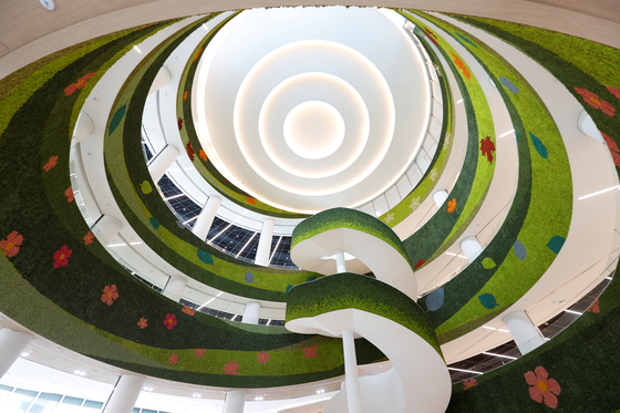
The Gyeonggi Provincial Library is organized around a central hall, with the peripheral “Gyeonggi Book Path” and a central spiral staircase known as the “Well of Wisdom.” The space is designed to be explored as if taking a leisurely walk. / Photo: Gyeonggi Provincial Library
Unlike
conventional libraries, where shelves are isolated by floor, the bookshelves
here are interconnected within an open structure. This encourages knowledge to
be perceived not as fragmented information, but as a system that
expands through relationships. Centered on the central space, the
library transforms from a fixed building into a dynamic field of
knowledge in motion.
Beyond Books,
Toward a Platform — A Public
Experiment Where AI, Environment, and Games Coexist
The most visible
change proposed by the Gyeonggi Provincial Library is the expansion of content.
Approximately 340,000 volumes are currently held, with plans to expand the
collection to 550,000.
However, the
identity of the library is not defined by the number of books it owns.
AI studios, book
grounds, console game zones, climate and environmental archives, and
multilingual resource spaces all presuppose a “post-book” library. Reading,
digital creation, gaming, discussion, and hands-on experiences coexist within a
single public space. As a result, the library no longer functions as a quiet
reading room alone, but as a multi-layered cultural platform.
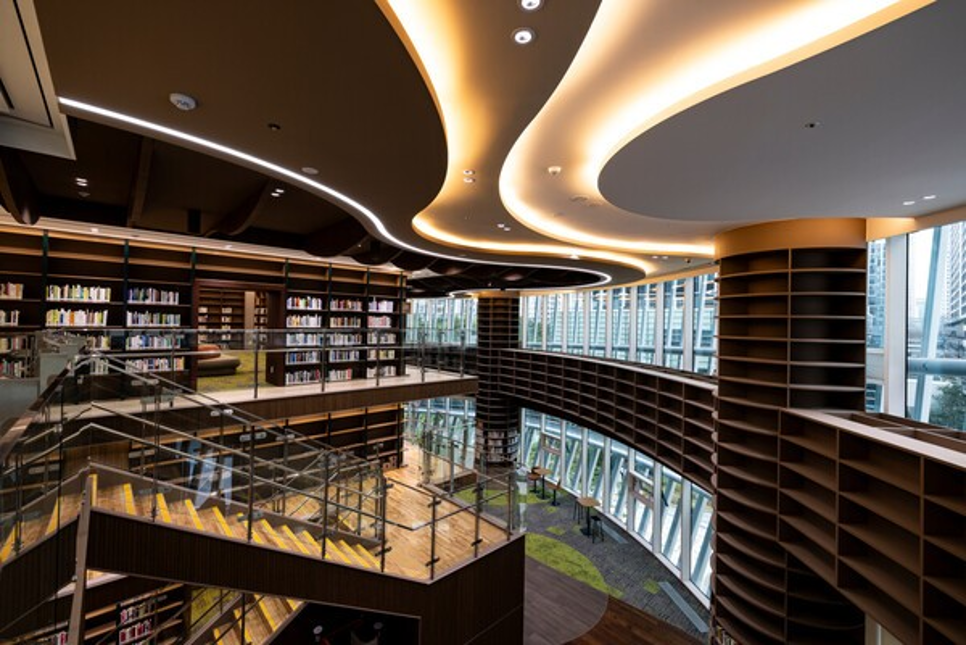
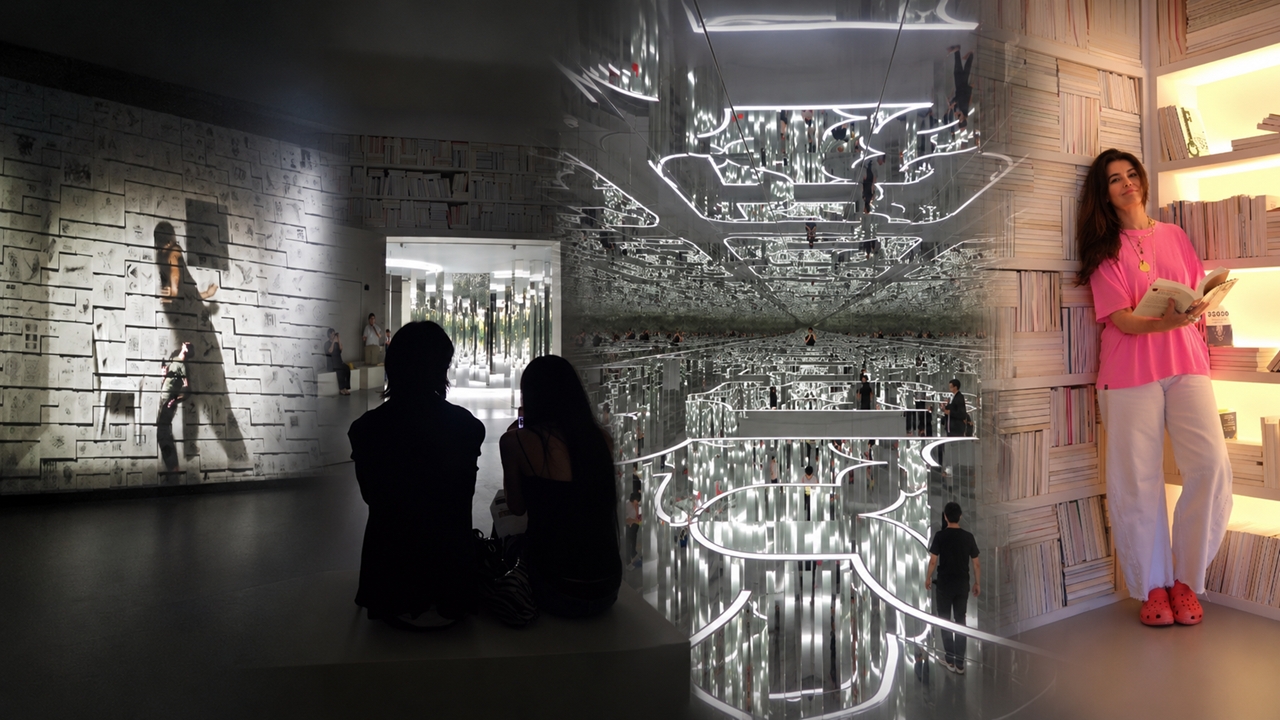
Interior of the Gyeonggi Provincial Library / Photo: Daebo Construction
In particular,
the combination of AI-based content creation spaces and environmental archives
signals an intention to address key issues of the future society
within the public realm. It demonstrates that a library can move beyond being a
neutral repository to become a place that actively raises social questions.
The
Coexistence of Nature and Technology — A Model for
a Sustainable Public Space
Architecturally,
the Gyeonggi Provincial Library is also symbolic. Vertical gardens and
plant-based spaces distributed throughout the interior, along with the rooftop
Sky Library, extend the library beyond a closed indoor environment into one
that is connected with nature. These elements create a setting where rest,
learning, extended stays, and contemplation naturally coexist.
Solar and
geothermal energy systems, along with air purification design, position
sustainability not as a decorative feature but as a structural premise. This
approach illustrates how public architecture can move beyond functional
efficiency to present ethical standards for future cities.
Beyond the
Region, Toward a Destination — A New
Cultural Status for the Public Library
The Gyeonggi
Provincial Library serves residents of the region while also functioning as a
cultural destination open to visitors from elsewhere. Game spaces, AI
facilities, multilingual resources, and open lounges broaden the range of
users, encompassing younger generations as well as families.
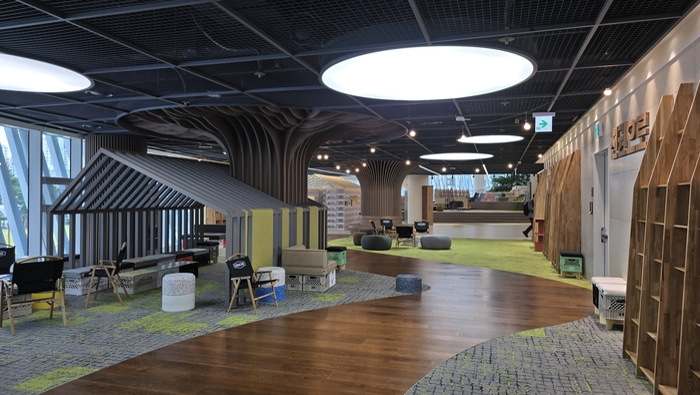
Interior view of Korea’s largest public library, the Gyeonggi Provincial Library / Photo: Gyeonggi Province
This clearly
reflects a shift in the role public libraries are expected to play today. No
longer spaces for a specific group or function, libraries are increasingly
understood as urban cultural hubs and platforms embedded in
everyday life.
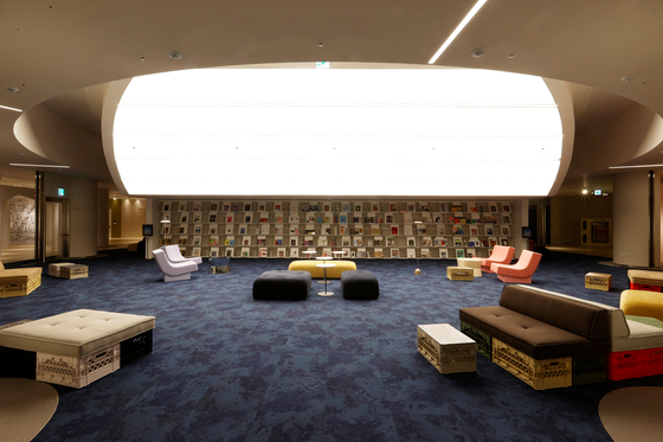
A lounge on Basement Level 1 designed for picture book exhibitions, original illustrations, and magazine reading / Photo: Gyeonggi Provincial Library
Imagining What
Comes After the Public Library
The significance
of the Gyeonggi Provincial Library lies not in its status as “the largest,” but
in its role as an experiment in the future of public libraries.
By allowing books
and technology, environment and play, learning and rest to coexist within a
single structure, the library demonstrates how a traditionally defined space
can be reconfigured in an era when knowledge is no longer accumulated in fixed
forms.
The library poses
fundamental questions:
Where is
knowledge created? What should public space embrace? And what kind of place
should a library become in the future?
The Gyeonggi
Provincial Library offers one possible answer.