
President Lee
Jae-myung recently emphasized that “in the international society of the 21st
century, culture is at the core of national prestige and national power,”
adding that “even an additional supplementary budget should be
arranged if necessary to restore and strengthen the foundations of culture and
the arts.”
This statement
should not be read simply as a call for increased funding. Rather, it signals a
deeper question about the stage at which Korea’s cultural policy currently
stands. At a time when “K-culture” is receiving unprecedented global attention,
the recognition that the foundations of culture and the arts are in fact drying
up is particularly significant.
For this
awareness to lead to meaningful policy change, however, a more fundamental
examination must first be undertaken—one that asks what the current support
system is failing to address.
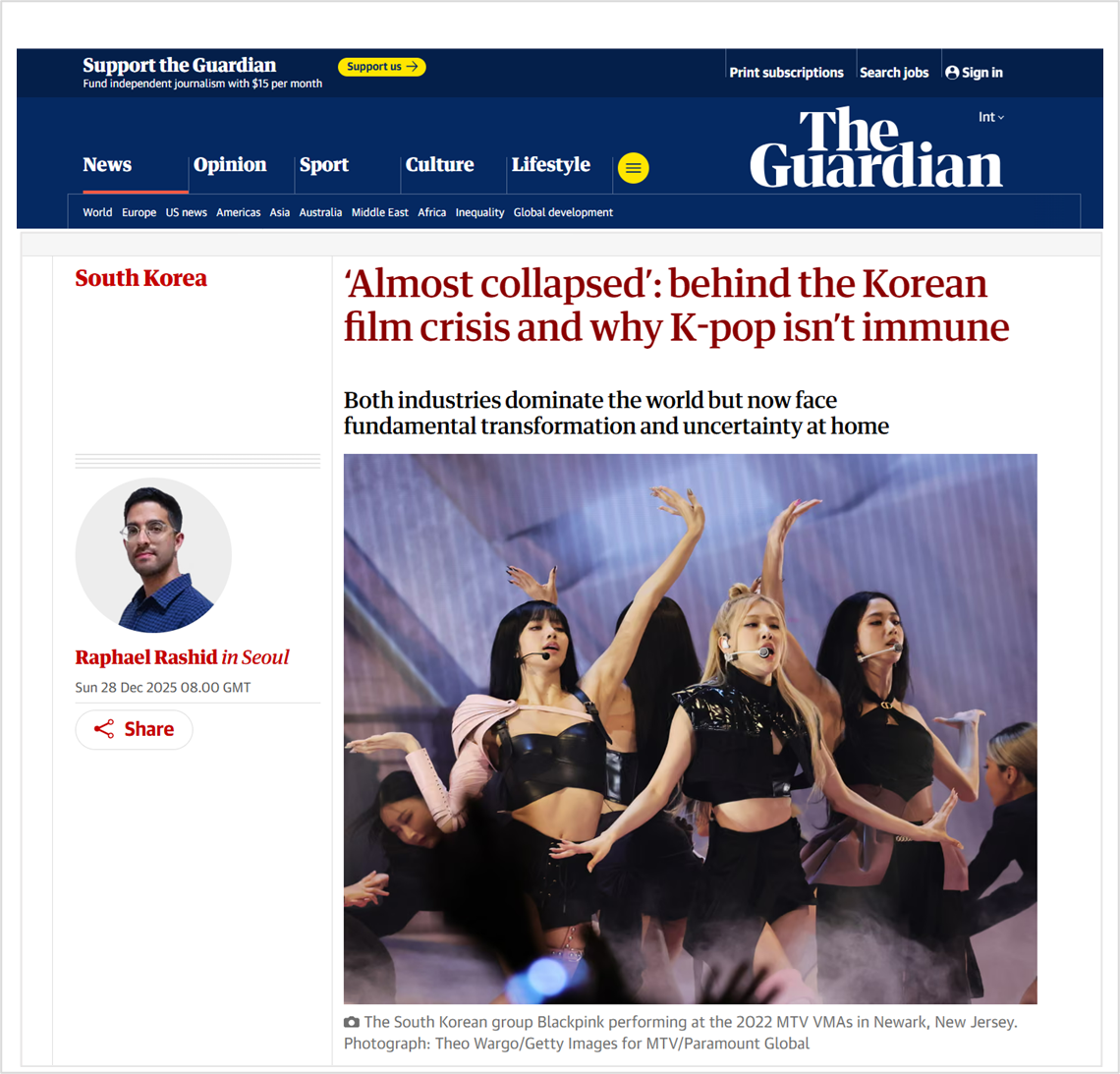
Screenshot from “The Guardian” article on the Korean film crisis
A recent article
in “The Guardian”, titled 「Almost collapsed:
behind the Korean film crisis and why K-pop isn’t immune」, offers a sober diagnosis of the
contradictions within Korea’s cultural industries. While Korean cultural
content enjoys overwhelming success in global markets, both film and K-pop
domestically are experiencing structural weakening. According to the article,
survival strategies driven by short-term results are instead eroding the very
ecosystems that make creative production possible.
In Korean cinema,
audience numbers and production volumes have plummeted, and the foundation that
once supported mid-budget films and emerging directors has nearly collapsed.
K-pop, meanwhile, has been reorganized around global tours and core fandoms, pushing
smaller agencies—once responsible for experimentation and diversity—to the
brink of survival. In both industries, only the sectors that directly
generate measurable results remain, while the structures that once enabled
those results are disappearing.
This situation
mirrors, with striking precision, the reality of Korea’s contemporary art
scene.
Why Is Support
for the Development of Fine Art Always Deferred?
Korea’s public
cultural policy and support systems have repeatedly been designed around
visible achievements, quantifiable outcomes, and overseas expansion. The
problem is that such criteria fundamentally conflict with the way fine art
actually functions.
Fine art does not develop on
the premise of short-term results.
An artist’s language emerges through long
periods of failure and accumulation, through repeated cycles of criticism and
interpretation.
Seeds must be planted, roots must take hold, and soil must be
sustained before any fruit can appear. Yet the current support structure
concentrates resources only at the moment when results become visible,
investing little in the seed and root stages that make those results possible.
This pattern is
not characteristic of culturally advanced societies, but rather of societies
where culture is treated purely as a consumable outcome. It is a typical
symptom of systems that ignore conditions of production and long-term
accumulation.
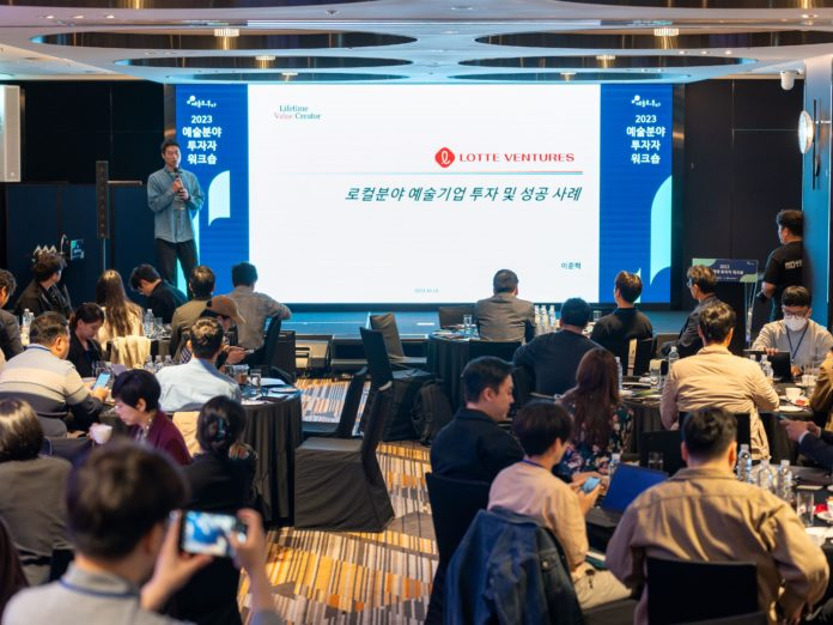
View of the Arts Investment Workshop hosted by the Ministry of Culture, Sports and Tourism and the Arts Management Support Center
Source: Ministry of Culture, Sports and Tourism · Arts Management Support Center
When
Distribution, Startups, and Global Metrics Replace the Purpose of Support
Over the past
several years, public support for contemporary art in Korea has shifted from
the language of “support” to that of “performance management.” The Arts
Management Support Center has positioned market research and statistics on
distribution sectors—galleries, auctions, and art fairs—as the policy
foundation for “fostering the visual arts industry and revitalizing the market.”
Across numerous programs, indicators such as the number of negotiations,
participants, transactions, and overseas buyers are accumulated as
representations of policy success.
International
distribution platforms operated or supported by the Center are explicitly
labeled as “markets” (such as PAMS), and event outcomes are frequently
presented in terms of numerical indicators like deal counts.
The issue here is
not distribution or market activation in themselves. Rather, it lies in the
fact that distribution metrics have begun to replace the fundamental purpose of
arts support. Questions central to fine art—what an artist’s work accumulates
over time, what kind of language it forms, and how that language connects to
criticism, exhibitions, archives, and collections—are pushed to the margins of
policy design. As a result, public support becomes less about supporting
artists and more about reproducing results in standardized, measurable forms.
When Programs
Take Precedence over Ecosystems
The Korea Arts
Council has likewise operated under constant pressure to translate support
systems into “evaluable results.” Public evaluation reports on the Arts and
Culture Promotion Fund have themselves pointed out problems such as
oversimplified performance indicators and weak causal links between project
goals and evaluation criteria. In other words, structural conditions are in
place where indicator management takes precedence over the original intent of
support.
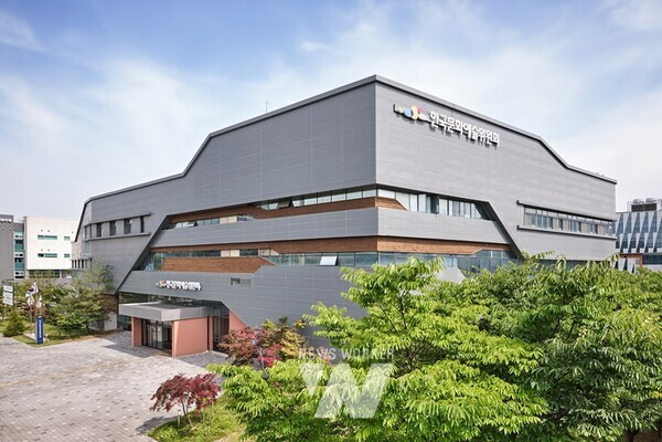
Arts Council Korea Headquarters, Naju
Within this
environment, public funding tends to favor short-term, trend-driven programs
rather than long-term foundational development. Calls for proposals emphasizing
online platforms or technology-based creation frequently promise to build “new
ecosystems” by spanning creation and dissemination.
Yet while such
programs may be effective at producing visible results under the banner of “innovation,”
they remain structurally insufficient to guarantee the long-term accumulation
required by fine art—deepening artistic practice, refining critical language,
sustaining networks among artists, curators, and researchers, and
systematically linking archives and collections.
The Expansion
of Startup and Investment Frameworks, and the Marginalization of Fine Art
Programs such as
the “Arts Industry Academy” and “Early-Stage Arts Startup Support,” operated by
the Arts Management Support Center, translate art into the language of
entrepreneurship, investment, and corporate development.
While this
framework may offer tangible benefits to certain segments of the arts
ecosystem, it aligns poorly with the realities of fine art, which constitutes
the majority of artistic practice. The non-market value of artistic work, the
uncertainty of long-term research and production, and the non-linear nature of
artistic achievement do not fit neatly into startup models.
As policy
frameworks increasingly center on corporatization, commercialization, and
scalability, the foundational domains of fine art become structurally
inexpressible. This approach is
superficial and short-sighted because when artistic value is defined only in
terms of what can be immediately disseminated, cultural policy inevitably
counts only the fruit while allowing the seeds to wither.
The foundations
of fine art are built not through programs, but through time—through the slow
interweaving of education, criticism, exhibition infrastructure, documentation,
research, archives, and museum systems. As this foundation weakens,
internationalization devolves from meaningful entry into global discourse into
mere momentary exposure.
Art Korea Lab:
Reconsidering the Nature of Its Achievements
Art Korea Lab
provides perhaps the most emblematic example of this issue. Its reported
achievements for 2025 are, numerically speaking, clear: approximately 70,000
annual users, 150,000 cumulative visits, around 4 billion KRW in total
investment raised, the discovery of 47 convergence-art projects, and increased
utilization of facilities such as media walls, kinetic installations, and
immersive sound studios.
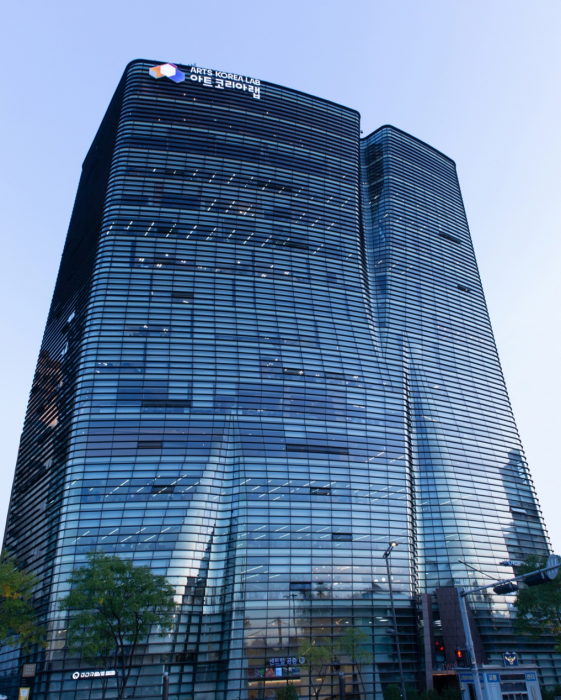
View of Art Korea Lab
However, upon
closer examination, these achievements align less with the internationalization
of Korean contemporary art than with the overseas expansion of
technology-driven creative content.
Art Korea Lab’s
stated mission encompasses education, experimentation, prototyping,
distribution, and startup incubation at the intersection of art and technology,
and its performance indicators are correspondingly aligned with investment,
employment, and global expansion.
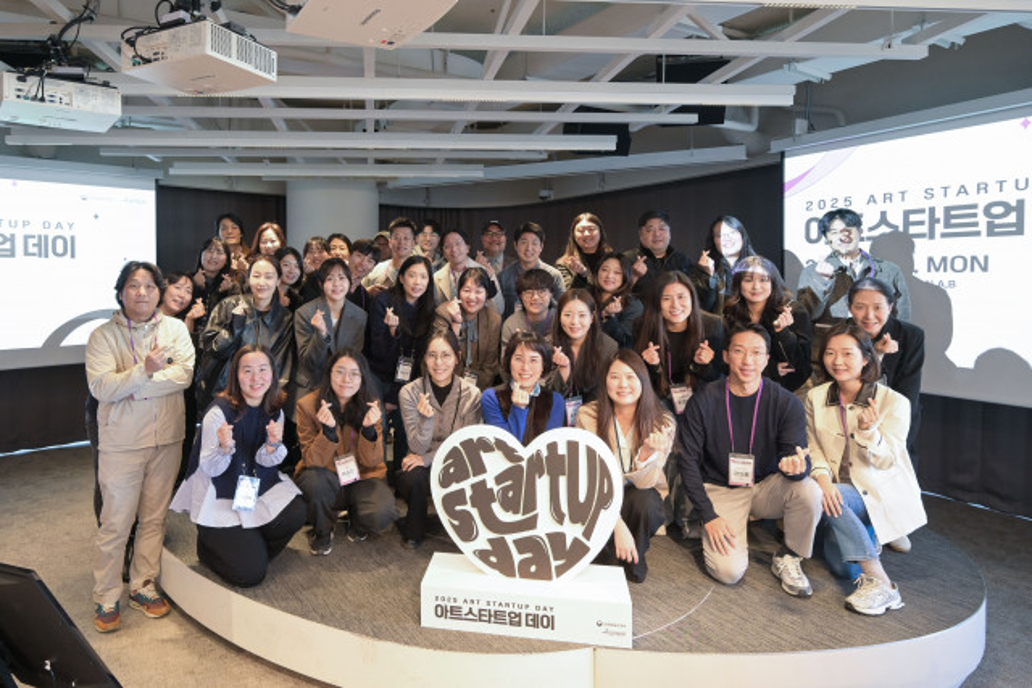
Group photo of participants at “2025 Art Startup Day,” hosted by the Ministry of Culture, Sports and Tourism and organized by the Arts Management Support Center / Source: Startup Daily
This is a
strategically understandable choice. Technology-based art offers high mobility
and scalability, enabling short-term international success. But when this
pathway is generalized as the internationalization of Korean contemporary art
as a whole, a serious problem arises. The internationalization of art is not a
matter of participation counts or technological scale, but of how works are
interpreted, recorded, and situated within international discourse, museums,
collections, and critical systems.
As structures
that prioritize “what has been implemented” over “what is being articulated”
become more entrenched, fine art is pushed ever further from the center of
policy.
Internationalization
Is Not a Movement, but Contextualization
Internationalization in art
cannot be explained by the number of overseas exhibitions or technical
sophistication.
What matters is how a work is interpreted within global art
discourse,what art-historical position it occupies, and how it connects to museums,
collections, and systems of criticism.
Current
performance metrics emphasize questions of implementation and scalability,
rather than meaning and context. As a result, what travels abroad is often not
an aesthetic language but a technological format—closer to entry into
international media-arts markets than into the global art world.
This structure
disadvantages fine artists not because of a lack of capability, but because of
the way support systems are designed. Painting, sculpture, concept-driven
installation, and non-material practices are inherently difficult to visualize
within short-term, results-based evaluations.
What Should
Public Platforms Be Responsible For?
Serving as a
global distribution hub for technology-based art and bearing responsibility for
the internationalization of Korean contemporary art are fundamentally different
objectives. If both are to be pursued simultaneously, performance indicators
and support structures must be clearly differentiated.
When
heterogeneous outcomes are bundled under a single banner of “global success,”
technology-driven sectors are strengthened, while fine art is naturally
marginalized. This is not a matter of intention, but of structure.
Before
Results, the Criteria Must Be Rebuilt
For the President’s
remarks to carry genuine significance, they must lead not only to increased
funding, but to a redesign of support criteria themselves. Unless obsession
with short-term results is abandoned and parallel investment is made in
preserving seeds and roots—long-term working conditions for artists, criticism
and documentation, archives and museum systems, and sustained engagement with
international discourse—the internationalization of Korean contemporary art
will remain structurally unattainable.
The
internationalization of Korean contemporary art is not a question of adopting
more technology, but of deciding which art, and by what standards, is
introduced to the world. This is not a moment to celebrate results, but to ask
what those results have cost—and to reset direction accordingly.