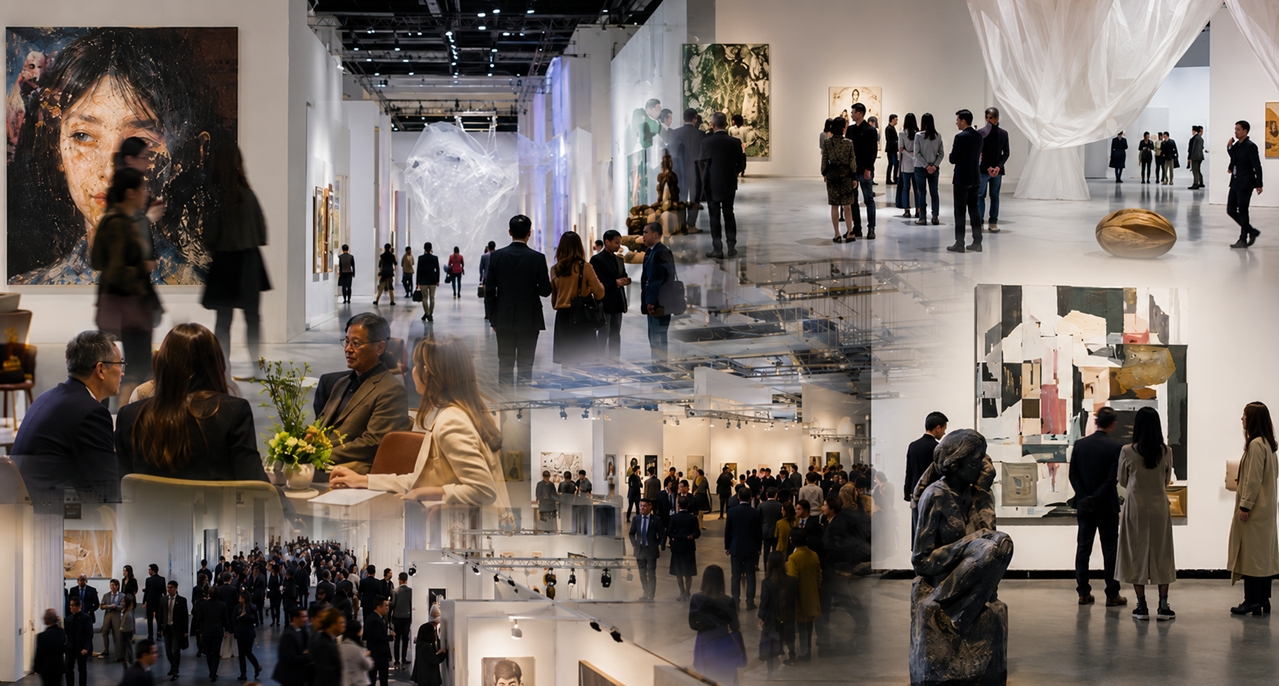

Contemporary art
is frequently discussed today through the language of crisis. This crisis is
often framed as a loss of meaning: the claim that contemporary art has nothing
new to say, that critique has become repetitive, and that form has grown stale.
Yet such diagnoses miss the core of the problem. The crisis facing contemporary
art today is not the exhaustion of meaning, but the collapse of the internal
capacity and criteria required to judge, evaluate, and accumulate the meanings
that have already been produced—and, with them, the will to distinguish what is
genuinely new.
Contemporary art
continues to speak at length. Social inequality, political conflict,
technological transformation, and questions of identity and institutions are
repeatedly invoked through exhibitions and artworks. Discourse has not
disappeared. What has disappeared, however, is a sustained account of how these
meanings are judged to be significant, what should be recorded as achievement,
and what should be acknowledged as failure.
This essay begins
from precisely this point. The crisis at hand is not a crisis of production but
a crisis of judgment—one that has hardened into a structural condition rather
than remaining a matter of individual attitude or choice.
The Weakening
of Judgment and Its Consequences
For decades,
contemporary art has been wary of judgment itself. Singular aesthetic
standards, hierarchical ranking, and form-based exclusion were criticized as
remnants of modernist power structures. In their place, the suspension of
judgment emerged as an ethical and aesthetic stance.
This suspension
initially served a clear purpose. It was a strategy designed to address complex
realities without reducing them to a single evaluative framework, to keep
interpretation open and prevent one criterion from suppressing others. Over
time, however, as this suspension was repeatedly institutionalized within
exhibitions and cultural systems, it gradually solidified into a persistent
deferral of judgment itself.
Explicitly
stating what an artwork has achieved, why that achievement is convincing, or
where its limits lie came to be regarded as unnecessary, or even dangerous. At
this point, a crucial fact must be acknowledged: the absence of judgment is
never neutral. When judgment is no longer produced internally, it does not
vanish; it simply takes another form. And more often than not, that form is
determined not by essential criteria internal to art, but by external and
non-essential logics.
The Logic of
Selection That Fills the Vacuum
As internal
structures of judgment weakened, the selection of artworks and exhibitions
increasingly came to follow a different logic. This logic does not resemble a
new aesthetic or theory. Rather, it revolves around questions such as: Can the
work be quickly understood? Can it generate an immediate response? Can it
circulate smoothly within existing exhibition and distribution systems?
Such a logic does
not demand depth or completion. Instead, it privileges instant recognizability,
clearly legible messages, easily explainable forms, and high compatibility with
exhibition environments and circulation networks. Works that can be selected
without sustained evaluation, and consumed without explanation, are repeatedly
favored.
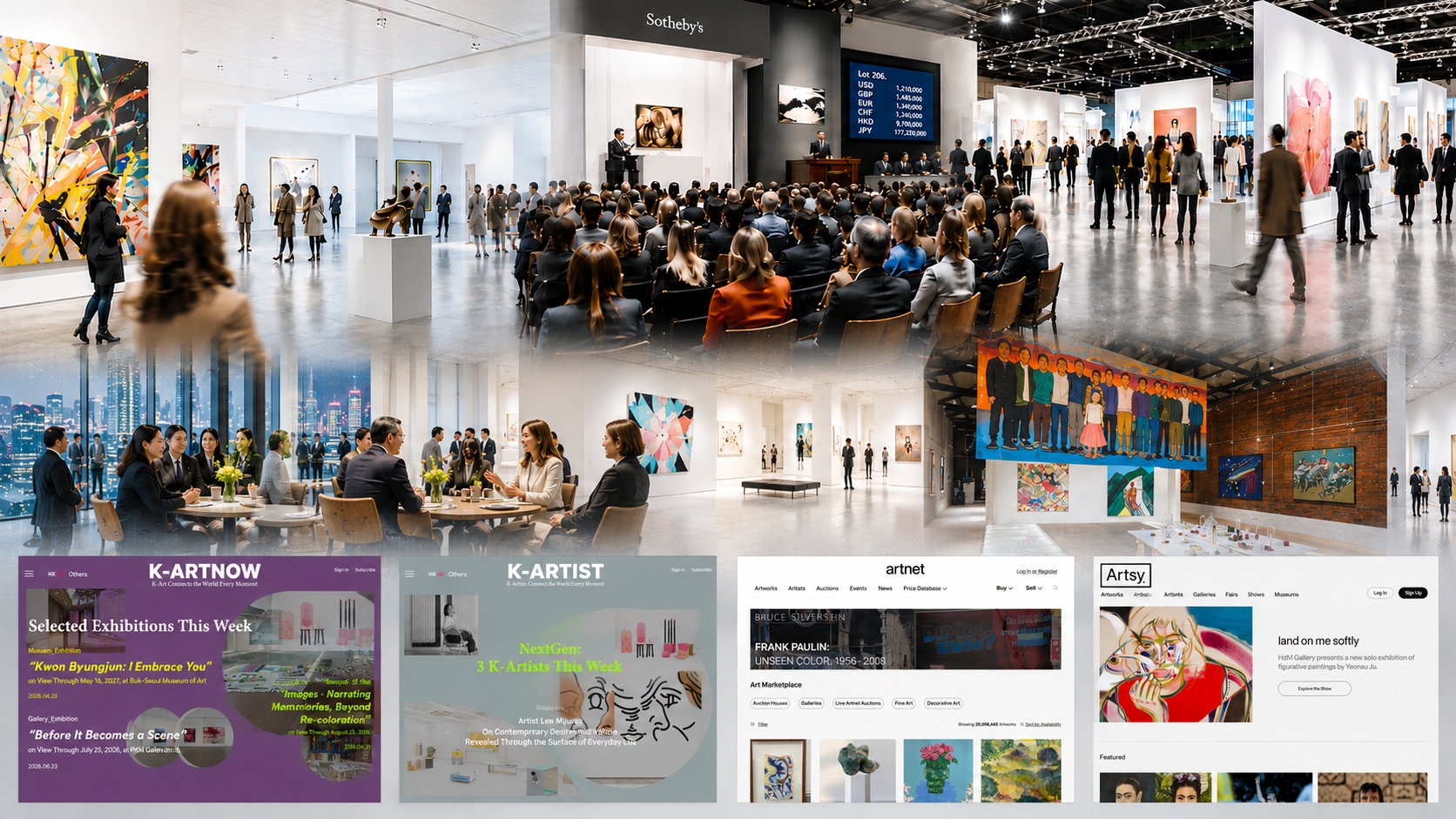
In this process,
artworks are gradually adjusted to align with the operating mechanisms of the
market. Here, “the market” should not be understood merely as a site of sale,
but as an integrated system encompassing exhibition, distribution, promotion,
and discourse. Works that fit this system are continuously selected, and the
repetition of that selection begins to function as judgment itself.
Market-Adapted
Works and the Distortion of the Essential
Market-adapted
works are not necessarily commercial in appearance. They may adopt radical
imagery or critical language. Yet their radicalism and criticality are
themselves managed safely within institutional and economic frameworks.
Such works raise
issues, but these issues are rarely subjected to rigorous testing through the
internal logic of form and structure. Instead, they circulate frictionlessly
through exhibitions, discourse, and distribution. Selection thus shifts away
from judgment of essential achievement toward evaluation of select ability.
At this point,
non-essential elements begin to speak in place of the essential. Completion,
structural density, and depth of thought are left largely unexamined, while
frequency of exposure and outcomes of selection stand in for value. The
essential does not disappear; it is obscured by the absence of judgment.
Results come to evaluate process, and surface replaces interiority as the
criterion of value.
A Structure
That Fails to Record Failure
The most serious
consequence of this structure is the absence of recorded failure. When failure
is not recorded, revision becomes impossible; when revision is impossible,
accumulation cannot occur.
Exhibitions
proliferate and new works constantly appear, yet explanations of why something
failed—and in what sense—rarely remain. As a result, subsequent selections
differ little from previous ones. Forms appear to change, but the logic
governing selection repeats itself. Under these conditions, contemporary art
can generate change, but not development.
The Specific
Position of Korean Contemporary Art
Korean
contemporary art has experienced this condition with particular intensity and
speed. In rapidly adopting international exhibition formats and discursive
languages, the value of artworks has often been determined less by internal
evaluation than by external reception and selection.
Participation in
international exhibitions and modes of consumption has frequently functioned as
the basis of value. Yet structures capable of analyzing and reassessing these
outcomes internally have remained underdeveloped. As a result, Korean contemporary
art exists in a dual condition: judgment is suspended internally, while
externally rendered judgments are accepted as fact. As this gap widens, the
intrinsic achievements of works remain unexplained from within, replaced
instead by the mere fact of selection.
What the
Korean Contemporary Art Scene Is Missing
What is most
conspicuously absent in the Korean contemporary art scene today is the question
of judgment and responsibility. Under the assumption that judgment inevitably
leads to exclusion or violence, the refusal to judge has come to appear
ethically sound. Yet this refusal ultimately transfers responsibility for
selection to the market, institutions, and external responses.
Equally neglected
is the perspective of accumulation and record. Little attention is paid to what
individual exhibitions and works leave behind, or how they relate to previous
attempts. Consequently, contemporary art remains trapped in the present, lacking
criteria by which to assess its own capacities.
How Judgment
Might Be Recovered
What is needed is
neither a new trend nor a more radical appearance. What is needed is the
recovery of judgment. This judgment is not a return to hierarchical ranking,
but an articulation—through language—of what a work has achieved, where it has
persuaded, and where it has lacked density.
Exhibitions must
not end with the mere presentation of problems. They must articulate what was
proposed, how it was realized through form, structure, and experience, where it
succeeded, and where it failed. Criticism must move beyond description toward analysis
and evaluation.
Above all, there
must be the courage to record failure. Only where failure can be articulated
can revision occur, and only where revision occurs can accumulation take place.
Why Korean
Contemporary Art Has Not Yet Become Central
The conditions
described here are not unique to Korea. The suspension of judgment,
market-adapted selection, and the replacement of the essential by the
non-essential are widespread throughout the global art world. Korean
contemporary art is not an exception, but rather a field in which these
conditions appear in concentrated form.
The decisive
difference, however, lies elsewhere. In the central zones of the global art
world, judgment is not entirely abandoned. Debates persist over what
constitutes achievement and failure, which forms and problematics can lead to
further development. Judgments collide openly, failures are articulated
critically, and these records of judgment become part of art history.
By contrast,
Korean contemporary art has long focused on the question of how far it has
arrived. Participation in international biennials, entry into global galleries,
and exhibitions at overseas institutions have functioned as markers of success.
Yet the question of what has been left behind—what judgments have been produced—has
remained secondary.
As a result,
Korean contemporary art is frequently cited as a case within the global art
world, but rarely recognized as a source of criteria. This is its most
fundamental limitation.
The center of the
art world is not the place where the most exhibitions occur. It is the place
from which one can say what matters, and what no longer does. Centrality is not
produced through exposure or volume, but through the capacity to accumulate judgment.
To think the
post-contemporary condition is not to declare a new era. It is to confront the
conditions already in operation, and to reconstruct a structure capable of
producing judgment within them.
The possibility
for Korean contemporary art to move toward the center of the global art world
does not lie in responding more quickly, but in judging more precisely—and in
accumulating those judgments. When this condition is met, Korean contemporary
art may no longer appear merely as one example among many, but as a reference
point for the global art world itself.
Jay Jongho Kim graduated from the Department of Art Theory at Hongik University and earned his master's degree in Art Planning from the same university. From 1996 to 2006, he worked as a curator at Gallery Seomi, planning director at CAIS Gallery, head of the curatorial research team at Art Center Nabi, director at Gallery Hyundai, and curator at Gana New York. From 2008 to 2017, he served as the executive director of Doosan Gallery Seoul & New York and Doosan Residency New York, introducing Korean contemporary artists to the local scene in New York. After returning to Korea in 2017, he worked as an art consultant, conducting art education, collection consulting, and various art projects. In 2021, he founded A Project Company and is currently running the platforms K-ARTNOW.COM and K-ARTIST.COM, which aim to promote Korean contemporary art on the global stage.