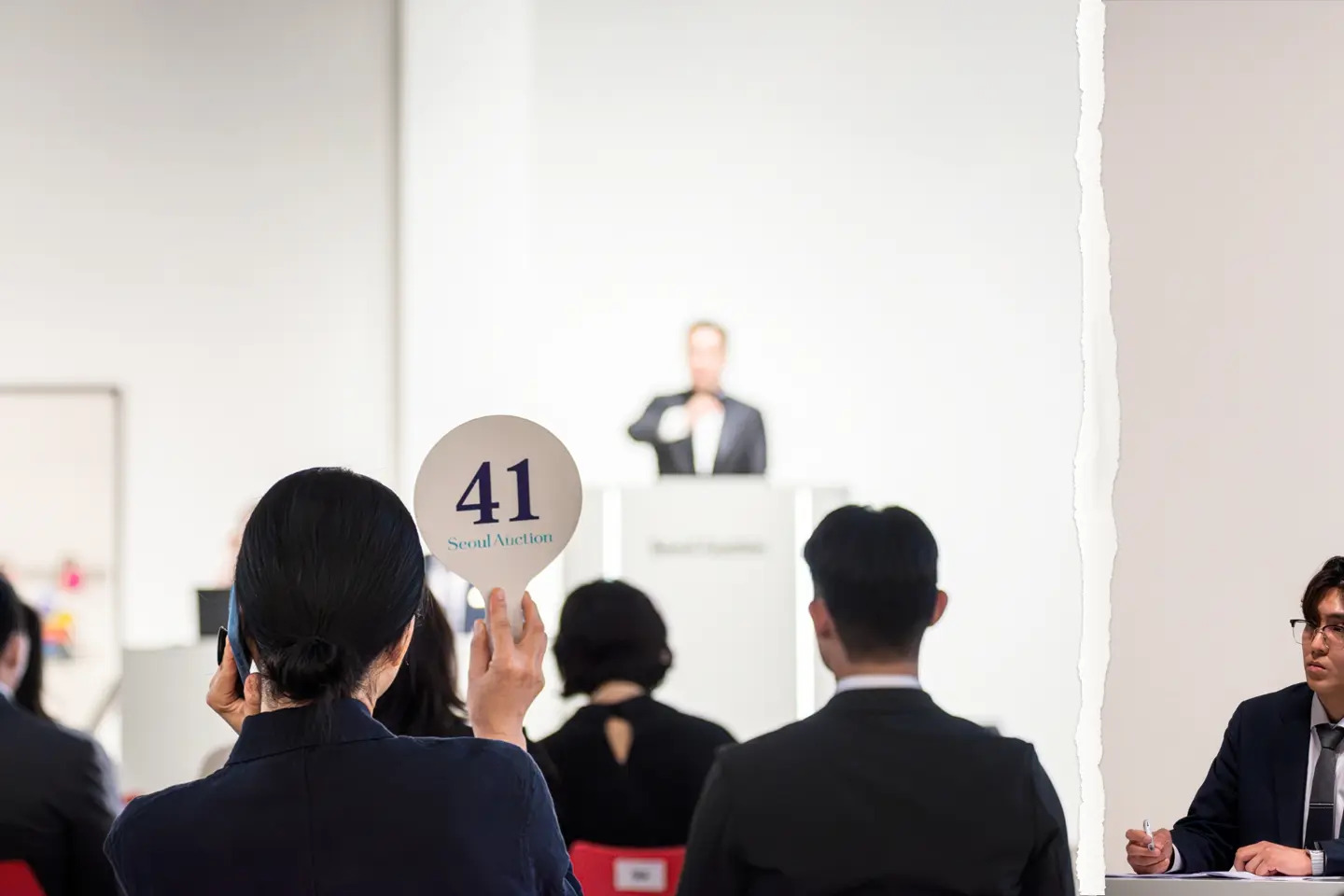

At DDP Museum
Exhibition Hall 1, a large-scale retrospective of《JEAN-MICHEL BASQUIAT: Signs:
Connecting Past and Future》, is currently on view.
Representatives
of the Basquiat estate participated in shaping the exhibition’s direction, and
the co-curatorial team—Jiyoon Lee (Founder of SUUM PROJECT; Artistic Director
and Curator), alongside the internationally recognized Basquiat specialists
Dieter Buchhart and Anna Karina Hofbauer—designed its structure and narrative
together. The presentation brings to Seoul roughly 230 items in total,
including major paintings reportedly insured at around KRW 1.4 trillion, some
70 paintings and drawings, and approximately 160 pages of archival material
excerpted from eight notebooks.
Its scale and
numbers drew attention even before opening, but what the exhibition ultimately
puts on the table is not a matter of magnitude. It asks viewers not simply what
to see, but how to read. And that “reading” begins with the surface itself—with
the marks left behind and the rhythm of what has been worked over.
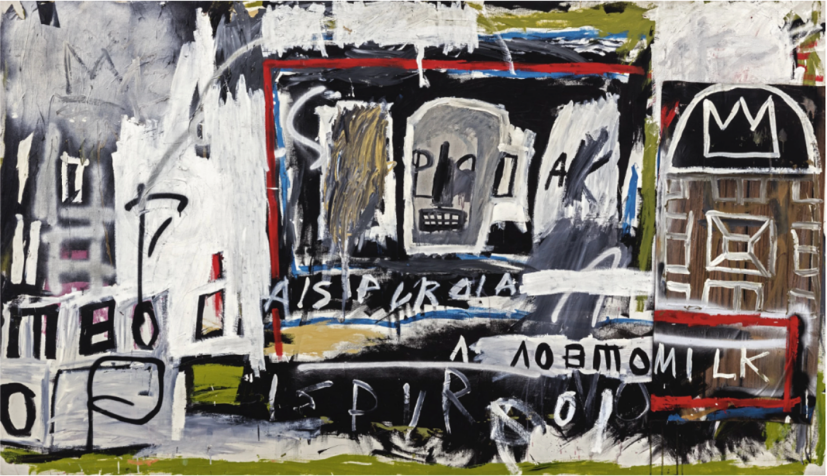
‘New York, New York’, signed SAMO© and dated New York 1981 on the reverse. Acrylic, oil stick, spray paint, silver spray paint and paper collage on canvas, 128.4 x 226.2 cm. 50 1/2 x 89 in. Private Collection. Photo: Aproject Company
When you stand before the work, what registers first is not
polish but roughness that feels deliberately retained. In place of refined
brushwork or a stable composition, the canvas is governed by repetition and
friction—by traces of erasure. Smeared oilstick, lines that seem scratched into
being, and words and symbols returned to with insistence crowd the pictorial
space.
The surface reads less as impulsive release than as a
calculated attempt to translate the noise, tension, and imbalance of 1980s New
York into painterly terms. Basquiat’s canvas is not so much an outpouring of
feeling as a weave in which disparate signs collide and overlap.
The exhibition begins precisely here, with a question that is
both historical and formal: why would an artist in the 1980s choose, instead of
a “beautiful image,” to leave jagged, incomplete text and symbols on a canvas?
1. Historical
Context: Why Did “Language” Enter the Canvas?
New York in the 1980s—the city in which Basquiat worked—stood
at a significant cultural and intellectual turning point. If the previous
generation of Abstract Expressionism emphasized the materiality of paint,
physical gesture, and the artist’s interior life while keeping literary
elements at a distance, Basquiat’s generation moved with a different set of
pressures. In this period, text and sign increasingly functioned as key
instruments for understanding the world.
In the humanities, semiotics, structuralism, and
deconstruction—associated most visibly with Roland Barthes and Jacques
Derrida—shifted attention from what an image represents to how meaning is
produced. Meaning was understood not as fixed but as unstable, sliding, and
continually open to re-reading, and that sensibility seeped into visual culture
at large.
This theoretical turn
did not remain inside academia. Hip-hop culture and graffiti, formed in the
Bronx in the 1970s, pulled words and sentences onto the street’s surface,
making text physical and visible. A sentence became something read and seen at
once; tags, scrawls, and rhythm fused with the city’s pulse to form a visual
vernacular. Whether or not Basquiat systematically studied theory, the New York
he inhabited was already an environment acutely responsive to text and symbols.
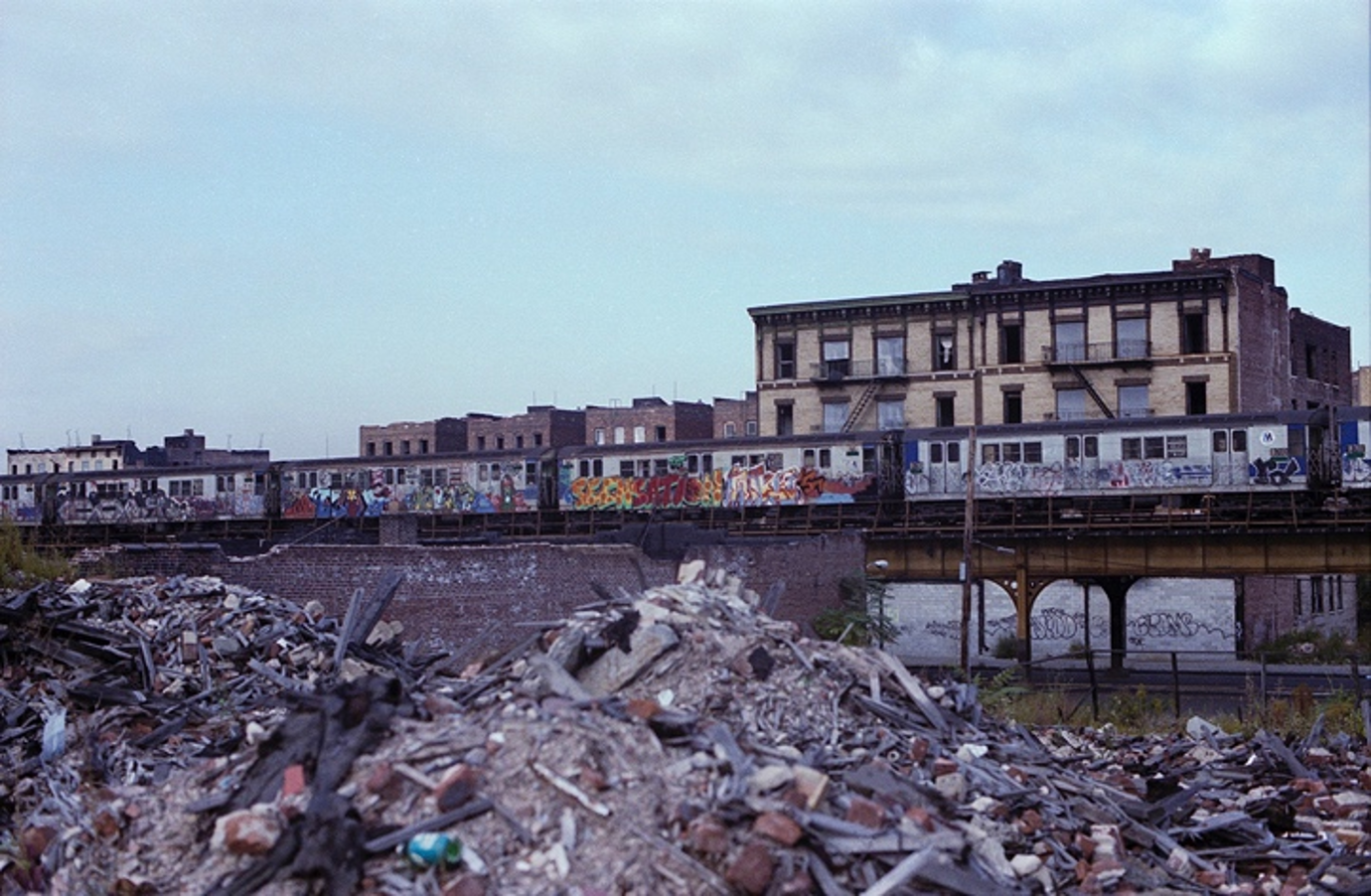
Destroyed and abandoned buildings along Hoe Ave. and the IRT line in the Bronx, 1981. Photo: Henry Chalfant. Courtesy: Eric Firestone Gallery, New York.
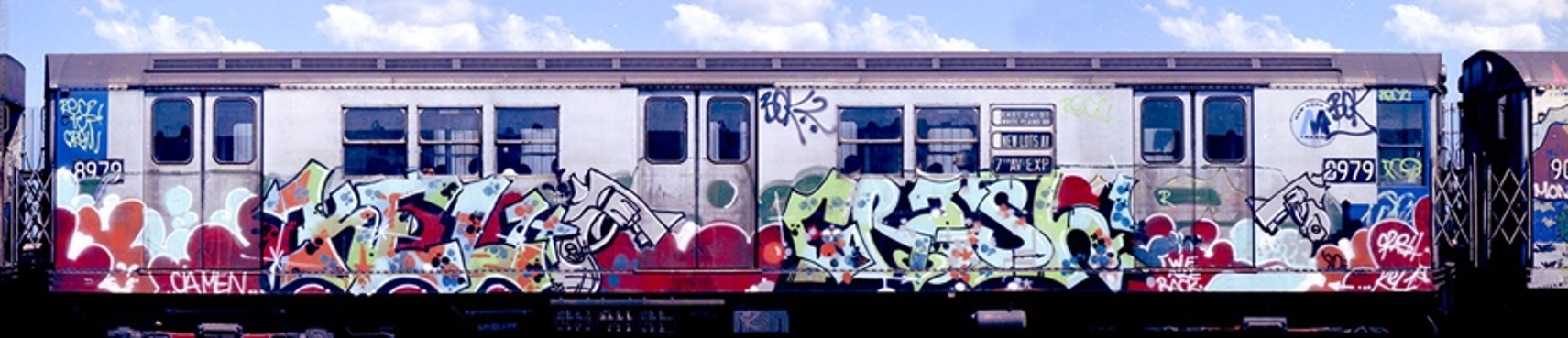
“KEL CRASH” by Kel and Crash, on the 7th Avenue Express, 1980. Photo: Henry Chalfant. Courtesy: The Bronx Museum.
Parallel currents were already unfolding within art.
Conceptual practices in the 1960s and 70s shifted attention away from the craft
of making and toward the conditions under which meaning takes shape. Joseph
Kosuth’s One and Three Chairs (1965) demonstrated how an object,
an image, and a definition operate on different planes, making clear that
visual art could no longer be confined to form alone. Lawrence Weiner likewise
presented the sentence itself as the work, asserting that language can hold
sculptural force.
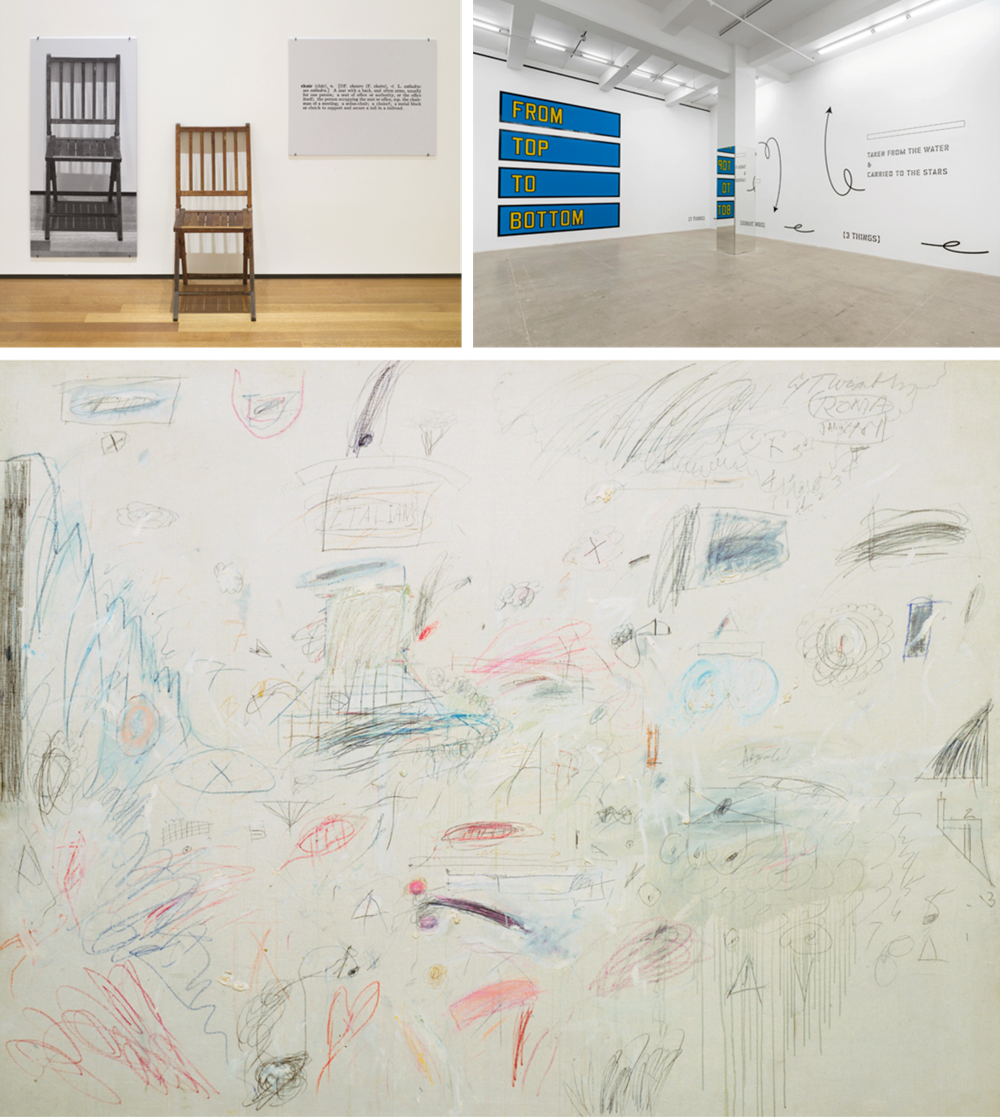
(Left) Joseph Kosuth, One and Three Chairs, 1965 © 2025 Joseph Kosuth / Artists Rights Society (ARS), New York, Courtesy of the artist and Sean Kelly Gallery, New York (Right) Lawrence Weiner, Apropos Lawrence Weiner exhibition installation view, 2022 © Marian Goodman Gallery (Bottom) Cy Twombly, The Italians, Rome, January 1961 © 2025 Cy Twombly Foundation
Meanwhile, Cy Twombly had, since the 1950s and 60s, drawn
scribble, handwriting, and fragmentary phrases into painting, blurring the line
between writing and drawing. In his work, language functions—before it delivers
meaning—as trace and rhythm. These trajectories helped form the aesthetic
ground from which Basquiat could later emerge.
Ultimately, the entry of language into Basquiat’s canvas was
not accidental; it was the result of an era in which the border between ‘seeing’ and ‘reading’ was dissolving—an intersection of historical conditions,
street culture, and the legacy of conceptual art. His painting was what emerged
when those currents met.
2. Notebooks: Crushed Oilstick and Edited
Information
A key component of this show is the set of eight notebooks—roughly 160
pages of documents—presented here as essential material for understanding
Basquiat’s point of departure. These notebooks are not simply a bundle of
doodles; they resemble a private archive built through repeated collecting,
arranging, and accumulating of words, names, sentences, and signs. They reveal
him not as an artist who produced images purely on emotional impulse, but as
someone with an editor’s mind—gathering, sorting, and cutting information as
part of his preparation.
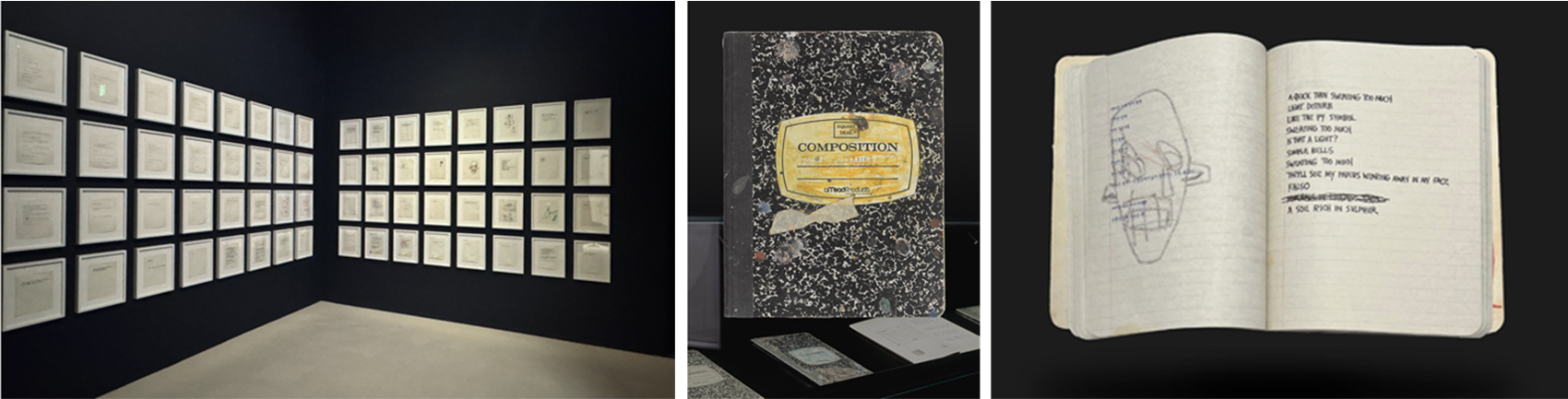
Exhibition View of《JEAN-MICHEL BASQUIAT: Signs: Connectiong Past and Future》, 2025, Photo: Aproject Company & Notebook image @ SUUM project
The pages repeatedly surface biblical quotations, anatomical
terms, Black historical figures, the names of athletes and musicians, lists of
words, and shards of sentences. These elements reappear later in paintings and
drawings, rearranged in new contexts. The notebooks function not merely as memo
pads but as reservoirs of language—workspaces where words are stored, tested,
and kept in motion before they migrate into painting.
That layered record becomes material trace on the canvas. The
crushed oilstick marks and overpainted letters visible in the large works on
view are the result of notebook language translated into painterly action.
Basquiat wrote words, struck through them, and covered them again—over and
over.
As his remark suggests—“I cross out words so you will see
them more”—this erasure is not deletion but insistence. Scratches and remnants
seize the gaze and keep meaning suspended, refusing final settlement. In that
process, painting becomes less a vehicle for delivering a message than a place
where text and image are generated, interrupted, and forced into collision.
3. Colliding Symbols: Dissecting
Institutions and Capital
Included in
the exhibition, Museum Security (Broadway Meltdown) condenses the way text and symbols
can operate as social critique. The repeated phrase “Museum Security” exceeds a
job title; it points to the constrained position Black people were often
allowed to occupy within the American art institution of the 1980s.
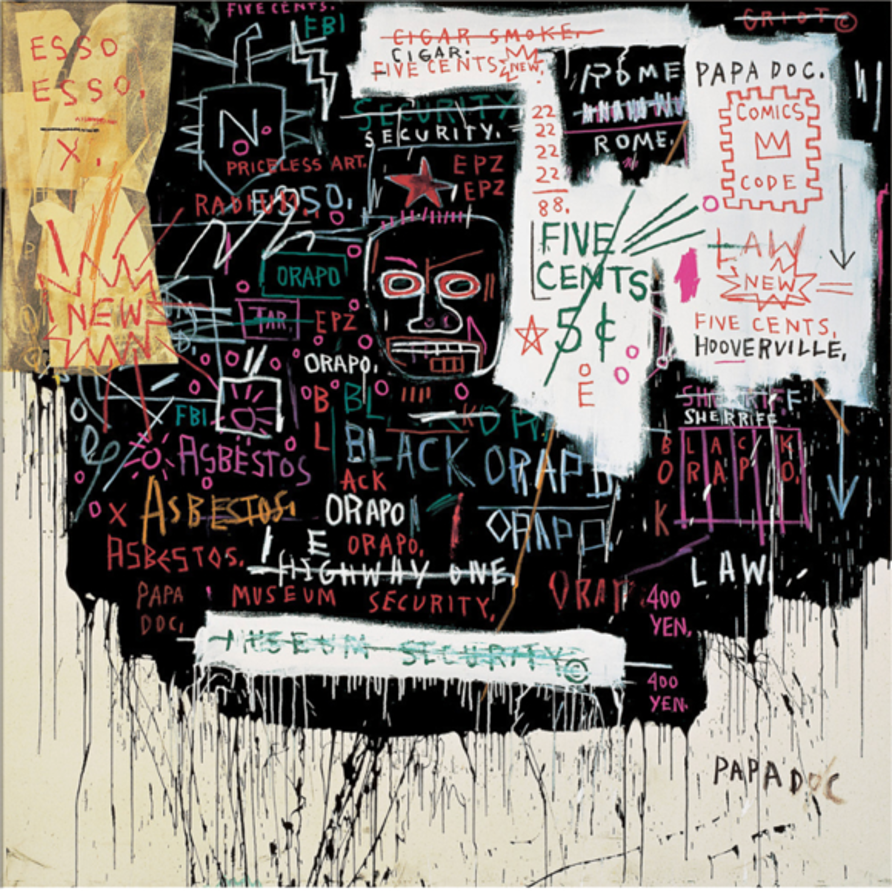
Museum Security (Broadway Meltdown), Acrylic, oil stick and paper collage on canvas, 84 x 84 in. (213.4 x 213.4 cm.), Painted in 1983 (14), Private Collection.
The downtown
art world centered around SoHo was governed by entrenched white power
structures, and Black individuals were frequently recognized not as artists but
as guards or service workers. Basquiat became an exceptional success, yet he
was also consumed through the romantic image of a “street genius,” turned into
a spectacle. He faced suspicion even at openings, and could become a target of
surveillance in the very spaces where his work hung.
Phrases such
as “Esso” and “Priceless Art” register a cold awareness of how art circulates
under the logic of capital. The crown—repeated throughout his work—is less a
boast than a symbolic sovereignty claimed by one who has been excluded. By
placing the crown beside commodity signs, Basquiat compresses into a single
image the contradictions knotted between art, power, and money.
4. Gathering the Fragments: The
Aesthetics of a Collection
Another point that sets this retrospective apart is “the diversity of its sources”. Rather
than relying on the holdings of a single museum, it brings together works from
private collections around the world, revealing multiple faces of Basquiat that
resist being organized into one stable account. Works collected across
different contexts and tastes meet in the space of DDP, making evident—without
forcing the point—that his practice cannot be reduced to a single style or
narrative.
This configuration encourages viewers to approach him not as
a fixed figure within a particular lineage, but through a wider lens: the ways
signs and language operate visually.
Notably, the exhibition places Basquiat’s works in limited
proximity to the Hunminjeongeum Haerye (the explanatory text for the Korean
alphabet), rubbings of the Bangudae Petroglyphs in Ulsan, and Nam June Paik’s
TV-robot works. Rather than drawing lines of influence, this functions more as
a prompt to recognize, side by side, how letters, symbols, and technology have
acted as visual language across different eras and media. The visitor is not
compelled to decode; instead, the display gently widens attention to the many
ways signs have shaped human thought and expression.
Closing:
Questioning the Signs of Our Time
Basquiat’s status is not
the kind that neatly overlays popular symbolism and art-historical achievement
at equal weight. His work sharply captured the sensibility of its image
culture, leaving a powerful imprint through the fusion of text and image. Yet today,
the evaluation surrounding his name is often shaped in advance by the language
of the market and the stories of circulation, before sustained looking has a
chance to arrive.
Price,
scarcity, a mythologized biography, and endlessly repeated images can operate
like a ready-made framework, producing a symbolic excess that outgrows the
work’s actual achievement. At that point, Basquiat functions less as an artist
than as an icon consumed by contemporary culture.
This
does not mean his work is light or superficial. Rather, the role he played in
art history is less a singular “turning point” that single-handedly produced a
rupture than a concentrated instance in which already-formed
currents—conceptual art, text-based practice, graffiti culture, and the
circulation of mass imagery—crossed and intensified. Put differently, he did
not invent an entirely new language; he made unusually visible, with
exceptional clarity, the clash of visual and cultural languages already
scattered across his time.
For
this reason, responses to Basquiat often come with built-in tension. Popular
fascination, institutional endorsement, and speculative fever can make the work
feel “already known,” leaving it vulnerable to consumption without critical
distance. Seen this way, Basquiat is less a “great exception” than a case that
condenses the conditions under which late twentieth-century image culture
operated.
Within
such conditions of consumption and circulation, just as Basquiat built an
identity in 1980s New York through his own system of signs, we, too, need to
look back at the symbols and markers in which we live. When we recall that his
work was not simply personal expression but the result of a continuous
awareness of his position within the era’s structures of language, power, and
images, the question becomes not a passing impression but a stance.
What
is “the crown” for us now, and what is the “copyright (©)” that invisibly
defines—or controls—us? The landscape of today, where social media metrics,
algorithms, and the logic of capital set the terms of what feels legible and
desirable, resembles—strikingly—the cultural conditions Basquiat faced in the
1980s. Only now, signs circulate faster, grow more intricate, and harden into
the measures by which perception and judgment are calibrated.
Therefore, in this exhibition, rather than consuming Basquiat through the myth built around his image, we should attend closely to his way of working—the fierce discipline of speaking, striking through, erasing, repeating, and testing meaning. His paintings do not deliver a sealed statement; they show, plainly, how image and language clash, slip, and generate sense in motion. The encounter, then, is not a backward-looking retrospective so much as a question that still presses on the present.
Just as Basquiat fought the given order on the canvas, we are led to ask how the marks of algorithms and capital—encountered daily—shape the contours of our thinking. In the end, Basquiat’s traces can prompt each of us, from where we stand, to refine how we read such marks—and to consider how we might write them anew.
Exhibition Information
Exhibition: JEAN-MICHEL BASQUIAT: Signs: Connecting
Past and Future
Venue: DDP (Dongdaemun Design Plaza), Museum
Exhibition Hall 1
Dates: 2025.09.23 – 2026.01.31
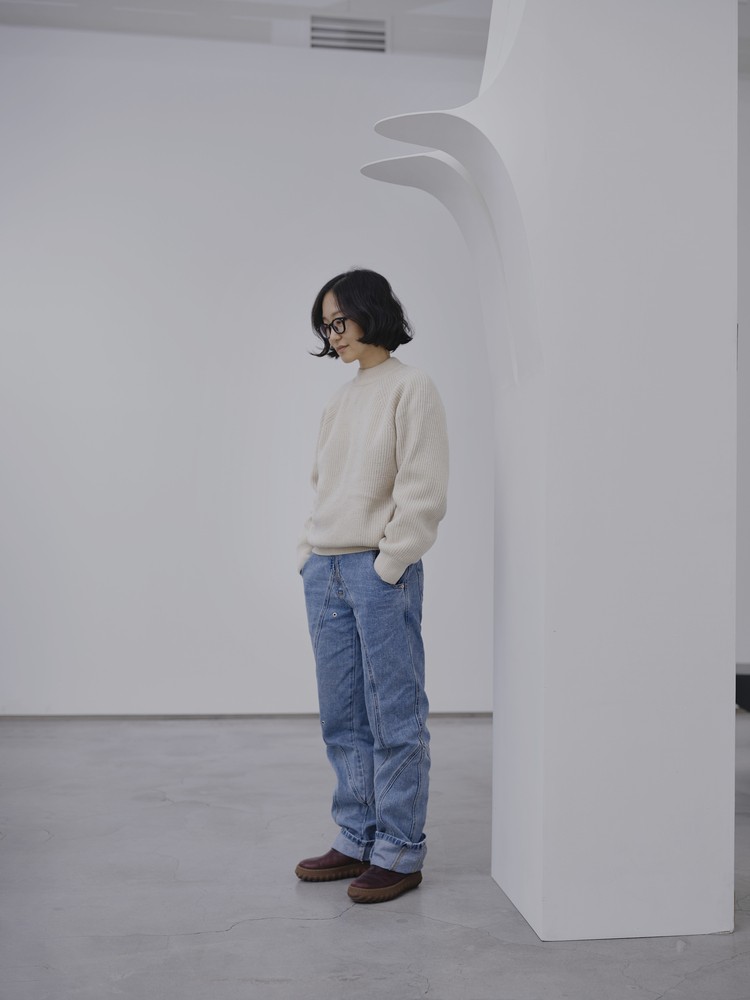
Kim Heejo is an artist working across painting and sculpture, approaching form as a *schematic medium* grounded in systems-based thinking. Shaped by long-term practice in New York and ongoing work in Seoul, her work emphasizes structural logics and generative processes over fixed imagery. In this article, she presents an artist-led reading of a Jean-Michel Basquiat exhibition.
www.heejokim.com
| @in.station