
In
a report released on February 2, Hana Securities suggested that the domestic
art auction market, led by Seoul Auction, may be entering a rebound phase. The
report, authored by analyst Park Chansol, noted that uncertainties surrounding
transactions have partially eased following the passage of the tax revision
bill. Amid continued increases in real estate and equity prices, artworks may
once again emerge as a store of value.
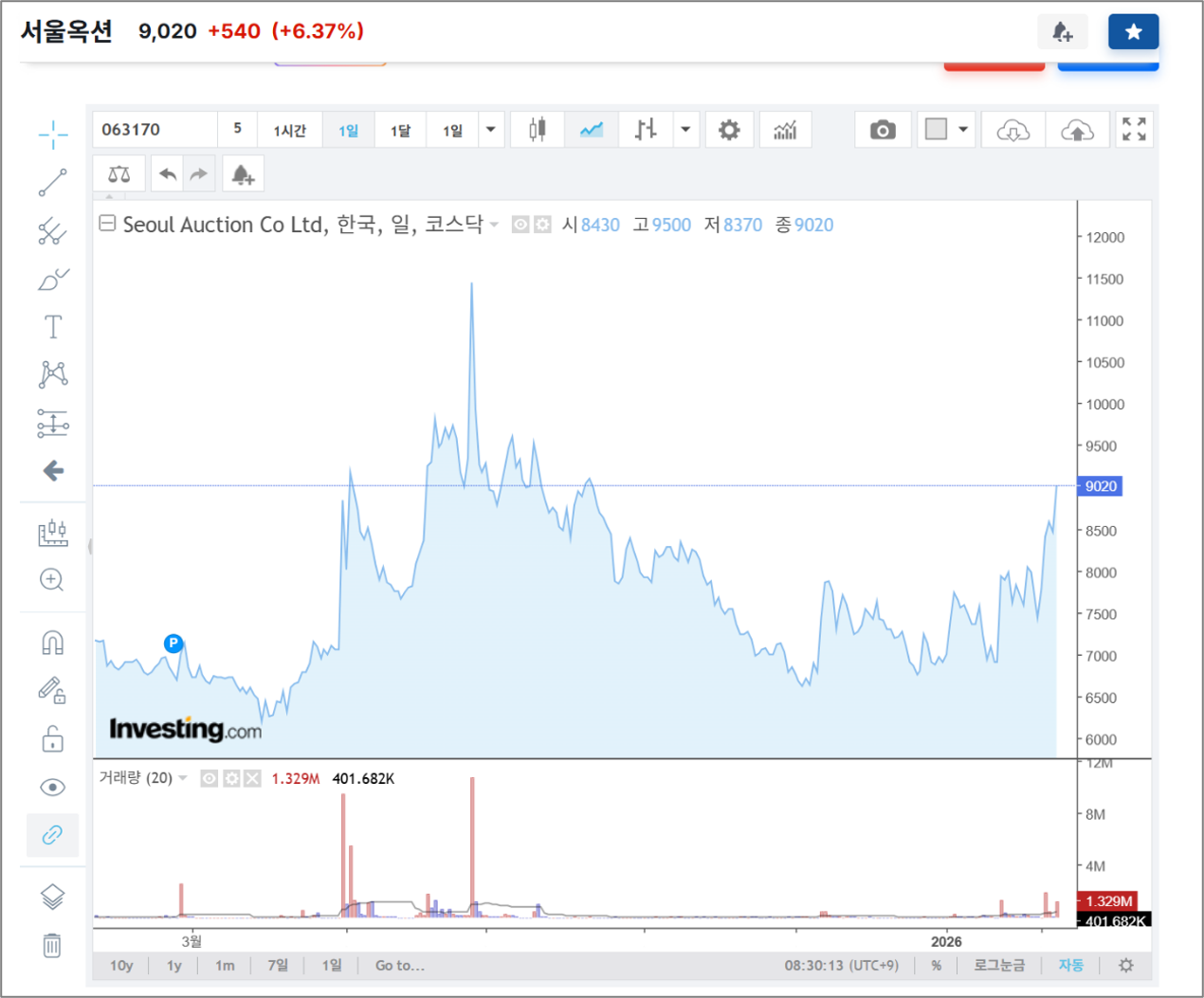
Seoul Auction Stock Price Overview / Source: Investing.com
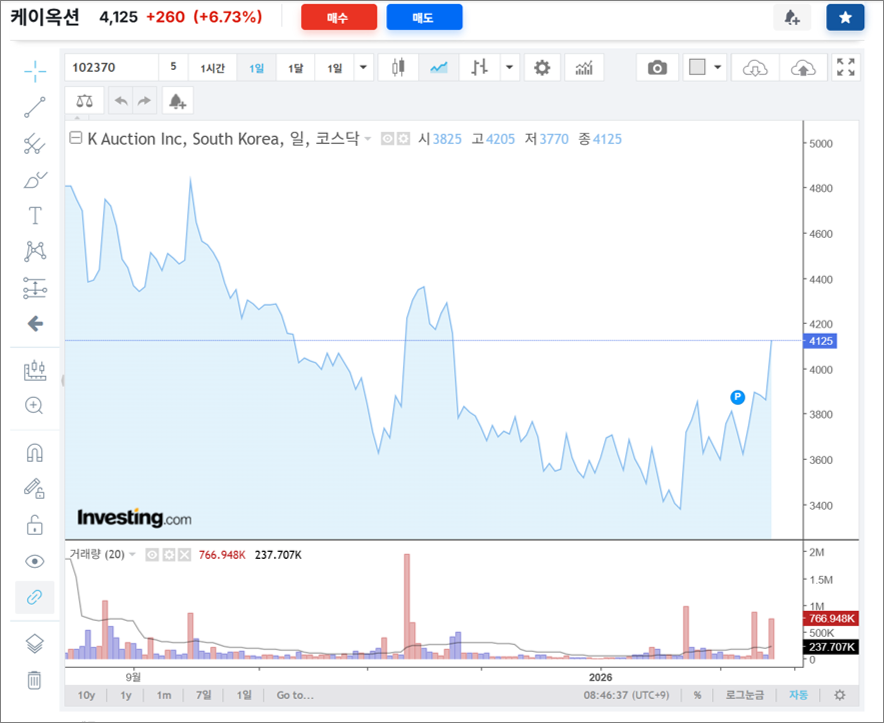
K Auction Stock Price Overview / Source: Investing.com
The
core of the report lies not merely in evaluating a single stock, but in
assessing whether the market structure has passed its bottom. Hana Securities
stated that if Seoul Auction and K Auction each expand their consignment
volumes to over KRW 10 billion (approximately USD equivalent) per auction
season, this could be interpreted as a clear signal of a full-scale market
rebound.
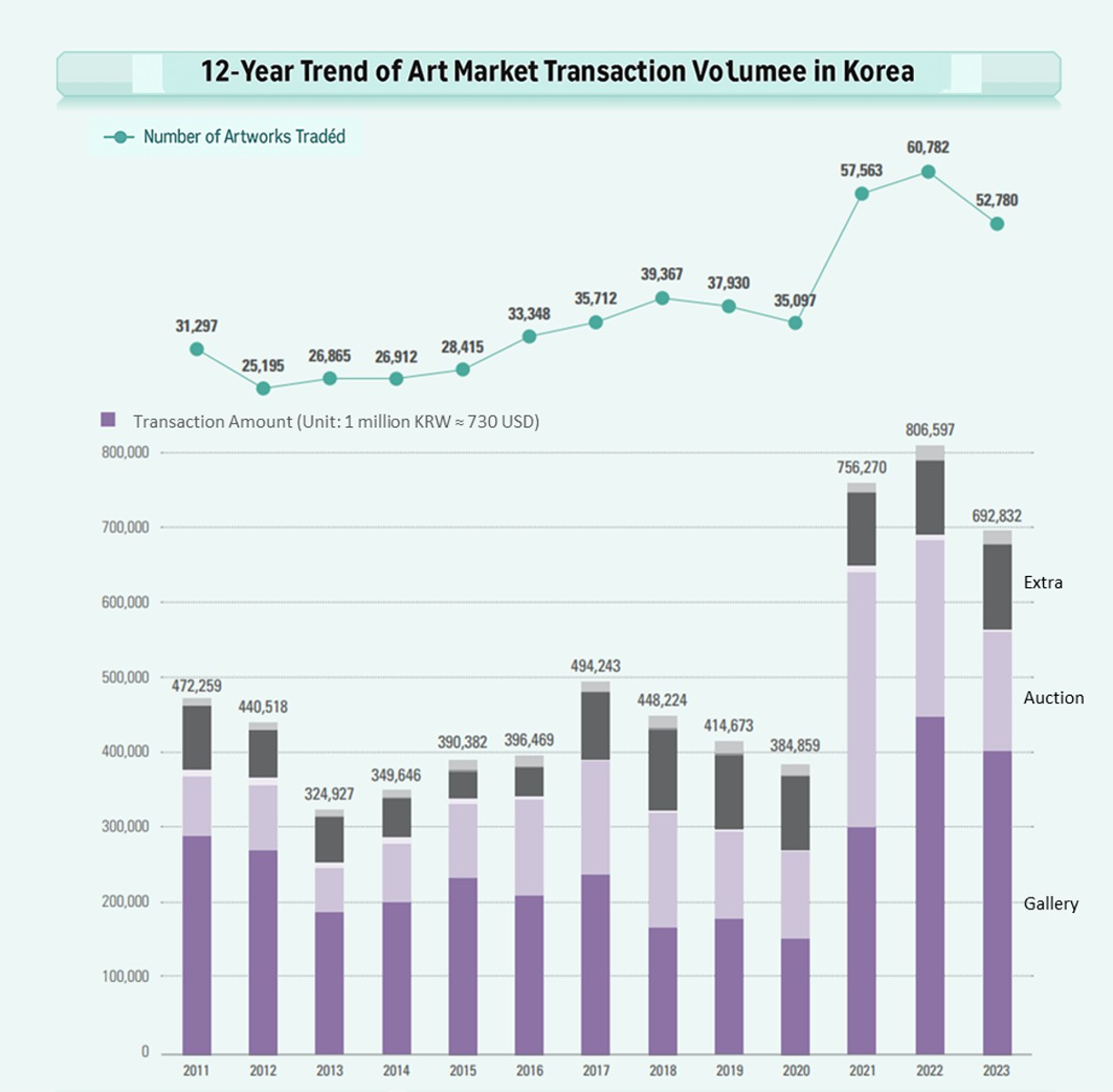
"2024 Art Market Survey" Report (Based on 2023 Data) / Photo : Korea Arts Management Service (KAMS)
Preconditions
for Rebound: Tax Environment and Asset Prices
The
tax revision bill passed at the end of 2025 is cited as a factor that has
partially alleviated the wait-and-see attitude among high-net-worth
individuals. The art market, by its nature, is highly sensitive to tax and
policy signals.
At
the same time, as prices of major asset classes such as real estate and
equities continue to rise, the possibility of portfolio diversification into
artworks is being raised. The market boom of 2021 similarly coincided with a
broader asset price upcycle.
From
an investment perspective, this suggests that artworks may once again be
re-evaluated not merely as consumer goods but as alternative assets. However,
as an alternative asset class, artworks are characterized by low liquidity and
limited price discovery. While returns may expand in bull markets, transactions
can stall during downturns. Any investment approach must take these structural
characteristics into account.
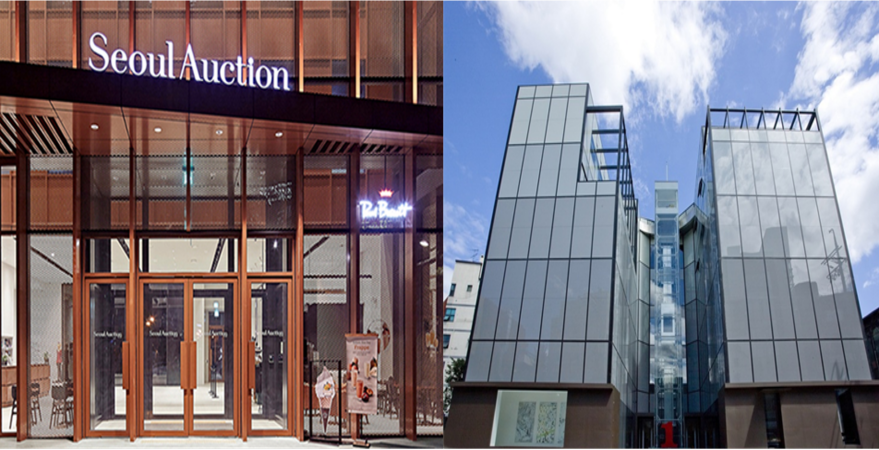
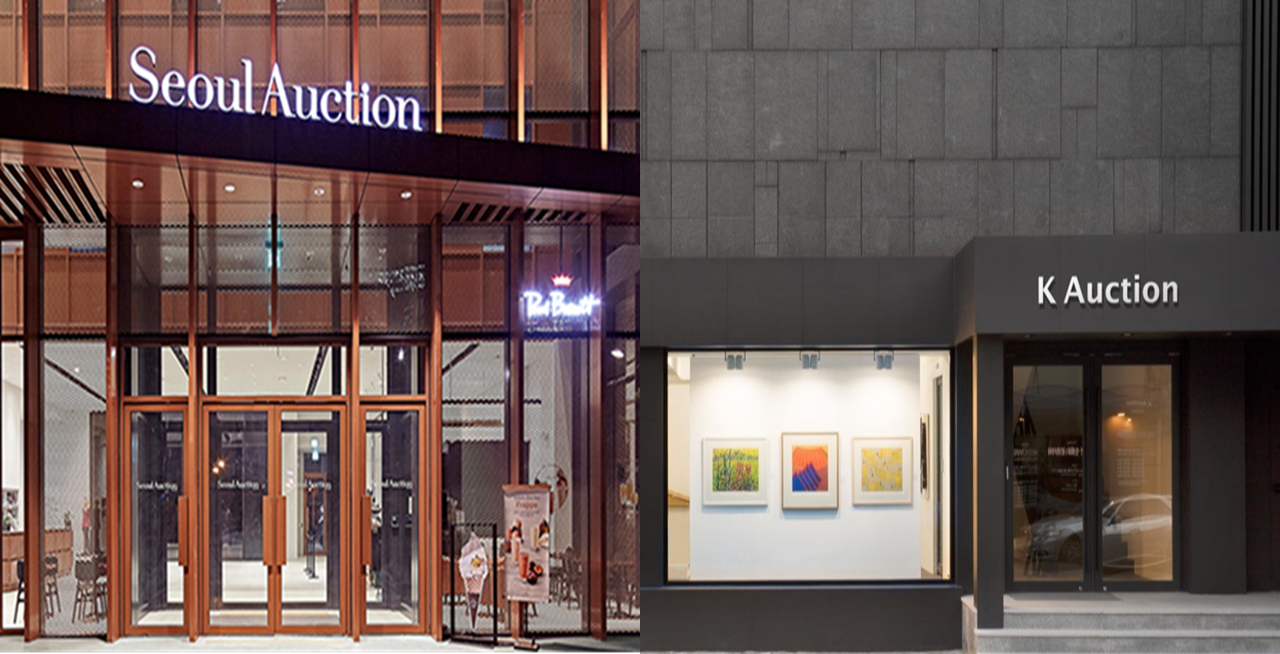
(Left) Seoul Auction headquarters, (Right) K Auction headquarters
Real
Indicators: Consignment Volume and Total Sales
In
the auction market, the most reliable leading indicators are total
consignment volume and clearance rates. Hana Securities noted that if
individual auction houses increase consignment volumes to over KRW 10 billion
during the April–June auction season, this would constitute a genuine recovery
signal. This benchmark reflects whether market sentiment is translating into
actual lot composition.
Seoul
Auction currently holds the largest market share in the domestic auction
sector. Together with K Auction, the two companies account for approximately
90% of the Korean art auction market, forming an effective duopoly. Their
consignment strategies and auction results effectively determine the direction
of the domestic market.
From
a collector’s standpoint, this period is particularly significant. The early
phase of expanding consignment volumes often corresponds to a
transitional stage just before prices begin to rise in earnest.
Conversely, once blue-chip works become overheated, entry costs escalate
sharply. Therefore, first-half auction results serve as a critical indicator
for assessing acquisition timing.
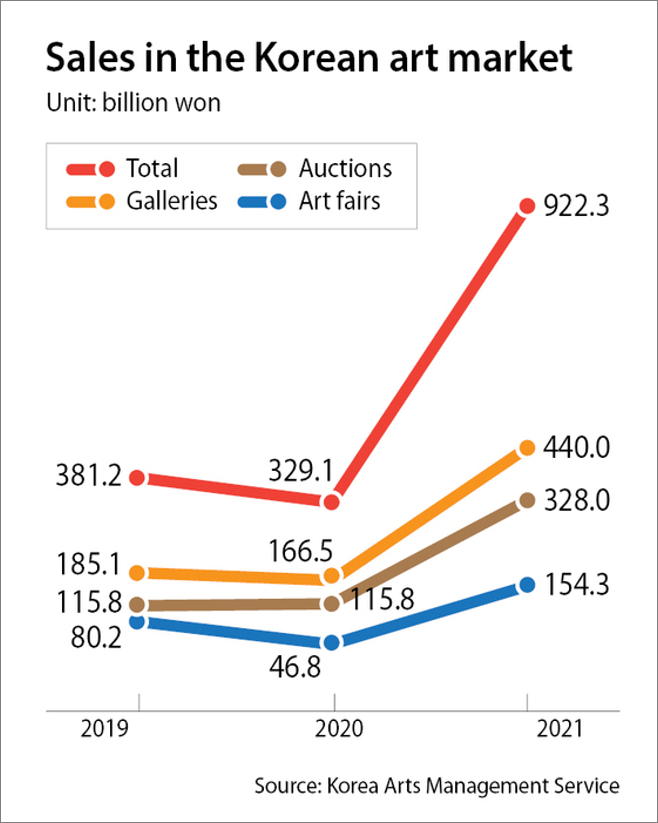
2021 Art Market Statistics / Source: Korea Arts Management Service (KAMS)
Valuation
Perspective: Remembering 2021
The
report references the 2021 boom period as a key comparison point. At that time,
Seoul Auction recorded KRW 79 billion in revenue and KRW 19.7 billion in
operating profit, reaching a market capitalization of approximately KRW 700
billion.
Given
that the company’s business structure has not undergone significant changes,
Hana Securities believes that similar valuation multiples could be applied if
demand rebounds. In other words, an expansion in total auction sales could
directly lead to a revaluation of corporate value.
For
investors, the key variable is the direction of total auction sales. In the
short term, quarterly hammer totals and increases in consignment volumes serve
as leading indicators for corporate performance and share prices. If total
auction sales begin to show double-digit year-on-year growth, this could
justify a reassessment of valuation multiples.
The
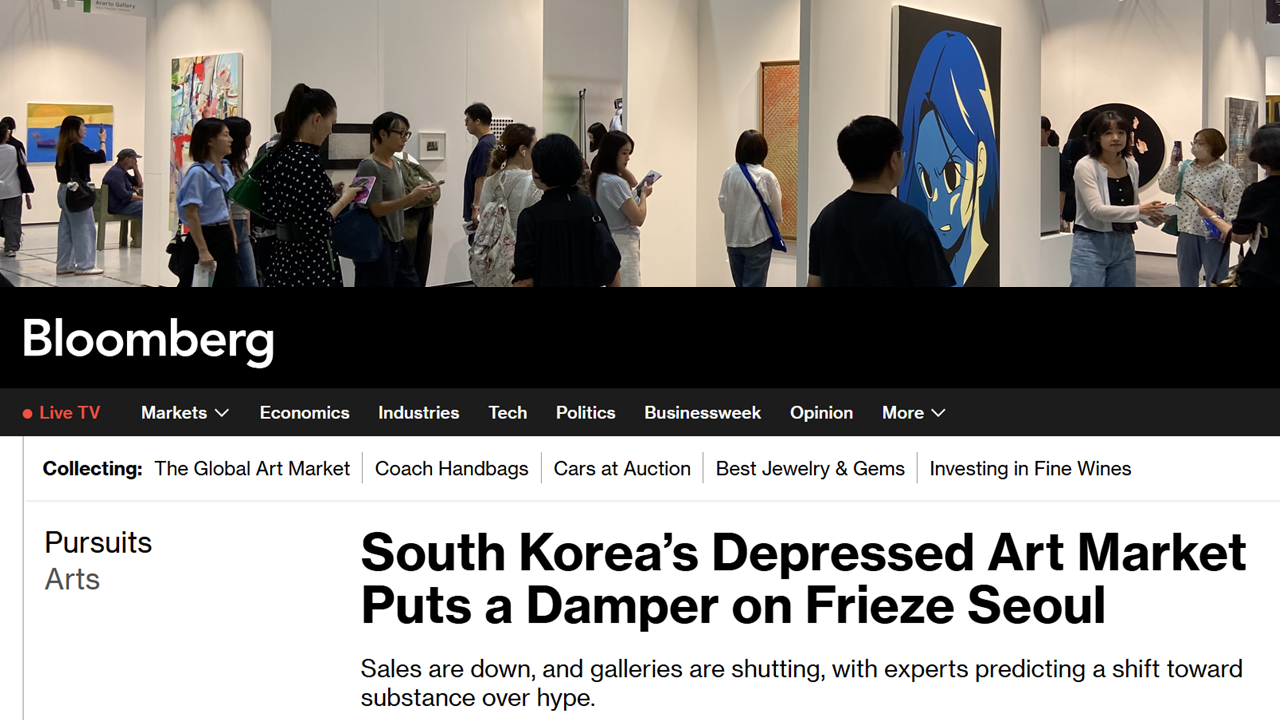
Mid-Low Price Segment and the Art Fair Variable
The
report interprets the recent increase in art fair attendance as a signal of
recovery in the mid- to lower-priced segment. This segment is closely tied to
the inflow of new collectors.
From
a collector’s perspective, as the mid-market stabilizes, the market base
broadens and excessive price concentration on certain blue-chip artists may
ease. In the long term, this can reduce price volatility and strengthen overall
market resilience. From an investment standpoint, expansion in mid-priced
transactions provides a more stable revenue foundation. While high-value works
tend to be volatile, mid-tier transactions offer greater repetition and
turnover.
Risk
Factors and Strategic Implications
The
rebound thesis hinges on three conditions.
First,
whether actual consignment volumes meaningfully expand during the first half of
the year. Second, whether clearance rates remain consistently above 70%. Third, whether total hammer prices for high-value blue-chip works show
meaningful quarter-on-quarter growth.
Investors
should focus less on short-term headlines and more on the trajectory of
consecutive quarterly data. Collectors, meanwhile, should avoid overheated
short-term cycles and selectively approach the market during the early phase of
recovery following price corrections.
Conclusion:
At the Threshold of Structural Recovery
Hana
Securities concluded that Seoul Auction’s auction-related performance has
likely passed its bottom, and that the company’s stock price may soon enter an
upward trend. However, the auction results of the first half of 2026 will
represent more than corporate earnings. They may serve as a turning point in
assessing the structural direction of the entire Korean contemporary art
market.
The
consignment strategies of Seoul Auction and K Auction, the strength of
blue-chip artist results, the resilience of the mid-market, and the broader
asset price environment must align simultaneously. Only then can the current
rebound signal evolve from a temporary recovery into a structural shift. For
investors, this is a moment that calls for data-driven and gradual
positioning. For collectors, it demands selective
acquisition strategies and a long-term perspective.