
The Post-Contemporary Condition
and the Problem of Value Production
The current crisis of
contemporary art cannot be explained by stagnation in production or exhaustion
of imagination. Countless exhibitions and projects continue to be organized,
and new formal strategies and critical concerns consistently emerge. The issue
lies elsewhere: whether this production and expansion have actually accumulated
value, and whether that accumulation has strengthened the structural foundation
of Korean contemporary art.
Over the past two decades, Korean
contemporary art has experienced visible achievements: an increase in the
number of exhibitions, expanded international exchange, collaborations with
overseas institutions, and growth in market scale. However, it requires careful
reassessment whether this expansion has truly formed evaluative standards;
whether accumulated achievements function as reference points that shape the
next generation of artistic practice; and whether this growth has led to the
development of a structure capable of producing international discourse and
sustaining competitive intellectual authority.
If achievements do not translate
into accumulation and instead remain objects of consumption, expansion remains
merely quantitative. Unless a properly functioning evaluative circulation
structure is in place, individual accomplishments become disposable events
rather than enduring standards.
The Operational Structure of
Contemporary Art and the Circuit of Value
Contemporary art operates as a
complex system in which artists, theory, institutions, markets, media, and
platforms interact. For this system to function productively, what is produced
must pass through processes of evaluation, become accumulated, and then return
as criteria for subsequent production. Only when such a circulation structure
exists can structural evolution occur.
It is necessary to examine
whether this circulation structure operates with sufficient precision in Korean
contemporary art.
The density of the field depends
on whether the achievements of exhibitions are structurally analyzed through
criticism, and whether those analyses are institutionally reflected in
curatorial planning and market selection. If exhibitions are consumed as isolated
events and criticism disappears as episodic commentary, the system loses its
capacity to accumulate standards.
Although each sector remains
active, there is little evidence that shared evaluative criteria are being
systematically consolidated. As a result, new forms appear without being
assessed in relation to previous ones; repetition and differentiation become indistinct.
When such a condition persists, production may continue, but structural
advancement inevitably slows.
Artists and the Structure of
Production
Artists in Korean contemporary
art have demonstrated a high degree of sensitivity and adaptability to
international discourse. This capacity has enabled participation in
international exhibitions and the expansion of networks. Yet it remains
necessary to ask whether this adaptability has led to the formation of
autonomous standards.
If there is insufficient internal
analysis of how tightly conceptual problems are integrated with formal
solutions, how serial works structurally evolve, or whether recurring
strategies represent development rather than variation, individual works may receive
attention but fail to function as long-term standards.
In a structure where
participation in international exhibitions becomes an index of achievement,
participation itself easily becomes the objective. For participation to become
a criterion rather than an endpoint, systematic analysis of the formal and conceptual
achievements that made such participation possible must accompany it. Without
such analysis, the authority of evaluation naturally remains with external
institutions and discursive frameworks.
The Evaluative Function of Art
Theory and Art Journals
Criticism and theory serve as
mechanisms that articulate evaluation and preserve it as public record.
However, criticism often remains at the level of summarizing curatorial intent
or reiterating an artist’s stated concerns. Systematic analysis of formal
persuasiveness, recurring strategies, and structural limitations is rarely
accumulated.
As a result, evaluation may
exist, but it remains confined to individual texts rather than consolidating
into long-term standards. If domestic discourse is not systematized into
internationally referable conceptual frameworks, interpretation and positioning
of Korean art are likely to be shaped by external scholars and institutions.
This is not merely a question of
prestige. It is a question of interpretive authority. Without conducting and
properly recording value judgments, artistic practice cannot be positioned
within aesthetic or art-historical significance.
Institutional Responsibility:
Museums, Biennales, and Non-Profit Organizations
Museums and biennales are not
simply exhibition venues; they are institutional mechanisms for formalizing
value judgment at a public level. A robust archival structure must analyze and
record curatorial objectives, selection criteria, modes of implementation,
formal achievements, and limitations.
If exhibitions are consumed as
one-time events and subsequent evaluation is not systematically accumulated,
curatorial structures are likely to repeat themselves. The issue is not the
quantity of exhibitions but whether their outcomes become criteria for future
decisions.
If value judgment is not
institutionalized, institutions remain limited to receiving external discourse.
Institutions that accumulate value judgments, by contrast, can transition into
proposing standards.
The Contemporary Art Market and
the Need for Structural Analysis
The growth of the Korean
contemporary art market and its recent international activities are tangible
achievements. Yet there has been insufficient analysis of how market selection
reinforces particular formal and strategic tendencies.
If systematic research is not
conducted into which types of works are repeatedly considered
market-compatible, how certain formal characteristics correlate with price
increases, and how market-friendly strategies shape aesthetic trends, market
results risk being mistaken for intrinsic achievement.
When market selection is not
clearly distinguished from internal evaluation, internal standards gradually
become subordinate to external outcomes. The market is not an object of moral
denunciation but of analysis. Only through analysis can boundaries between
internal criteria and market response be properly established.
Collections and the Formation of
Value Standards
A collection is not merely an
aggregation of owned works; it represents the sustained accumulation of value
judgments. When reasons for acquisition are publicly recorded and discussed,
collections function as long-term reference points.
If short-term profit dominates
collecting and evaluative reasoning remains private, collections cannot
contribute to structural standard formation. Only when collections are built
upon long-term, sustained perspectives do production, institutions, and markets
share a common reference framework.
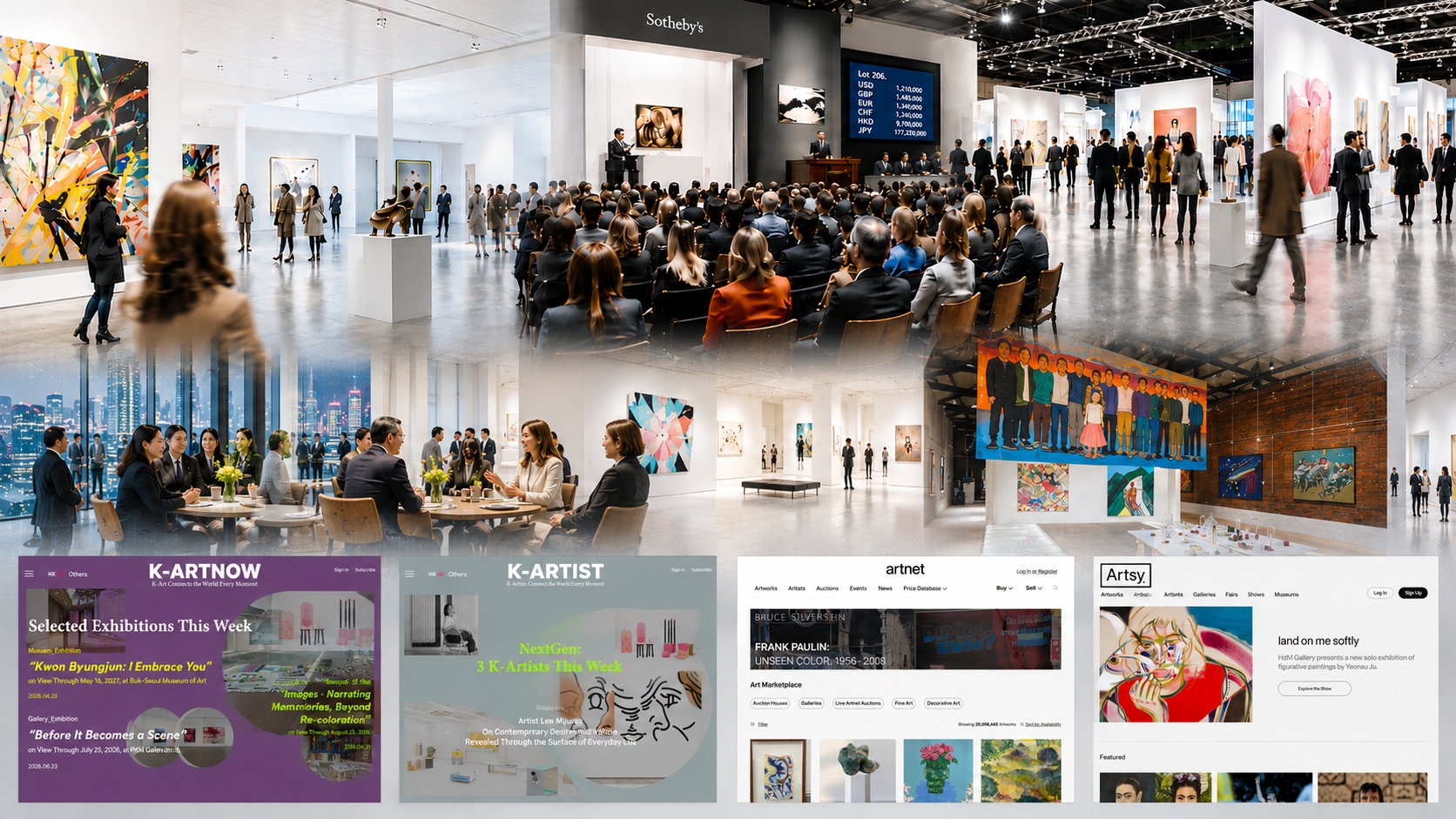
The Importance of Korean
Contemporary Art Online Platforms and Artist Digital Archives
In today’s international art
world, evaluation is formed not through impression or hearsay but through data
and documentation.
Only when artists’ work
histories, exhibition records, images, credit information, critical texts,
collection status, and translations are systematically organized, searchable,
and preserved long-term can structural analysis become possible. Such accumulated
records enable objective assessment of formal evolution, conceptual shifts, and
international positioning.
At present, materials in the
Korean art field are dispersed across institutions, galleries, and personal
websites. Formats are not standardized; exhibition listings are inconsistent;
English-language information is limited; and past materials and critical texts
are often lost without proper archiving.
As a result, research and
reference concerning Korean artists increasingly depend on external databases,
overseas museum archives, and international gallery records.
This is not merely a matter of
convenience. It is directly linked to interpretive authority. How an artist is
understood, which exhibitions are deemed significant, and which works are
recognized as representative are ultimately determined by documentation
structures.
Without a domestically grounded,
internationally credible online platform, Korean contemporary art remains
dependent on external classification and interpretive frameworks. Conversely,
if data are standardized, structured multilingual, and systematically
interconnected across exhibitions, criticism, market information, and
collection data, evaluation can be produced internally and circulate
internationally.
Artist digital archives and
integrated platforms are therefore not promotional tools but infrastructural
mechanisms for standard formation. Only a field that structures its own records
can secure interpretive authority. Only a field that accumulates evaluation
structurally can move toward becoming a producer of international discourse.
Structural Transformation for the
Global Positioning of Korean Contemporary Art
For Korean contemporary art to
develop international discursive authority, systematic value evaluation must
precede further quantitative expansion. The number of exhibitions, cases of
overseas advancement, and market growth are important indicators, but they do
not in themselves establish criteria for discourse production. Authority
emerges not from frequency of participation but from the capacity to publicly
articulate what constitutes achievement and what constitutes limitation.
This requires not isolated
strengthening of individual sectors but comprehensive structural redesign.
Artists’ formal density must be analyzed through internal criticism; that
analysis must inform institutional planning and verification systems. Institutions
must record and accumulate selection criteria and outcomes rather than
consuming exhibitions as events.
Market selection must be treated as an object
of analysis before being accepted as an index of achievement. Collections must
function as accumulations of long-term evaluative standards rather than
instruments of short-term appreciation. And digital infrastructure must
standardize data, preserve records long-term, and structure them for
international accessibility. When these elements are interconnected, a
circulation structure of accumulation emerges.
Artists’ works become
structurally articulated through criticism; that structure informs
institutional criteria; market selections are reinterpreted through criticism
and collection practices. When this circulation repeats, individual judgments
solidify into long-term standards. Without such circulation, achievements fail
to accumulate, strategies repeat, and structural evolution is delayed.
If the deferral of value judgment
continues, evaluative authority shifts outward. Invitations from external
institutions, international market responses, and foreign media evaluations
become de facto standards, while internal judgment merely ratifies external
outcomes. In such a condition, increased international visibility does not
guarantee interpretive authority.
By contrast, when evaluation is
internally produced, recorded, and institutionalized, a field can define
itself. The center is not a status granted from outside; it is the result of
accumulated internal judgment.
This transformation cannot be
achieved through declaration or rhetoric. It requires systematic documentation,
sustained analytical accumulation, and explicit articulation of standards.
Post-exhibition assessment reports, publicly accumulated criticism, market data
analysis, transparency in collection criteria, and standardized,
internationalized digital artist archives must operate in parallel. When such
design is repeatedly implemented, evaluation shifts from opinion to structural
asset.
The possibility for Korean
contemporary art to move toward the center of the global art world does not lie
in greater production or faster reaction. It lies in constructing a structure
that does not evade judgment, that preserves judgment as public record, and
that uses accumulated standards as the basis for subsequent decisions. Only a
field that accumulates judgment can propose standards. Only a field that
proposes standards can function as an international reference point.
When such structural
transformation is realized, Korean contemporary art can be recognized not
merely as a collection of cases, but as a standard in its own right.
Jay Jongho Kim graduated from the Department of Art Theory at Hongik University and earned his master's degree in Art Planning from the same university. From 1996 to 2006, he worked as a curator at Gallery Seomi, planning director at CAIS Gallery, head of the curatorial research team at Art Center Nabi, director at Gallery Hyundai, and curator at Gana New York. From 2008 to 2017, he served as the executive director of Doosan Gallery Seoul & New York and Doosan Residency New York, introducing Korean contemporary artists to the local scene in New York. After returning to Korea in 2017, he worked as an art consultant, conducting art education, collection consulting, and various art projects. In 2021, he founded A Project Company and is currently running the platforms K-ARTNOW.COM and K-ARTIST.COM, which aim to promote Korean contemporary art on the global stage.