
The term “The Conditions
of the Post-Contemporary” is not intended to declare the arrival of a new
era. Rather, it functions as an analytical concept designed to bring the
operative principles that contemporary art has established for itself back into
the realm of critical reflection. Meaning continues to be produced actively,
incessantly, across diverse sites and through a wide range of practices. The
crucial question is how these meanings and values are to be organized, and,
more fundamentally, how they are to be judged.
The limitation of contemporary art does not lie in a failure of
meaning production, but in the neutralization of the structure of value judgment.
Unless this structure is reconstituted,
any discussion of the future of contemporary art remains inevitably
hollow.
The notion of the post-contemporary condition begins
precisely from this recognition.
Modes of Value
Judgment in Modern and Contemporary Art
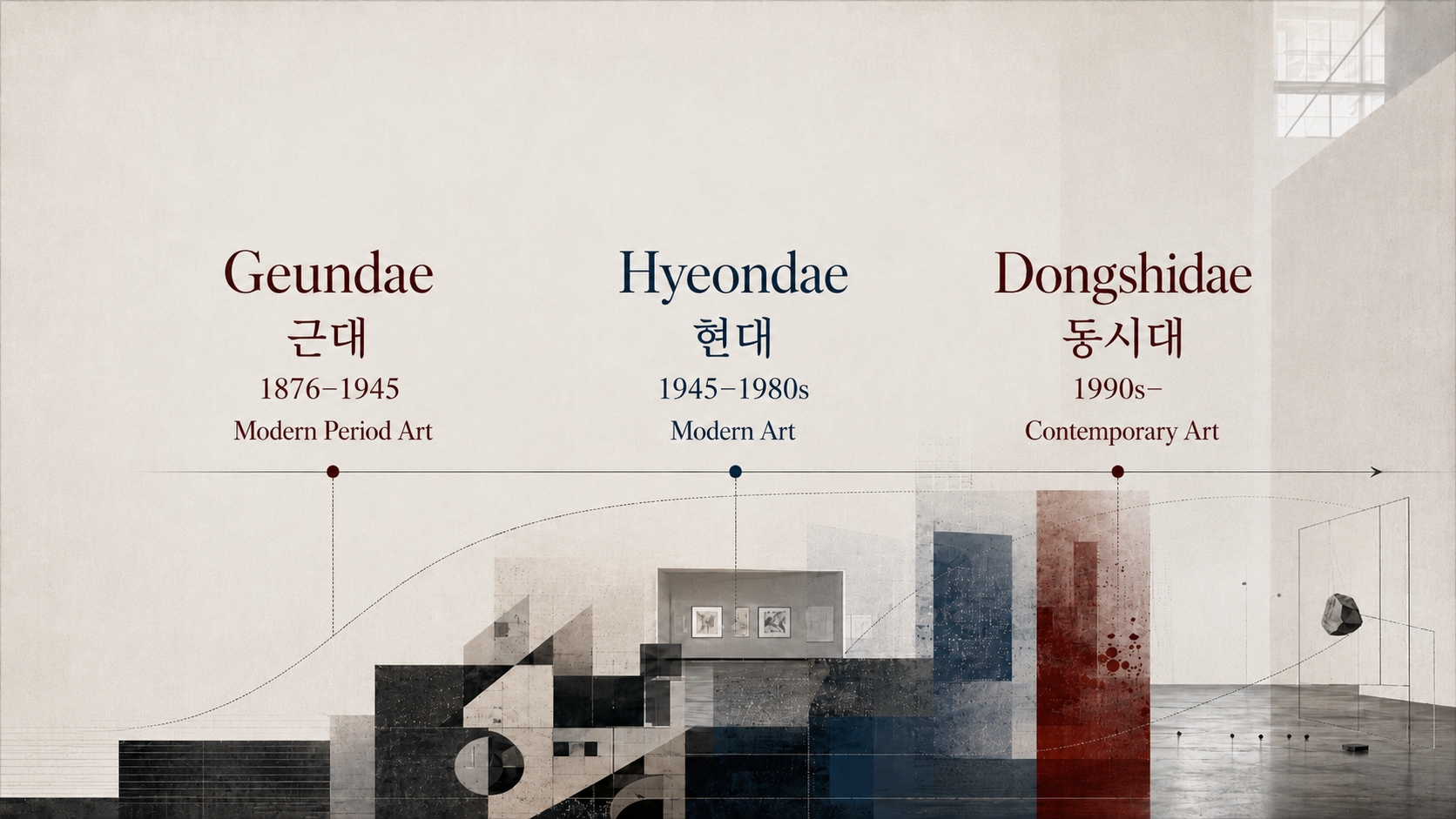
In modern art,
meaning was organized through the internal formal logic of the artwork. Form,
composition, materiality, and the autonomy of the medium functioned as criteria
for evaluating artistic achievement, while criticism compared works on the
basis of these criteria, ranking them and accumulating hierarchies over time.
The strength of
this structure lay in the clarity of its evaluative circuit. It was possible to
articulate, in logical terms, what a work had achieved and where it had failed,
and such articulations functioned as valid criteria for judging other works as
well.
Contemporary art,
however, emerged by rejecting or redefining this structure. From the
perspective of modernism, the notion of an artwork’s intrinsic meaning no
longer fixes the work to a single interpretation. Instead, meaning is generated
through the social, institutional, and discursive conditions in which the work
is situated, as well as through the position and experience of the viewer and
the modes of circulation and reception.
In this sense,
the artwork is no longer a vessel containing a complete meaning, but a medium
that triggers the production of meaning. This shift proved effective in
accounting for the complexity of the contemporary condition and, in moving
beyond the exclusionary logic of modernism, appeared to accommodate a wide
range of practices within a single field.
The problem,
however, is that while contemporary art achieved a significant expansion of
meaning, it revealed a serious structural vulnerability at the stage where such
achievements needed to be translated into a language of judgment. Production
became excessive, while the mechanisms capable of converting meaning into value
judgment remained insufficient.
What the “Deferral
of Value Judgment” Has Produced
In contemporary
art, the “deferral of value judgment” emerged from the recognition that
singular and immediate judgments—the mode practiced by modern art—were no
longer capable of adequately grasping the complexity and multiplicity of the
contemporary condition.
As a result,
value judgment was not abolished but left unresolved: both its criteria and its
timing remained undefined, and this suspension came to be accepted as natural
and legitimate. Under the name of the “deferral of value judgment,” this
suspension performed several important functions.
It undermined the
authority of form-centered evaluation, excluded the dominance of particular
aesthetic universals, and operated institutionally to place regional and
cultural differences on a shared platform. Accordingly, what defines the
current state of contemporary art is not the absence of criteria, but their
excessive proliferation. Criteria such as context, political engagement,
participation, community, institutional critique, identity, narrative, research,
archives, technology, and ecology are invoked simultaneously.
This plurality in
itself is not the reason the post-contemporary condition has come into
question. On the contrary, such plurality has enriched the field of art. The
problem lies in the fact that these criteria fail to complement or verify one
another, functioning instead as parallel forms of suspended judgment.
A judgment made
on the basis of one criterion is immediately nullified by another. References
to formal completion are dismissed as “formalism,” discussions of aesthetic
achievement as “apolitical,” emphases on political radicality as “moralism,”
and institutional critique as merely “a role performed within the institution.”
As this process repeats, value judgment becomes structurally
impossible.
Criteria block other criteria, cancel one another out,
and ultimately consume one another.
Under these
conditions, it becomes impossible to rigorously assess the specific
achievements of individual works. Criticism ceases to address “why” a work
matters and instead limits itself to describing “what context” it occupies.
Countless exhibitions pass by as events, failing to accumulate as aesthetic or
art-historical achievements. This is the most damaging consequence produced by
the absence of value judgment in contemporary art.
The Successes
and Failures of Contemporary Art
Contemporary art
continues to operate effectively in its capacity to register the conditions of
the present, to shift between media and forms, to formulate sensitive
problematics, and to articulate languages capable of interpreting institutions
and society. What no longer functions, however, is the capacity to preserve
questions such as what a work has achieved, on what grounds that achievement is
valid, where its limits lie, what kinds of revisions are required, and what
remains or is exhausted when themes and formats are repeatedly reproduced.
When sentences of
value judgment fail to endure, causal analysis becomes impossible. Without such
analysis, criticism loses its influence. The space vacated by diminished
criticism does not remain empty; it is occupied by a distorted system of
signals—what may be described as symbolic capital.
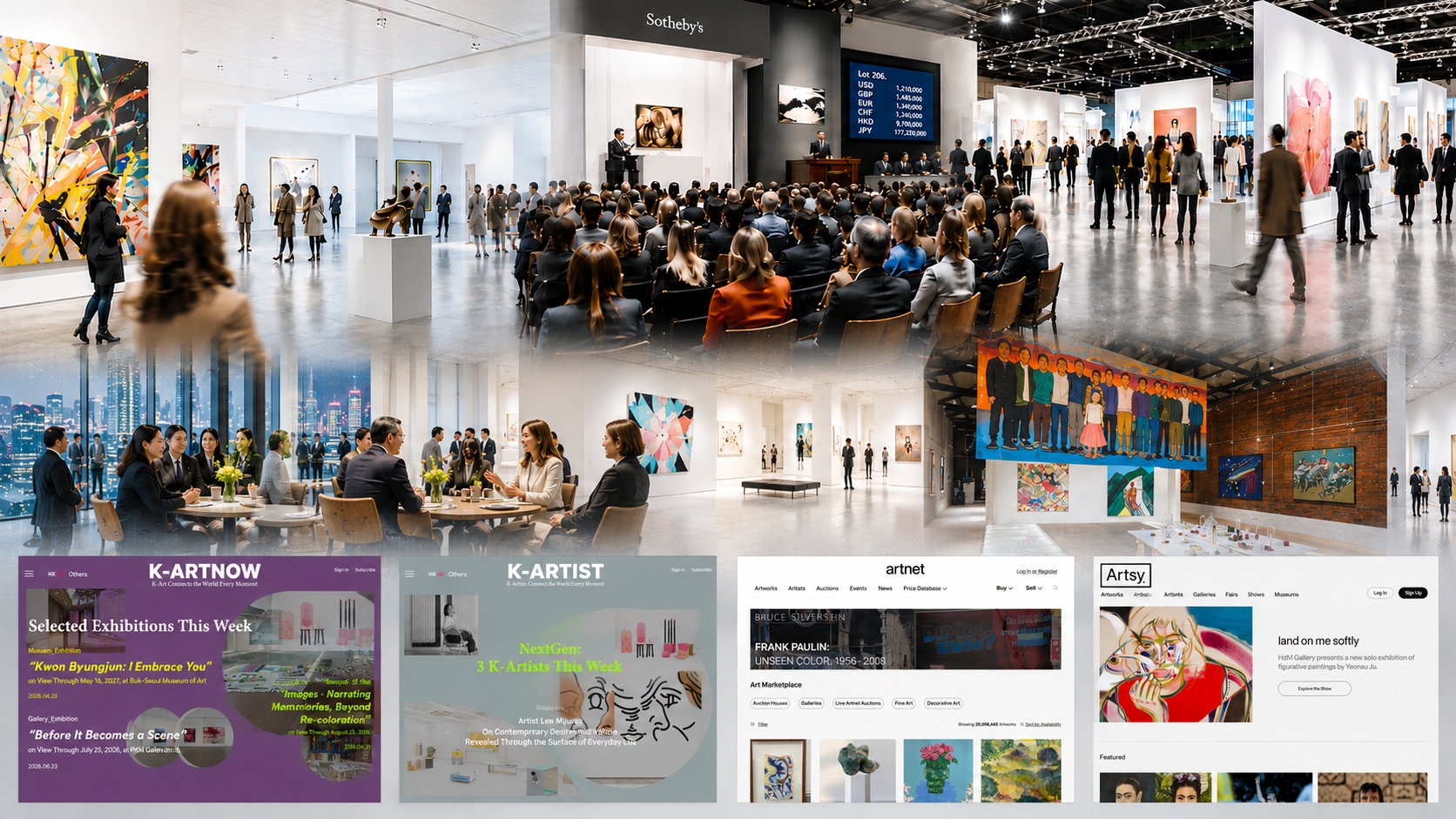
The void created
by the neutralization of value judgment is most rapidly occupied by the art
market, including galleries, art fairs, and auctions. This signaling system
produces powerful indicators of value without analyzing the intrinsic
achievements of artworks. Transaction records, hammer prices, repeated
exposure, booth placement, gallery networks, and collector lineups do not
explain quality, but effectively replace it.
The central issue
here is not a moral condemnation of the market. Rather, it is the structural
fact that as internal mechanisms of value judgment weaken, market signals come
to function as substitutes for judgment. Consequently, the intrinsic value of
artworks fractures. What a work does becomes less significant than where it is
shown, who acquires it, and at what price it is traded. Qualities such as
completion, density, structural design, skill, and formal control recede from
the center of evaluation, while indicators of exposure, connectivity, and
transaction take precedence.
When the internal
system of value judgment collapses, the market ultimately operates as a
comprehensive apparatus of evaluation. The result is a decline in cultural
awareness and the erosion—and eventual disappearance—of art’s unique role in
producing and sustaining human value, leading to the conditions characteristic
of a culturally regressive society.
What the
Conditions of the Post-Contemporary Signify
The core claim of
the post-contemporary condition is not that contemporary art lacks meaning, but
that a state in which meaning and value judgment are indefinitely deferred—never
converted into judgment—has become structurally entrenched. Thus, the
post-contemporary condition is not a slogan calling for the transcendence of
contemporary art, but a framework that enables reflection on what must be
reactivated in order to sustain contemporary art as a bearer of contemporary
value.
In the context of
Korean contemporary art in particular, this deferral functioned as a de facto
necessity for rapid integration into international exhibition formats and
discourses. It allowed practitioners to avoid comparison based on singular
criteria and to justify their practices within the shared language of “contemporary
issues,” postponing evaluation.
Yet as deferral
persists, it shifts from a period of reflective consideration to a state in
which judgment simply does not occur. It is this shift that constitutes the
post-contemporary condition.
What
Constitutes the Post-Contemporary Condition
To speak of “overcoming”
contemporary art is abstract and meaningless. Instead of vague prescriptions,
it is necessary to identify precisely the elements that require
reconfiguration.
First, the
evaluative circuit must be restored. This entails developing a language capable
of assessing achievement and limitation after meaning production, procedures
for preserving such assessments in accumulative form, and feedback mechanisms
through which accumulated judgments inform subsequent practices.
Second, criteria
must be aligned through processes capable of shared agreement. Plural criteria
arranged in parallel do not constitute plurality, but cancellation. Alignment
does not mean reduction to a single standard, but minimal structuring that
prevents criteria from nullifying one another.
For example,
exhibitions cannot conclude merely by claiming to have “raised an issue.” They
must specify what was raised, how it was realized through form, composition,
and experience, where density diminished, and what ultimately remained. Such
articulation is not an imposition of hierarchy, but a statement of
responsibility.
Accordingly, the
role of criticism must be redefined. Criticism must both contextualize
production processes and return to functioning as an analytical apparatus
capable of evaluating intrinsic achievement. This does not imply a return to
authoritarian judgment, but the ability to frame judgment not as a fixed
verdict, but as a transparent and verifiable analytical result.
Market signals
need not be denied, but the moment they become substitutes for value judgment,
internal evaluative structures collapse. Transactions and exposure may serve as
reference data, but they cannot replace assessment of achievement. This
separation is not an ethical issue, but a structural one: where value judgment
disappears, symbolic market value inevitably takes its place.
For the Future
of Korean Contemporary Art
What Korean
contemporary art requires is not a call to “do better,” but a return to
foundational questioning.
It is necessary
to reconsider what constitutes value, what defines the intrinsic achievement of
an artwork, what exhibitions and criticism should record as outcomes, and how
market signals should be interpreted and where their influence should end.
If the deferral
of value judgment is not reconfigured within the context of contemporary art,
meaning will continue to be produced but will fail to accumulate internally,
remaining subject to external signals. Under such conditions, Korean
contemporary art cannot escape a structure in which its value is determined by
others.
Therefore, what
practitioners in Korean contemporary art must recognize is the urgency of
reconstructing—without delay—a structure of value judgment capable of capturing
this unstable and disordered moment in objective language and articulating it
through clear concepts.
What is required
to avoid subordination or marginalization within a pluralistic, international,
and volatile world is not increased production, but the reconstruction of a
judgment system capable of assigning new value and order to what has already
been produced. Without the establishment of such post-contemporary conditions,
the future of Korean contemporary art cannot meaningfully be said to exist.
Jay Jongho Kim graduated from the Department of Art Theory at Hongik University and earned his master's degree in Art Planning from the same university. From 1996 to 2006, he worked as a curator at Gallery Seomi, planning director at CAIS Gallery, head of the curatorial research team at Art Center Nabi, director at Gallery Hyundai, and curator at Gana New York. From 2008 to 2017, he served as the executive director of Doosan Gallery Seoul & New York and Doosan Residency New York, introducing Korean contemporary artists to the local scene in New York. After returning to Korea in 2017, he worked as an art consultant, conducting art education, collection consulting, and various art projects. In 2021, he founded A Project Company and is currently running the platforms K-ARTNOW.COM and K-ARTIST.COM, which aim to promote Korean contemporary art on the global stage.