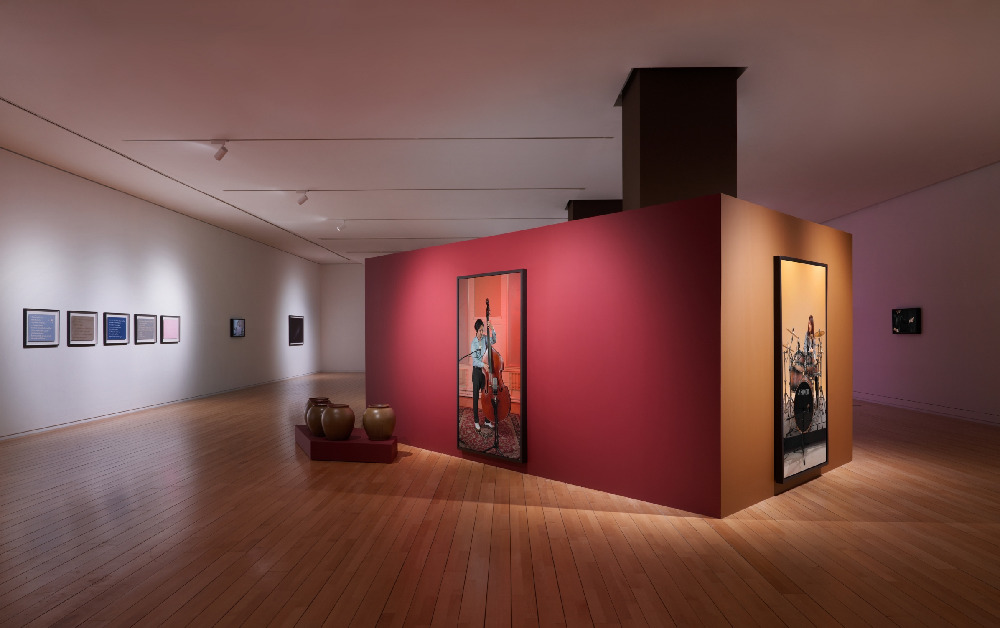

Korea Art
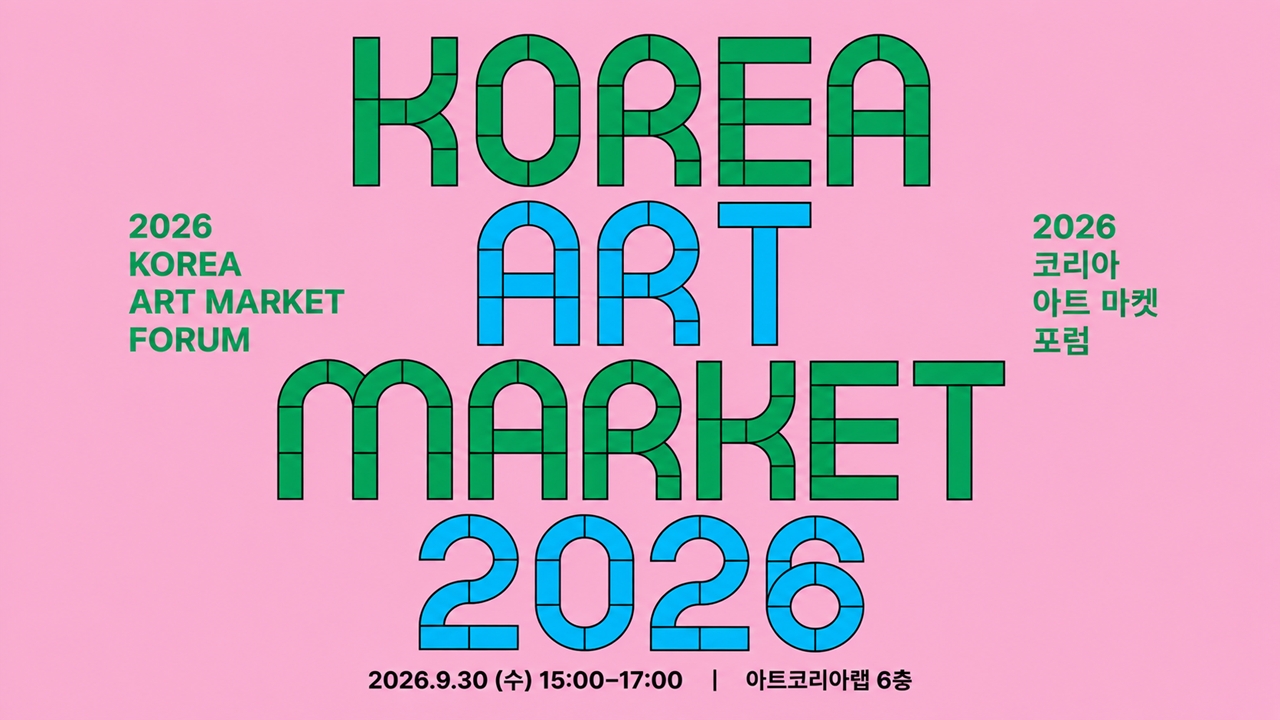
Market Forum 2026 took place on September 30 at Art Korea Lab in Gwanghwamun,
jointly organized by the Paradise Cultural Foundation and the Business Research
Institute at Seoul National University. Marking five years of collaboration
between Kiaf and Frieze, the forum addressed Korea’s gallery landscape, art
fairs and cities, and young artists. Sang-Hoon Kim, a professor at Seoul
National University Business School, delivered the opening remarks.
What
standards and methods should underpin a forum that discusses the present and
future of the Korean art market under the name “Korea Art Market”? This review
examines what the three sessions revealed and overlooked against those
standards. Its scope is the presentations and discussion delivered at the
event; an assessment of the annual reports as a whole is a separate matter.
Why Was Korea Art Market Established?
The
project began with a clear purpose that remains relevant. The Paradise Cultural
Foundation and Seoul National University’s Business Research Institute first
published 《Korea Art
Market 2022》 in 2022.
The
official introduction identified a gap: despite the rapid growth of the Korean
art market and increasing international interest, there was no English-language
market report systematically explaining Korean galleries, art fairs, auctions,
collectors, artists, and exhibition trends to readers abroad.
The first
report was published by the Business Research Institute, supported by the
Paradise Cultural Foundation, with translation support from the Korea Arts
Management Service.
In a 2023
interview, Professor Kim likewise explained that the report had been launched
to introduce Korean art to the world, drawing on examples such as the reports
produced by Artnet and Art Basel. In a 2025 interview, he emphasized that the
visual and performing arts required greater efforts toward industry development
and internationalization than K-pop and Korean television drama. Korea Art
Market can therefore be understood as a project seeking to build a knowledge
infrastructure through which the international art world can understand the
Korean art market.
Annual
editions followed in 2023, 2024, and 2025. The Paradise Cultural Foundation’s
official materials continued to describe the series, including its 2025
edition, as an English-language report for global readers. Korean-language
content, summaries, and commentary in the reports and related domestic
publications also broadened access for readers in Korea.
However,
the appearance of Korean-language content should be distinguished from the
publication of a separate Korean edition. The claim that a Korean edition began
in 2025 requires further confirmation against publication records.
A project
established to explain the Korean art market accurately to readers abroad
should apply rigorous standards to its definitions, data, and methodology.
What Underpins the Projection of a KRW 2.5
Trillion Market?
Among the
statements I heard in Professor Kim’s opening remarks was the possibility of
the Korean art market reaching KRW 2.5 trillion. In a 2025 interview, he had
also argued that Korea’s relatively low ratio of art sales to GDP suggested the
potential for the market to more than double.
There is a
case for discussing the Korean art market’s growth potential. A figure as
specific as KRW 2.5 trillion, however, requires an explanation of what it
includes, the current market size, the timeframe, and the growth rates and
drivers that would produce it. In the opening remarks I heard, the market
boundaries, base year, target year, and calculation method for this figure were
not specified.
Market
size varies according to how primary-market gallery sales and secondary-market
auction sales are counted, how double counting of art-fair transactions is
addressed, and whether overseas sales of works by Korean artists and related
services are included.
Moving
from the possibility of doubling to a projection of KRW 2.5 trillion requires
disclosure of the baseline market size, comparison countries, sales-to-GDP
ratios, growth period, and assumptions. These details allow readers to
determine whether the figure is an analytical forecast or an aspirational
target.
Standards for Market Analysis Must Come First
A
discussion that sets out to analyze the Korean art market requires at least
five standards.
First, definitions
and classifications: it should explain what constitutes the market
and the common criteria used to classify galleries, art fairs, and artists.
Second, data
and research methods: it should identify samples, sources, research
methods, base years, and comparable time-series data.
Third, structure
and movement: it should track market entry, growth, establishment,
and exit, alongside changes in revenue, costs, market share, and price
segments.
Fourth, causes
and consequences: it should explain why observed changes occurred and
how they affected transactions, profitability, and artists’ working conditions.
Fifth, the
measurement of internationalization: it should distinguish
participation in overseas events, entry into foreign markets, sustained sales,
and the development of local clients and distribution networks.
The
project has accumulated annual reports since 2022. For the 2024 report,
Yeon-Hwa Joo surveyed 17 leading Korean and international galleries operating
in Korea. In 2025, responses from 26 leading galleries informed an examination
of indicators including revenue, cost reductions, art-fair participation, and
represented artists. A presentation reviewing the past five years in 2026
should therefore have prioritized organizing the accumulated data into
comparable indicators that could reveal the trajectory of change.
If
respondents and questions differed from year to year, the presentation could
identify which findings were comparable and explain the limits of comparison.
Reviewing five years requires a consistent basis for measuring change over
time.
1.
Yeon-Hwa Joo — “Changes in Korea’s Gallery Landscape: Looking Back on Five
Years of Kiaf–Frieze Collaboration”
Visible
Examples, but Little Insight into the Structure of the Gallery Sector
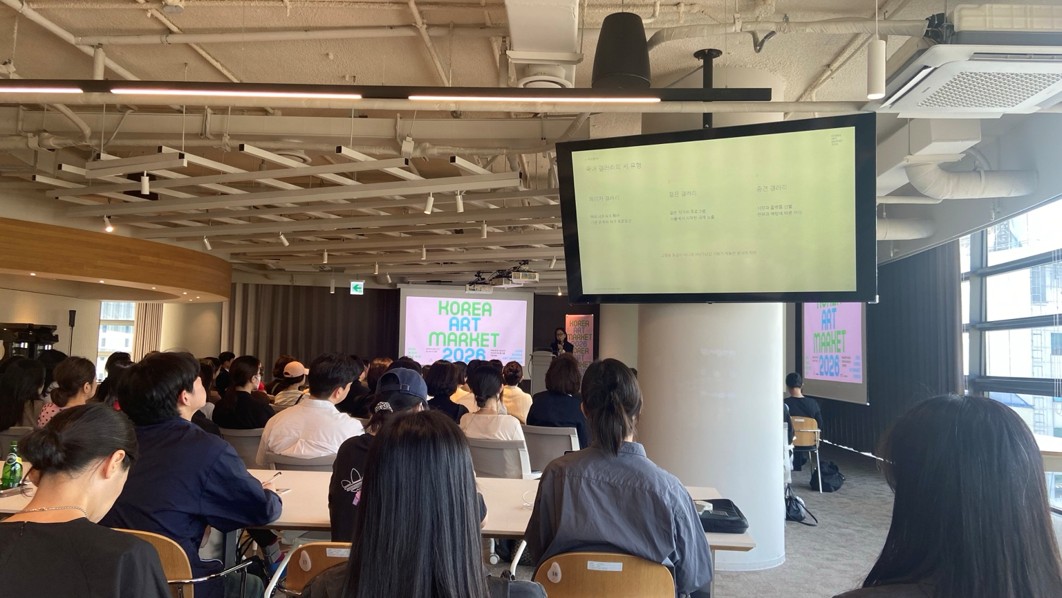
“Three Types of Galleries in Korea,” from Yeon-Hwa Joo’s presentation. Examples were organized into major, young, and mid-tier galleries.
Yeon-Hwa
Joo, a professor at Hongik University’s Graduate School of Culture and Arts
Management, described recent changes through major, young, and mid-tier
galleries; Korean galleries’ participation in overseas art fairs; international
galleries’ entry into Seoul; and increasing visits by international art
professionals. Each is worth examining. An analysis of the gallery sector also
needs to explain how these developments relate to one another and how they have
changed the market’s structure.
The
project already has a body of research to draw on. Joo’s 2024 gallery report
surveyed 17 galleries: five leading galleries, two international galleries with
operations in Korea, seven medium-sized galleries, and three galleries
established less than ten years earlier.
In 2025,
questionnaires were sent to 35 galleries, and 26 responses informed an analysis
of revenue, prices, transaction volumes, art-fair participation, cost
reductions, represented artists, and changes in buyer profiles. These
accumulated findings offered an opportunity to show movement within the market.
The
classification itself uses different criteria. “Young” primarily refers to
years in operation; “major” concerns scale and influence; and “mid-tier”
combines age, size, and recognition. Categories based on different variables
make it difficult to compare growth and decline across the three groups. Market
analysis requires common variables such as years in operation, revenue,
staffing, numbers of represented artists, average price levels, domestic and
overseas revenue shares, and dependence on art fairs.
The Role of Mid-Tier Galleries and the Missing
“Growth Ladder”
More
consequentially, the presentation did not sufficiently examine the functions of
the three categories or movement between them. If recently established
galleries such as Foundry Seoul and Whistle were presented as gaining
visibility through new programs and international networks, the conditions
facing mid-tier galleries and the factors producing these differences also
deserved attention.
While
emerging galleries can discover artists and develop experimental programs,
mid-tier galleries can provide continuity, support artists and programs over
time, and connect them with institutions, collectors, and overseas markets. If
this middle layer weakens and the sector polarizes between a few large
galleries and a continual influx of new ones, the infrastructure linking
artists’ development to distribution also comes under strain.
Does the
Korean market offer pathways for new galleries to expand their scale and
activities, or to sustain a distinctive specialization? Where these pathways
are blocked, what conditions create the obstacles?
Answering
this requires tracking five- and ten-year survival rates for new galleries,
revenue and cost structures among mid-tier galleries, artists’ transitions
between galleries, art-fair fees and overseas expansion costs, and the
development of client bases. Where data are unavailable, their absence can
itself be identified as a challenge for the Korean art market. A specialist
forum should be able to specify what needs to be researched and measured, even
when answers remain elusive.
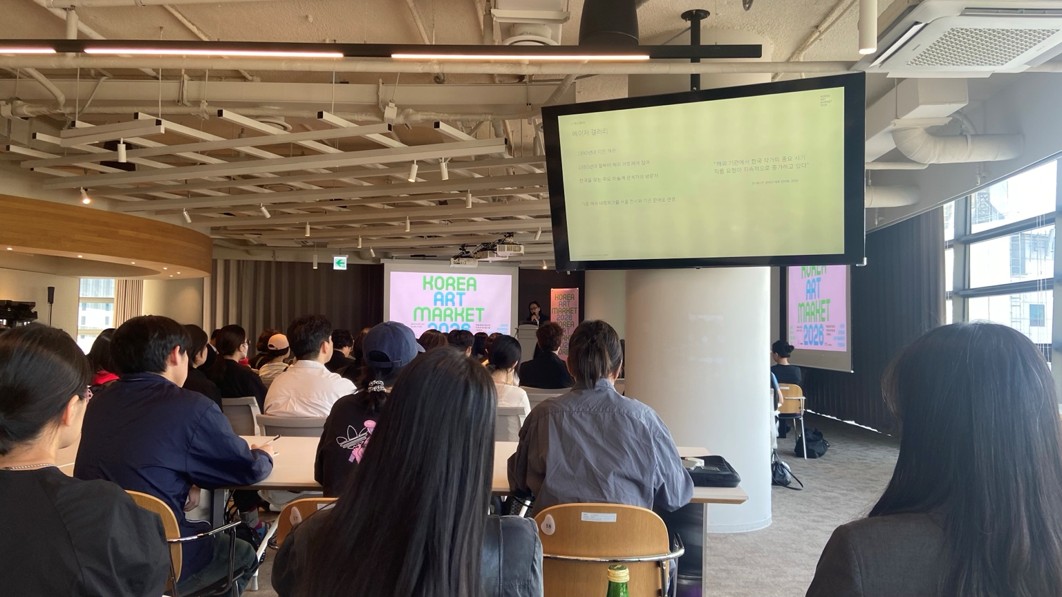
A presentation slide on the history and role of major galleries. Individual examples should be considered alongside market concentration and movement between tiers.
Market Entry Without an Analysis of Long-Term
Presence and Exit
If
international galleries’ entry into Seoul is presented as evidence of
internationalization, the analysis should also consider which galleries have
established lasting operations and which have withdrawn. Entry, establishment,
growth, and exit all need to be tracked to assess the sustainability of the
Seoul market.
An
international gallery opening a Seoul branch can indicate international
interest in the Korean market. Changes in the international competitiveness of
Korea’s gallery sector require separate evidence. When international galleries
withdraw, factors such as rent, client bases, sales volumes, and program costs
also warrant investigation.
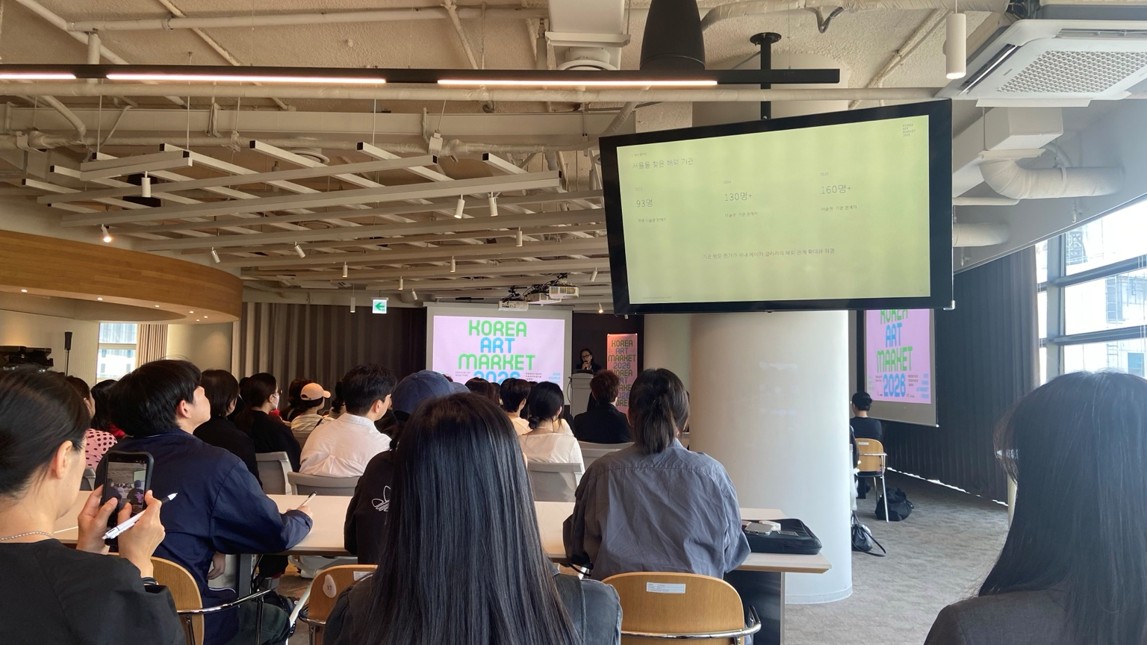
A slide showing an increase in international art professionals visiting Seoul. The next analytical step is to examine how these visits translated into transactions, acquisitions, and lasting networks.
Participation, Market Entry, and Two Different
Forms of Internationalization
Terminology
also needs precision when overseas art-fair participation by Korean galleries
is described as a history of expansion abroad. Participation in an overseas
event, entry into a foreign market, sustained overseas sales, and an
established presence supported by local clients and distribution networks are
distinct stages.
Frieze
Seoul, international megagalleries opening in the city, and visits by
international art professionals demonstrate stronger international connections
for Seoul as a marketplace. Whether Korean galleries have increased their
overseas sales and client bases, sustained participation in overseas fairs over
several years, or secured more overseas gallery representation and
institutional acquisitions for Korean artists requires separate measurement.
Joo’s
presentation did not provide a sufficiently developed framework for specialist
analysis of galleries and the art market. Several visible developments were
used to describe the past five years, but the scale and causes of those
changes, and their implications for the sector as a whole, remained
insufficiently explained.
2. Jang-Wook Lee — “From Events to an Ecosystem:
How Have Korea’s Art Fairs Changed Cities?”
Data Were Presented, but Analysis Stopped at the
Most Significant Findings
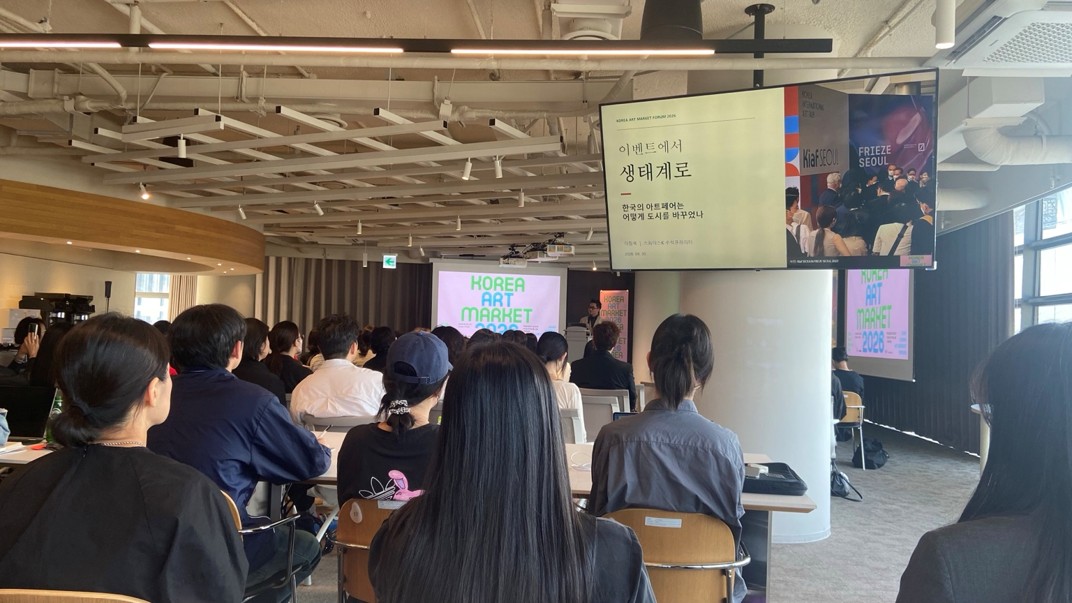
The opening slide of Jang-Wook Lee’s presentation, which considered art fairs in relation to cities and ecosystems.
Jang-Wook
Lee, senior curator at Space K, discussed how art fairs, particularly Frieze
Seoul, had changed the city’s cultural environment and visitor behavior. His
interpretation of Frieze as an accelerator of existing change, and his
consideration of art fairs at the ecosystem level, merit examination. However,
this hypothesis was not adequately supported by market analysis.
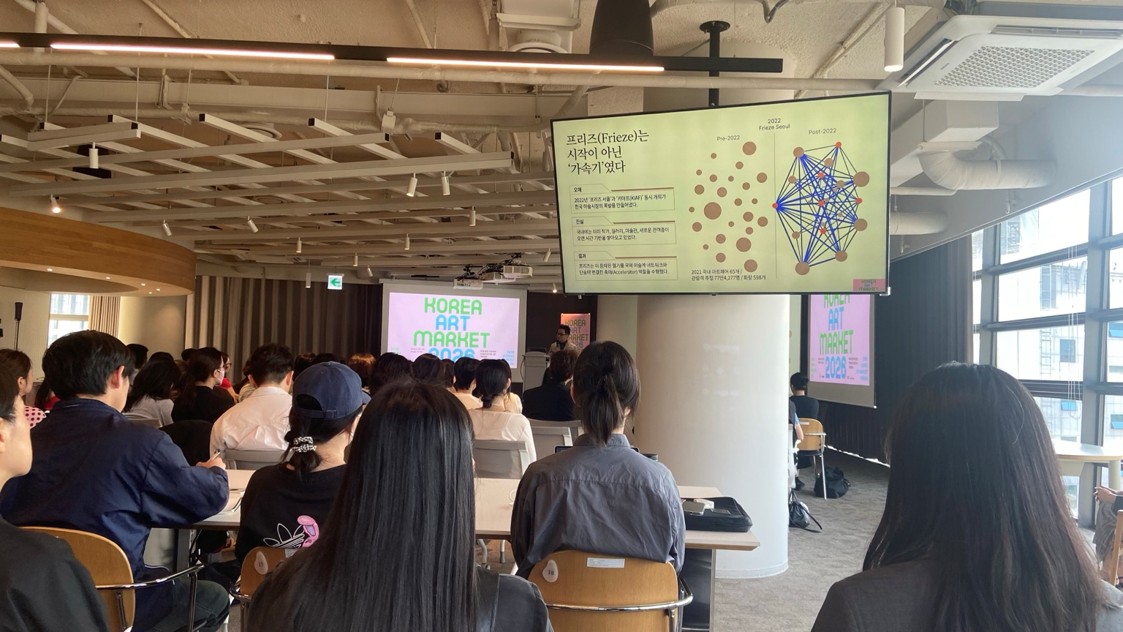
A network diagram of the period before and after Frieze Seoul’s launch in 2022. Empirical analysis requires definitions of the nodes and connections, together with an explanation of how they were measured.
The
network diagram, made up of points and lines representing the periods before
and after 2022, conveyed an intuitive image of change. To read it as analytical
evidence, however, viewers need to know which actors the nodes represent,
whether the connections indicate transactions, collaborations, or visits, and
the periods and sources from which the data were collected.
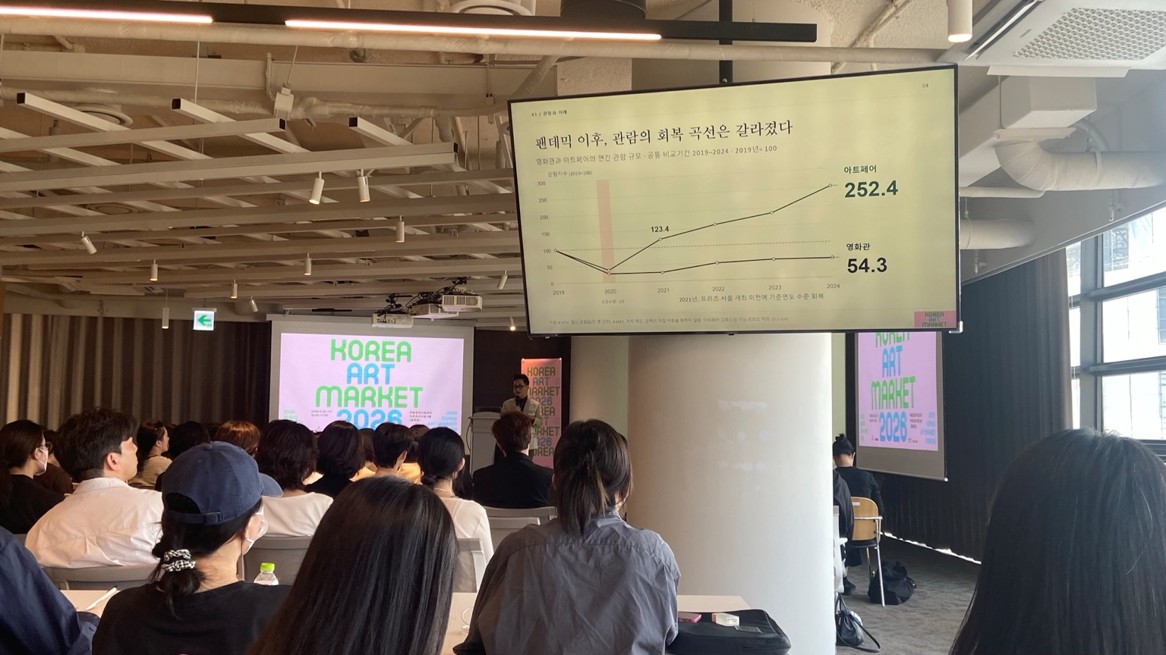
A slide comparing the post-pandemic recovery of attendance at art fairs and cinemas.
The chart
comparing attendance recovery at art fairs and cinemas can offer a starting
point for inquiry. Yet the two markets differ substantially in price, reasons
for attending, frequency of consumption, and supply structures. Differences in
recovery indices alone offer limited grounds for explaining structural growth
in the art market. The next questions should be why attendance recovered
quickly and whether those visits translated into purchases.
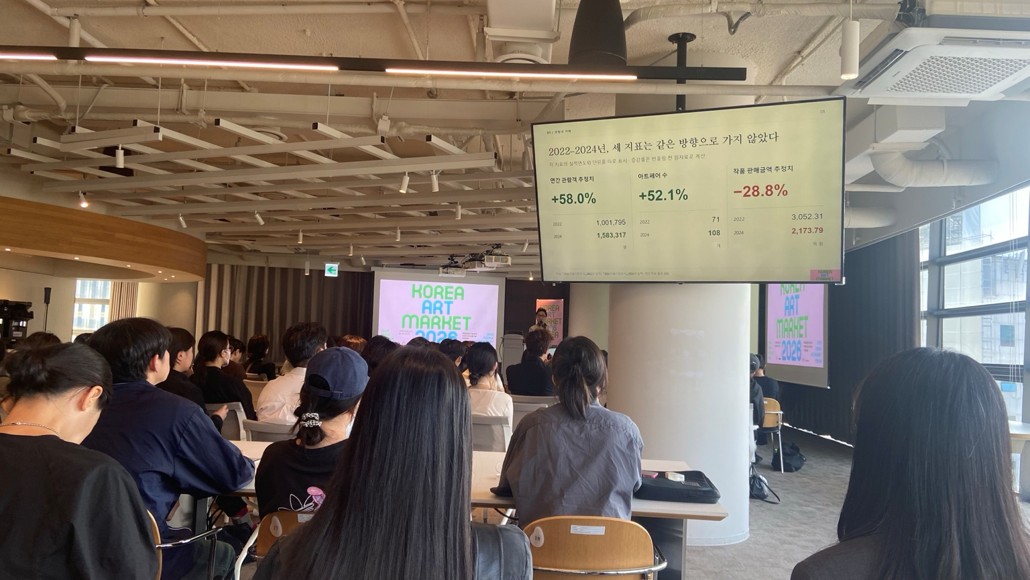
2022–2024: visitor attendance and the number of art fairs increased, while estimated artwork sales declined.
More Fairs and Visitors, but Lower Sales
The
presentation’s most significant figures showed rising attendance and event
numbers alongside declining sales.
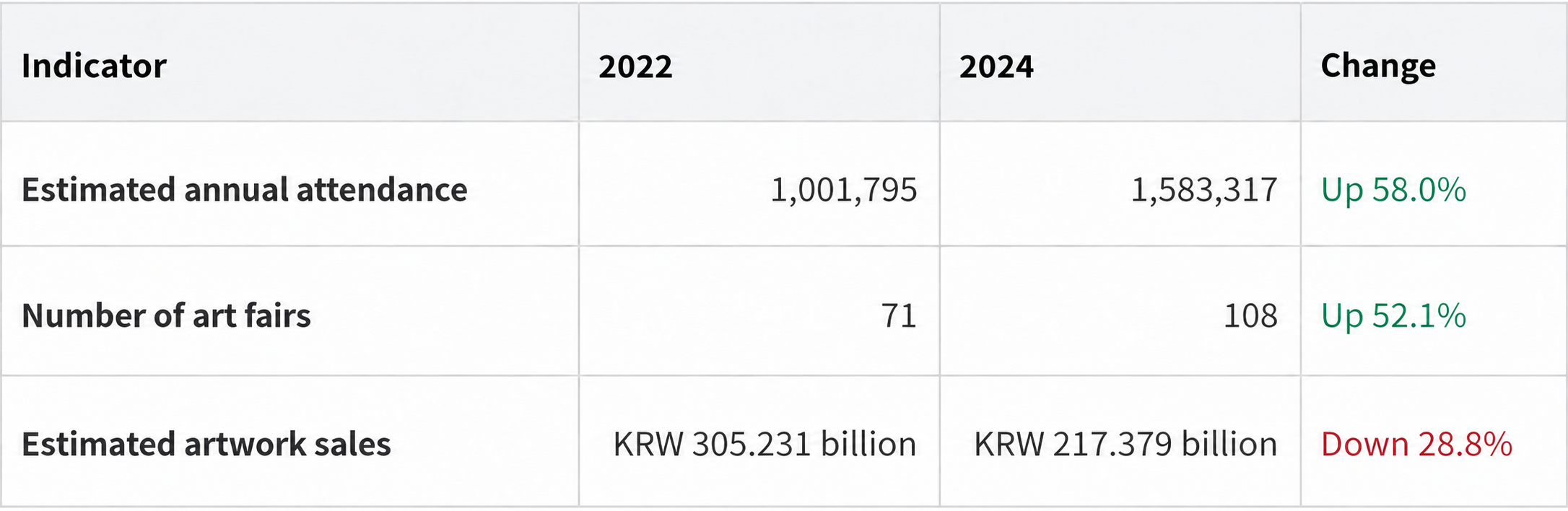
Figures are taken from presentation slides photographed by the author at the forum.
More
people attended more events, yet transaction value declined. How, then, did the
expansion of attendance and events over these years affect art sales?
This
discrepancy calls for investigation into oversupply, the high comparison base
created by the 2022 boom, interest rates and asset markets, purchasing power
concentrated in leading fairs and galleries, differences between new visitors
and actual buyers, and declining average transaction prices. Each is a
possibility to be tested.
The data
could have illuminated core features of Korea’s art-fair sector, but the
presentation moved toward a cultural and urban narrative without sufficiently
examining causes and consequences.
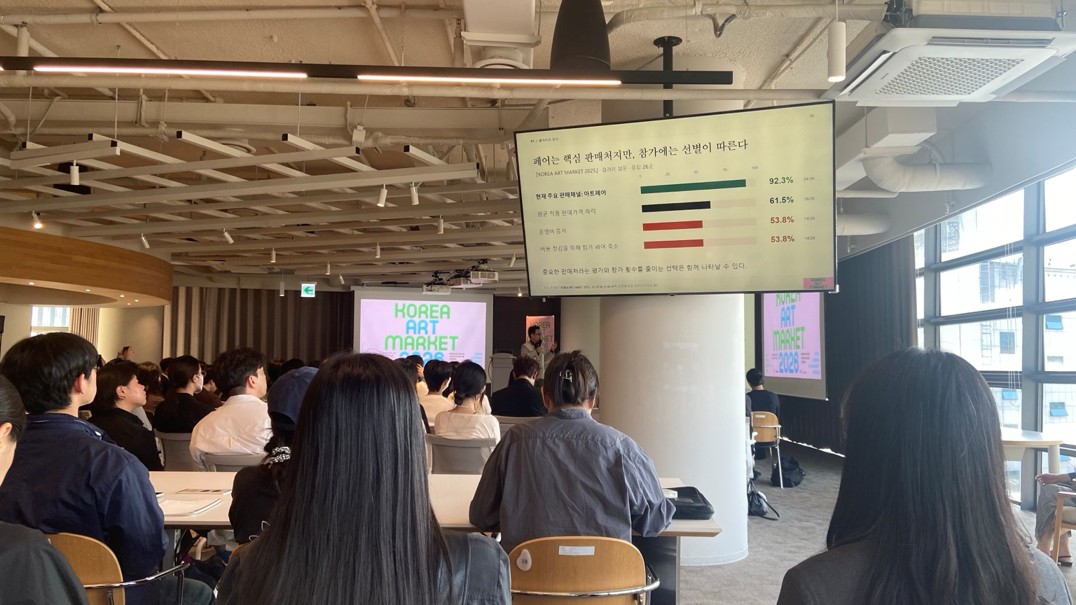
Gallery survey findings showing the importance of art fairs as a sales channel alongside declining sale prices and rising operating costs.
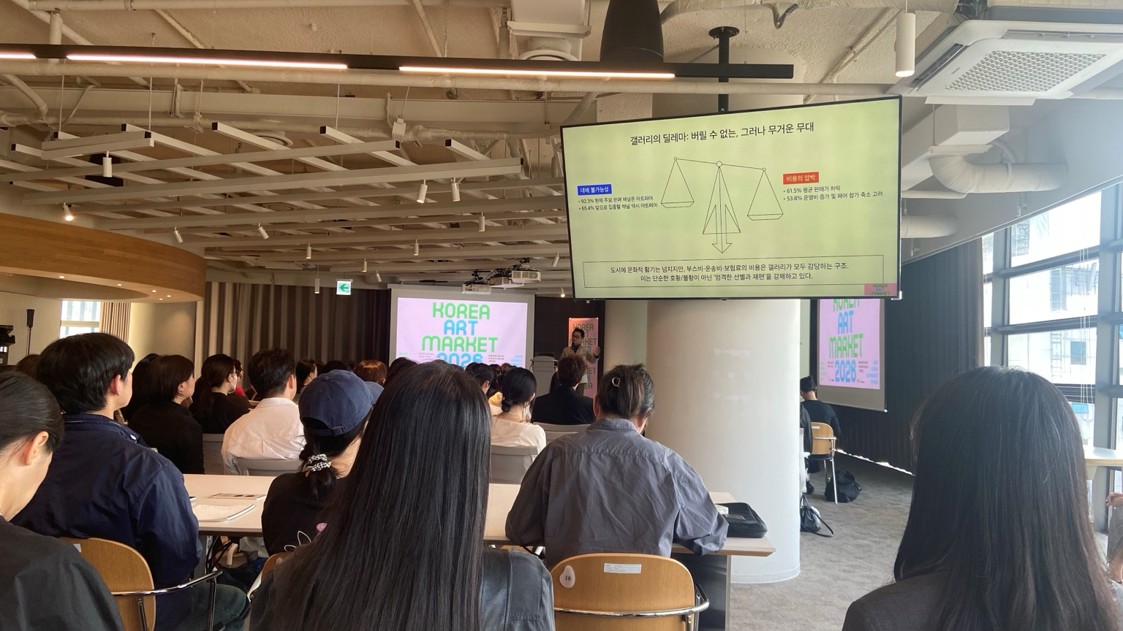
The presentation summarized galleries’ dilemma as “a stage they cannot give up, but one that weighs heavily on them.”
The
gallery survey also contained important structural signals. While 92.3% of
respondents identified art fairs as a major sales channel, 61.5% reported a
decline in average artwork sale prices and 53.8% reported increased operating
costs. If prices are falling and costs rising while galleries depend on fairs
for sales, the sustainability of that structure requires analysis.
Generalizing
a survey of leading galleries to the entire sector, however, requires scrutiny
of the sample’s composition and representativeness. These separate percentages
also do not establish that the same galleries experienced all three conditions.
Analysis
should compare sales and new-client acquisition with participation fees,
shipping, and staffing costs at individual fairs; differences in profit and
loss across major, mid-tier, and emerging galleries; and the relationship
between participation frequency and profitability. This would help establish
how much fairs contribute to galleries’ growth and earnings, and the extent of
their costs and competitive pressures.
Connecting Increased Attendance with Changes in
Transactions
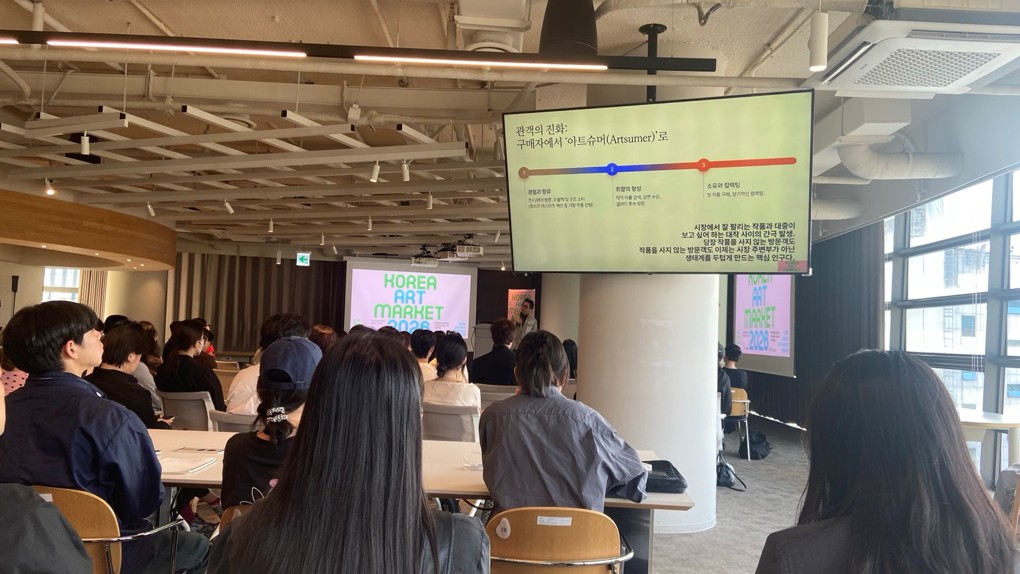
A slide describing a shift in visitors “from buyers to art consumers.”
The
visitor model described as “artsumers,” or art consumers, is also an
interesting hypothesis. Market analysis requires indicators such as
visitor-to-buyer conversion, repeat purchases after a first acquisition,
average spending per buyer, and purchase frequency. If attendance rises
substantially while sales decline, changes in art fairs’ cultural-event
functions and trading functions each need to be examined.
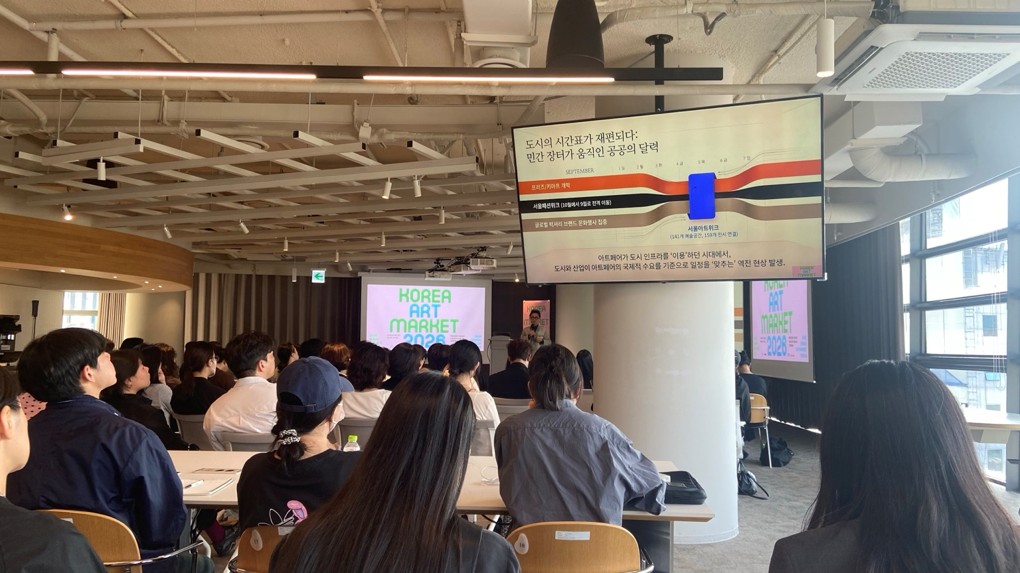
The concept of an “urban timetable,” linking art fairs with a city’s cultural calendar and industries.
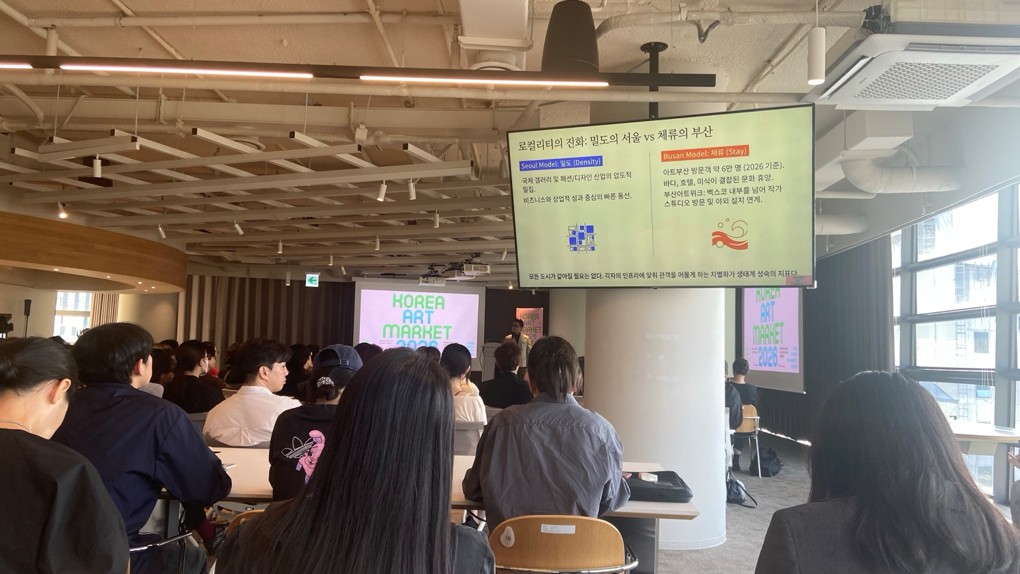
A locality model distinguishing Seoul through “Density” and Busan through “Stay.”
Concepts
such as Seoul’s “density” and Busan’s “stay” can be understood within
frameworks of urban culture and tourism. To explain them as art-market models
requires evidence on length of stay, the shares of visitors from other regions
and countries, purchase conversion rates, revenue accruing to local galleries
and artists, and the relationship between hotel and dining expenditure and
artwork transactions. Tourism effects and art sales need separate indicators,
followed by an examination of how the two connect.
The
presentation of significant figures is the starting point for market analysis.
Their causes, implications, and relationships with other indicators must then
be interpreted.
3. Moderator Ji-Hyun Lee — “A Conversation with
Young Artists”
Jinhee Kim, Omyo Cho, and Heejoon Lee: What Do
Their Cases Explain About the Wider Market?
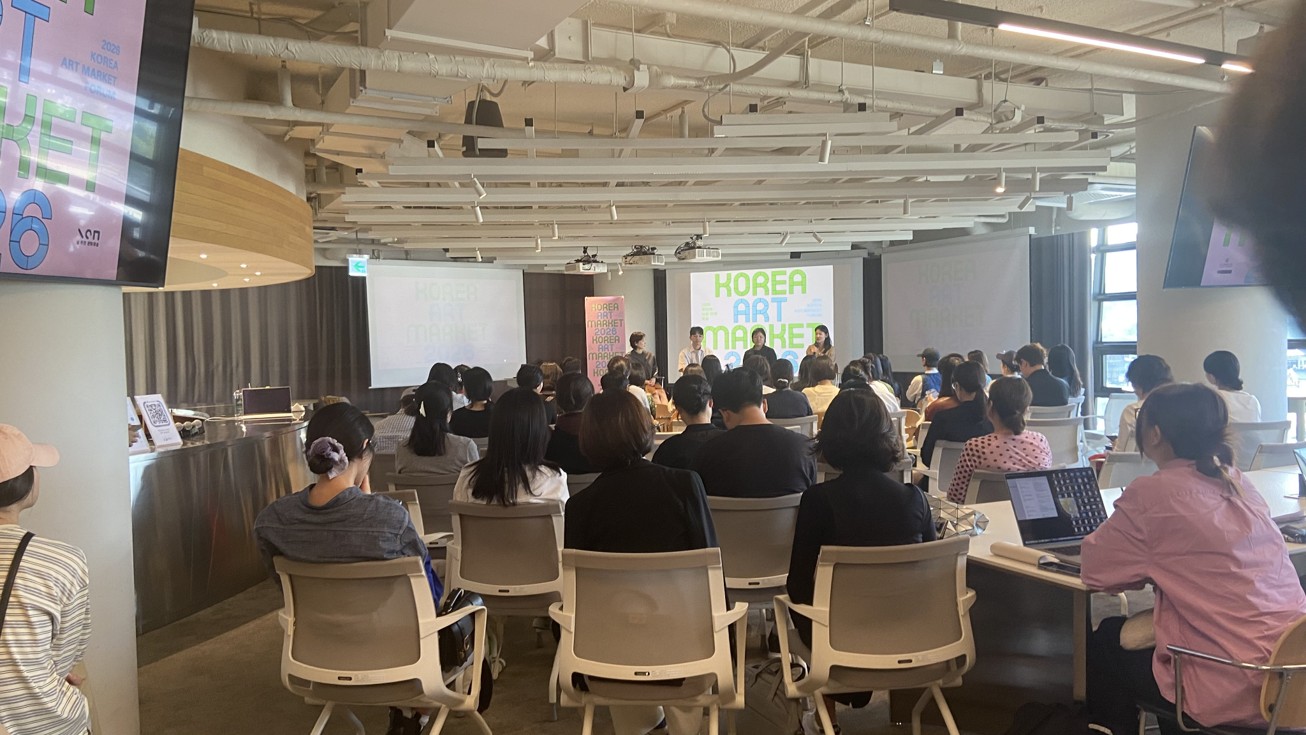
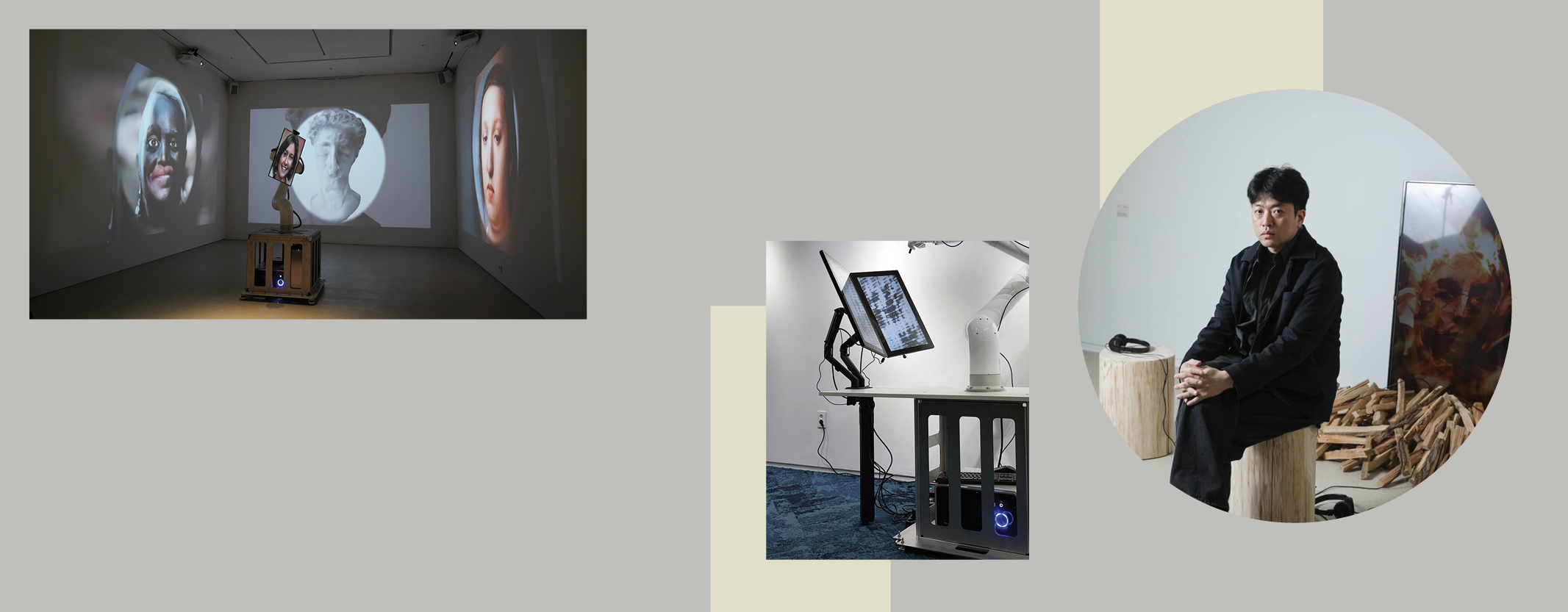
The final session, “A Conversation with Young Artists,” featuring Jinhee Kim, Omyo Cho, and Heejoon Lee, moderated by Ji-Hyun Lee.
In the
final session, moderated by Ji-Hyun Lee, co-CEO of ARTCULTURE4U, Jinhee Kim,
Omyo Cho, and Heejoon Lee discussed their work and professional experiences.
There is value in hearing directly from artists. Within a forum addressing
annual market trends and change over five years, however, the session needed to
explain why these three artists were selected and what structural changes in
the market their experiences illustrated.
Artists
are the market’s central producers. Relevant evidence would include the number
of young artists entering the market over five years, average price levels and
transaction volumes, gallery representation and changes in representation,
overseas sales and representation by overseas galleries, institutional
exhibitions and acquisitions, and continued professional activity after initial
market entry.
Situating
the three artists within this wider structure as examples of different pathways
would have made the session a qualitative case study. The indicators should
account for differences in medium and distribution, alongside working
conditions that sales figures alone cannot explain.
“Young
artist” also requires a definition: does it refer to age, years since debut, or
recent entry into the market? If the category means artists attracting
attention, the basis for that attention should be explained.
Connecting
the experiences of these three artists to market analysis requires selection
criteria and an explanation of the significance of their cases. The session did
not sufficiently establish what their practices revealed about conditions and
changes across the wider market for Korean artists.
4. What the Three Sessions Overlooked
The three
sessions addressed different subjects but shared a limitation. Galleries were
presented through categories and examples, art fairs through statistics and
cultural phenomena, and artists through three individual experiences. Analysis
connecting these elements within a single market structure remained
insufficient.
For
galleries, the key issues were the roles of different market tiers, growth and
stagnation, exit, revenue structures, and the results of internationalization.
For art fairs, they were the causes of falling sales, dependence on fairs and
profitability, and the relationship between event expansion and transaction
trends. For artists, selection criteria needed to be accompanied by an overview
of market entry, prices, representation, institutional acquisitions, and
continued professional activity.
Analyzing
the Korean art market means explaining who produces what, who distributes it,
who buys it, how prices are formed, and where capital and influence move. A
review of the past five years should show how this structure has changed over
time.
5. Korea Art Market Needs to Redesign Its
Analytical Framework
Those who
planned and organized the forum also bear responsibility for reviewing its
analytical standards. Why was this program, with this level of analysis,
presented under the name “Korea Art Market Forum”?
Since
2022, the project has stated its aim of explaining the Korean art market
objectively to readers abroad and contributing to the internationalization of
Korean visual art. By 2026, the forum should also have demonstrated how
accumulated cases and survey findings could be connected to standardized
longitudinal data and structural analysis. A report intended for global readers
needs definitions and methods that can be assessed by those outside the
domestic sector.
What is
needed is a shared system of definitions and classifications, time-series data
using consistent indicators, transparency about primary data and research
methods, and an analytical model connecting data across fields. Galleries, art
fairs, auctions, artists, and collectors should be linked through the
relationships underlying transactions and market movement.
For
galleries, measures of size, years in operation, revenue, represented artists,
price segments, overseas revenue, and survival rates should be standardized to
track movement between tiers and market concentration.
For art
fairs, attendance, transaction value, average prices, buyer conversion rates,
gallery profit and loss, new-client acquisition, and local economic effects
should be measured separately and their relationships analyzed.
For
artists, market entry, gallery representation, price changes, domestic and
overseas transactions, institutional exhibitions and acquisitions, and career
continuity should be tracked by cohorts defined by the timing of market entry.
For
internationalization, participation in overseas events, entry into foreign
markets, sustained sales, local networks and revenue, and acquisitions by
overseas institutions should be measured as distinct stages.
As the
Korean art market pursues internationalization, the methods used to study and
explain it also need to meet international professional standards.
The most
consequential question I took away from Korea Art Market Forum 2026 concerned
how accurately we understand this market through concepts, data, and analytical
methods. Raising the market’s standards begins with raising the standards by
which we examine it.
Jay Jongho Kim graduated from the Department of Art Theory at Hongik University and earned his master's degree in Art Planning from the same university. From 1996 to 2006, he worked as a curator at Gallery Seomi, planning director at CAIS Gallery, head of the curatorial research team at Art Center Nabi, director at Gallery Hyundai, and curator at Gana New York.
From 2008 to 2017, he served as the executive director of Doosan Gallery Seoul & New York and Doosan Residency New York, introducing Korean contemporary artists to the local scene in New York. After returning to Korea in 2017, he worked as an art consultant, conducting art education, collection consulting, and various art projects.
In 2021, he founded A Project Company and is currently running the platforms K-ARTNOW.COM and K-ARTIST.COM, which aim to promote Korean contemporary art on the global stage.