
Editor’s Note: This English edition includes additional contextual explanations for international readers who may be unfamiliar with Korean art-historical terminology and periodization.
A fundamental problem in Korean art history
remains insufficiently resolved: the criteria by which its historical periods
are distinguished.
When did Korea’s modern period in art
begin? What does hyeondae misul—the category
conventionally called “modern art” or “contemporary art” in Korean—actually
signify, and where does it begin? And from what point can we speak of Korean
contemporary art in the more specific art-historical sense of dongshidae
misul?
There is no shortage of scholarship
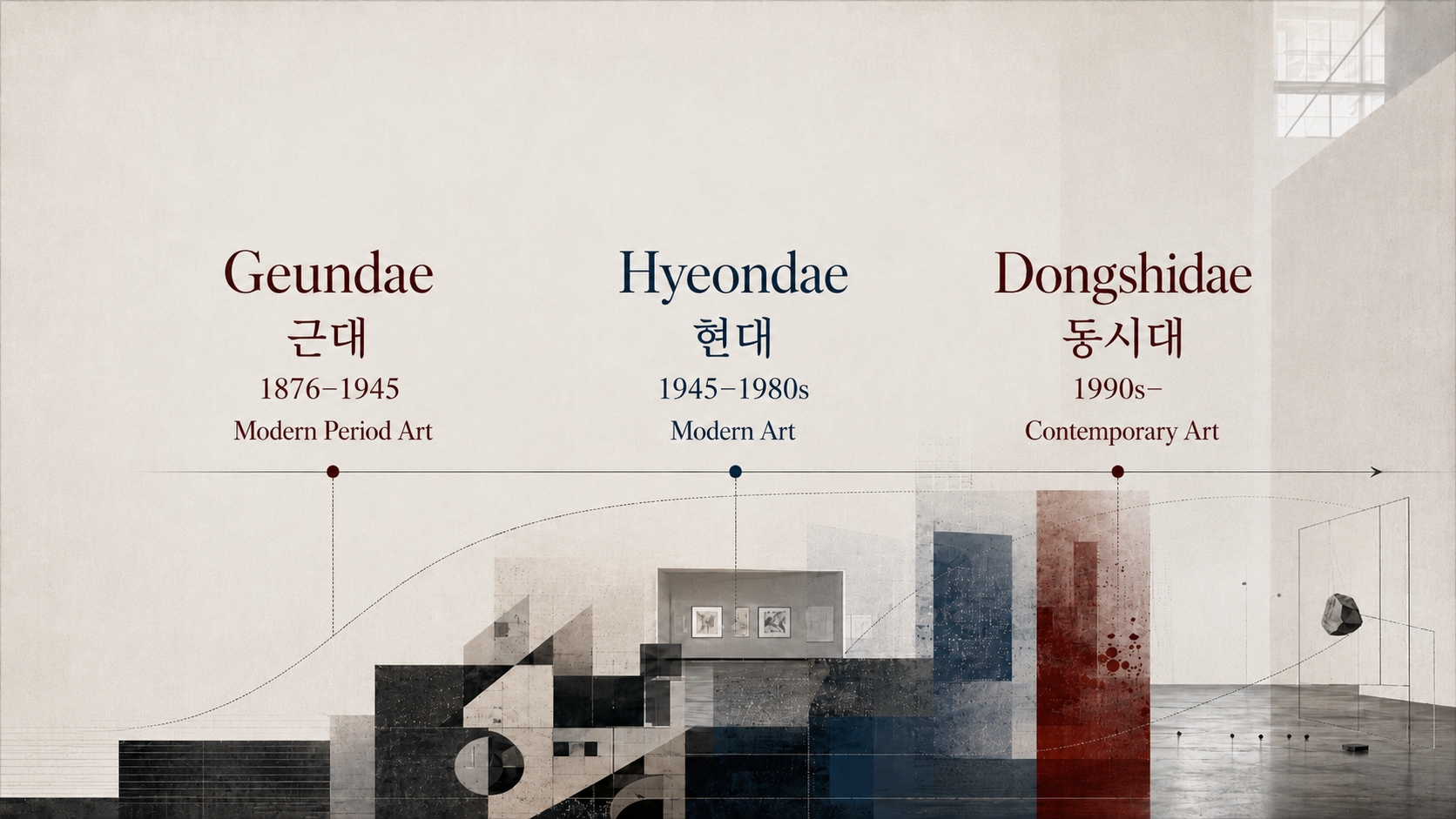
addressing each of these periods. Yet a coherent framework that connects geundae,
hyeondae, and dongshidae
within a continuous historical trajectory—and explains the character and
boundaries of each according to consistent criteria—has yet to be fully
established. Starting points vary among scholars, and the same term is often
used to designate different historical periods and conceptual categories.
This problem is not limited to deciding
where one chronological boundary should be drawn. Periodization provides a
historical framework through which transformations in artistic form, the
concept of art, institutional structures, and social conditions can be
explained. When terminology remains unclear, the nature of those
transformations also becomes difficult to articulate with precision.
Before discussing the beginning of Korean
contemporary art, it is therefore necessary to reconsider when the Korean
concepts of geundae, hyeondae,
and dongshidae were formed and how they have been
used.
The Translation of Modern Art as ‘Hyeondae
Misul’
According to currently available
scholarship, the use of the term hyeondae misul in
Korea can be traced back at least to the early 1920s.
The painter and critic Kim Chan-young used hyeondae
misul as a translation of “Modern Art,” a term he encountered
while studying in Japan. In a published dialogue between Kwon Haeng-ga and Kim
Youngna, the scholars explain that during the Japanese colonial period, the
English word “modern” was translated inconsistently through both geundae
and hyeondae. They specifically cite Kim’s
early-1920s use of hyeondae misul as a translation of
Modern Art.[1]
In journals such as Pyeheo,
Changjo, and Yeongdae, Kim
introduced and defended new Western artistic movements after Post-Impressionism
as questions of hyeondae misul. The Encyclopedia
of Korean Culture likewise describes him as one of Korea’s early modernists
and as an advocate of the new Western art that emerged after
Post-Impressionism.[2]
It is therefore reasonable to conclude that
hyeondae misul began to be used in Korea in the early
1920s as part of the process through which Western Modern Art was received and
translated.
It is important, however, to understand the
historical meaning of the word “modern” at that time.
The English adjective modern
still carries the general meanings of “new,” “up-to-date,” “of the present age,”
and “suited to contemporary conditions.” This was even more apparent in the
early twentieth century. For Kim Chan-young and his contemporaries,
Post-Impressionism, Cubism, and Futurism were not yet components of a completed
historical canon called Modern Art. They were among the newest and most radical
artistic developments of their own time.
Modern Art was therefore simultaneously a
modern historical formation and the newest art of the day.
In this context, Kim’s translation of
Modern Art as hyeondae misul was not inherently irrational or simply
mistaken. The term could naturally have been understood as “the art of the
present age,” “the new art of the time,” or “the latest art.”
The problem arose later, when this relative
expression of presentness became fixed as the name of a historical period.
A term that had initially referred to the
new art of a particular present gradually became an institutionalized category.
As time passed, the art that had once been “contemporary” in the ordinary
temporal sense became historical Modern Art. Yet the Korean term hyeondae
misul remained in use.
The distinction between geundae
and hyeondae as relatively separate historical
concepts became clearer only after Korea’s liberation from Japanese colonial
rule in 1945. Artists working after liberation sought to distinguish their
period from that of the preceding colonial generation.
From the 1950s onward, hyeondae
misul became widely used in contrast to geundae misul,
or the art of Korea’s modern period. This development was also influenced by
Japanese translation practices, and scholars have noted that these terms became
established without their conceptual implications having been fully
examined.[3]
In summary, hyeondae misul
was introduced in the early 1920s as a translation of Modern Art. After
liberation, particularly from the 1950s onward, it was generalized as the name
of a new period distinguished from colonial-era geundae misul.
The original translation need not be
condemned according to present-day standards. The more fundamental problem is
that the historical meaning of Modern Art changed, while the Korean
terminological system was not sufficiently reorganized.
Modern Art became an art-historical
category belonging to the past. Contemporary Art subsequently emerged as a
distinct category. Yet hyeondae misul continued to be
used for both.
When Both Modern Art and
Contemporary Art Become Hyeondae Misul
When hyeondae misul
first began to be used as a translation of Modern Art, the conceptual problem
confronting us today had not yet fully emerged.
At that time, Korea was primarily receiving
Western modernism and avant-garde movements after Impressionism. Contemporary
Art had not yet been established as an independent art-historical category in
the sense in which the term is used today.
During the latter half of the twentieth
century, however, the need to distinguish the art that came after modernism
from established Modern Art became increasingly apparent. With the rise of Pop
Art, Minimalism, Conceptual Art, performance, installation, video, and
multimedia practices, it became difficult to explain modernism and subsequent
artistic developments within a single historical category.
In English, a distinction gradually
developed between Modern Art and Contemporary Art.
This distinction does not mean that the
ordinary adjective modern ceased to signify something
new, current, or adapted to the present. It continues to carry those meanings
today. The crucial distinction is between the general adjective modern
and the institutionalized art-historical category Modern Art.
The phrase “modern design,” for example,
may still describe something contemporary, innovative, or suited to present
conditions. Modern Art, however, has become the proper name of a historical
field associated with the development of modernism.
The Korean term hyeondae misul
does not clearly register this distinction.
Books on modernism have been published as
histories of hyeondae misul, while books,
exhibitions, and institutions concerned with Contemporary Art have also been
described using the same term. A single Korean expression has consequently come
to denote two distinct English concepts.
The structure of the confusion can be
summarized as follows:
Modern Art = hyeondae misul
Contemporary Art = hyeondae misul
At the same time, when geundae
misul is translated into English, it is generally rendered as “modern
art” or “modern Korean art.”
This creates a second overlap:
Geundae misul = modern art
Hyeondae misul = modern art
Thus both geundae misul
and hyeondae misul can become “modern art” in
English, while both hyeondae misul and dongshidae
misul can become “contemporary art.”
This is not a minor problem of linguistic
duplication. It obscures the distinction between different historical periods
and different concepts of art.
If Modern Art refers to the historical art
formed through modernism, and Contemporary Art signifies the artistic
conditions that emerged after the limits or dissolution of modernism’s dominant
historical narrative, calling both hyeondae misul
inevitably blurs the art-historical transition between them.
In his 2018 essay “How Should ‘Contemporary
Art’ Be Translated?,” Kim Ki-soo begins from the premise that Modern Art and
Contemporary Art are conceptually distinct. He argues that their Korean
translations should be established within a coherent system that avoids
internal contradiction.[4]
Rather than declaring a single Korean term
to be the absolute answer, Kim emphasizes that the translation of Modern Art
must also be reconsidered in relation to whichever term is selected for
Contemporary Art.
His 2019 article, “The Problem of
Reestablishing the Periodization of Korean Modern and Contemporary Art,”
further proposes that the periodization of Korean art history should be
reassessed in light of international discourses on Contemporary Art that
developed through the 1960s and 1970s and became particularly prominent after
1989.[5]
The issue has therefore already been raised
within Korean scholarship. Yet changing a single translation cannot resolve the
entire problem. The historical criteria by which geundae,
hyeondae, and dongshidae
are distinguished must also be clarified.
A Translation Problem and a
Problem of Periodization
Two different questions are often combined
in this debate.
The first is a problem of translation.
How should Modern Art and Contemporary Art
be translated into Korean?
The second is a problem of Korean
art-historical periodization.
When did Korean geundae misul
begin and end? What defines hyeondae misul? When did
Korean dongshidae misul emerge?
Had Kim Chan-young translated Modern Art as
geundae misul rather than hyeondae misul, the later
terminological conflict might have been reduced.
The basic correspondence could have
developed as follows:
Modern Art = geundae misul
Contemporary Art = hyeondae misul or dongshidae
misul
This would have avoided at least one major
source of confusion: the use of hyeondae misul for
both Modern Art and Contemporary Art.
Alternatively, Kim might have used a more
explicitly relative expression such as “the new art of the present,” “the art
of the day,” or “the new art of the age.” Such a phrase might have remained a
description of artistic newness rather than becoming fixed as the permanent
name of a historical period.
Yet it would be historically reductive to
treat Kim’s choice as a simple mistranslation.
In the early 1920s, Modern Art was
genuinely the art of the present. The later distinction between an already
historicized Modern Art and a separate Contemporary Art had not yet been
established.
The decisive failure occurred not at the
moment of the original translation, but later, when the Korean art world did
not sufficiently revise its terminology in response to changes in art history.
Once Modern Art had become a historical
category and Contemporary Art had emerged as a distinct concept, the Korean
translation system should have been reconsidered.
Instead, hyeondae misul
continued to operate simultaneously as:
1. a translation of Modern Art;
2. a designation for post-liberation Korean
art;
3. a translation of Contemporary Art;
4. a general expression for art currently
being produced or exhibited.
The accumulation of these meanings
transformed a once understandable translation into a structural conceptual
problem.
The Unclear Boundaries of Geundae,
Hyeondae, and Dongshidae
The question of where Korea’s modern period
in art begins has long been debated.
The answer changes depending on whether the
decisive criterion is identified as the opening of Korea’s ports and the
introduction of Western culture, the formation of modern art education and
exhibition systems, the introduction of Western-style painting, or the
establishment of “art” as an autonomous institution. The evaluation of colonial
modernity is inseparable from this question.
The beginning of hyeondae misul
is also explained differently depending on whether the principal criterion is
liberation and the transformation of the state system, postwar abstraction
after the Korean War, Informel in the late 1950s, or the modernism and
Dansaekhwa of the 1970s.
The beginning of Korean contemporary art in
the more specific sense of dongshidae misul likewise
varies according to whether the crucial transition is located in the
experimental and conceptual practices of the 1970s, the postmodernism and
Minjung Art of the 1980s, or the globalization and biennial system of the
1990s.
It may therefore be methodologically
inverted to establish the beginning of Korean contemporary art first and then
simply position geundae and hyeondae
before it.
Unless the formation of geundae
and the character of hyeondae are properly defined,
it is impossible to explain precisely what contemporary art departed from,
transformed, or superseded.
What is required is not the declaration of
a single year as the definitive answer. Political transformations, the
formation of art institutions, changes in visual language, shifts in the
concept of art, and Korea’s relationship with the international art world must
be examined separately.
Only then can the dominant character of
each period be described.
Outdated Terminology and
Distorted Historical Perception
Terminology is more than a system of
labels. Scholarship thinks through concepts, and concepts are communicated and
accumulated through language.
When Modern Art and Contemporary Art are
both called hyeondae misul, the distinction between
the two becomes difficult to perceive. Modernism, postmodernism, and
contemporary art are subsumed under one category, while the distinction between
an art-historical period and an artist’s current activity is also blurred.
The confusion appears on three levels.
The first is a confusion of translation.
Different source-language concepts are rendered through a single Korean term.
The second is a confusion of periodization.
The historical boundary between Modern Art and Contemporary Art becomes
unclear.
The third is a confusion of classification.
Art belonging to an earlier historical period may be categorized as
contemporary merely because it continues to be exhibited or traded in the
present.
Outdated terminology produces conceptual
confusion, and conceptual confusion distorts historical perception. When
imprecise concepts are repeatedly reproduced through education, translation,
exhibitions, publishing, museums, and the art market, they solidify into
institutional convention.
This phenomenon may be described as
conceptual anachronism.
The problem is not simply that an old term
continues to exist. Nor is the problem that modern
still carries the ordinary meaning of something new, current, or suited to the
present.
The problem arises when a relative temporal
expression and a historical proper name are not distinguished.
The modern in “modern
technology” remains open to the present. Modern Art, however, has become an
established historical category.
The Korean term hyeondae misul
has been made to carry both meanings without consistently distinguishing
between them.
The term was initially capable of referring
to the new art of a particular present. It later became the fixed name of a
historical period. It was then reused for the art that followed that period.
A language that does not change even as the
historical structure it describes changes eventually produces anachronism.
Is Dansaekhwa Modern or
Contemporary?
Dansaekhwa offers a representative example
of this confusion.
Dansaekhwa emerged as a major tendency in
Korean art during the 1970s and has generally been studied within the context
of Korean modernism. Its emphasis on the flatness and materiality of painting,
repetitive physical action, the investigation of materials and supports, and
the minimization of representation connects it to central concerns of modernist
art.
This does not mean that Dansaekhwa should
be understood as a simple repetition of Western modernism.
It incorporates Korea’s material culture,
embodied modes of practice, conceptions of nature, and the specific conditions
of postwar society and art institutions. Nevertheless, there is no need to deny
that modernism constituted the primary art-historical framework within which
Dansaekhwa was formed and developed.
Despite this, international exhibitions,
galleries, art fairs, and art-market platforms frequently place Dansaekhwa
within the category of “Korean Contemporary Art” or “Contemporary Korean Art.”
In such cases, “contemporary” may function
less as a precise art-historical period designation than as an inclusive term
meaning “Korean art currently exhibited and traded within the international art
world.”
In exhibition and market classifications,
living artists, currently circulated works, postwar art, and contemporary art
may all be grouped within a single contemporary sector.
However, the practical classifications used
by exhibitions and markets should not be equated with art-historical
periodization.
Not every work becomes contemporary art
simply because it is exhibited today. Nor does the fact that an artist remained
active until recently mean that every phase of that artist’s work belongs to
the same art-historical period.
A single artist’s practice may contain a
modernist phase and subsequent transformations.
It is therefore necessary to distinguish
between “Korean art currently in circulation” and contemporary art as an
art-historical concept.
Dansaekhwa demonstrates that currentness
and contemporaneity are not necessarily synonymous.
Modernity, Modern Art, and
Contemporary Art
Part of the confusion results from the fact
that several related but distinct concepts are often treated as
interchangeable.
Modernity refers broadly to the social, historical, intellectual, and
cultural conditions associated with modernization: industrialization,
urbanization, new forms of subjectivity, secularization, capitalism, and
transformed experiences of time and space.
Modernism refers to the artistic, literary, architectural, and intellectual
movements that responded to or emerged from those conditions.
Modern Art is the art-historical category associated with the development of
modernism.
The adjective modern,
however, continues to function in ordinary language as a relative term meaning
new, current, progressive, or adapted to the present.
Contemporary Art does not simply mean any art produced at the same time as its
audience. It has also developed into an institutionalized and theoretical
category associated with the transformations that followed modernism,
Conceptual Art, postmodernism, globalization, and the pluralization of media
and artistic practices.
The difficulty in Korean arises because hyeondae
can carry the ordinary temporal sense of “present-day,” the historical sense of
“modern,” and the institutional meaning of “contemporary.”
Without distinguishing these layers, the
question “Is this modern or contemporary?” cannot be answered with precision.
Danto and Osborne: Different
Points of Departure
The differences among Western theories
concerning the beginning of contemporary art provide important clues for
understanding this issue.
Arthur Danto regarded Andy Warhol’s 1964 Brillo
Boxes as a symbolic event marking an art-historical transition. Once
artworks and ordinary objects could no longer be distinguished solely by their
outward appearance, the question of what constituted art shifted from visual
form to philosophical and conceptual interpretation.
Danto’s “end of art” does not signify the
cessation of artistic production. Rather, it refers to the end of the modernist
historical narrative in which one style overcomes its predecessor and advances
the progress of art. What follows is a pluralistic and “post-historical”
condition in which diverse styles and media coexist.[6]
Peter Osborne defines contemporary art as
post-conceptual art. From his perspective, the Conceptual Art of the late
1960s, represented by figures such as Sol LeWitt and Joseph Kosuth, decisively
dismantled the traditional identification of the artwork with a particular
medium. Conceptuality is a necessary but not sufficient condition of
contemporary art. An artwork includes both a conceptual dimension and its
material and aesthetic realization.[7]
At the same time, Osborne draws attention
to the global contemporaneity that emerged after 1989, as global capitalism,
transnational networks, and heterogeneous historical temporalities became
combined within a single present. For Osborne, therefore, 1989 is not so much
the initial art-historical rupture separating art before and after Conceptual
Art. It is closer to the historical condition under which post-conceptual art
became organized as a global system of contemporary art.
Kim Ki-soo’s research similarly explains
that the discourse of Contemporary Art developed through the 1960s and 1970s
and became publicly established, particularly after 1989, as an art-historical
discourse that displaced Modern Art.
It would be inappropriate, however, to
reduce the difference between Danto and Osborne to a choice between the 1960s–70s
and 1989.
Danto primarily explains an internal
historical and philosophical transformation within art.
Osborne builds on that transformation while
explaining both the mode of existence of post-conceptual art and the conditions
of global contemporaneity.
In the periodization of contemporary art,
transformations internal to art should be examined first. The subsequent
reorganization of already transformed artistic practices within globalized
institutions and networks can then be addressed at a second level.
The Problem of Establishing a
Single Theory as Orthodoxy
Lectures such as Cho Joo-yeon’s “Three
Concepts of Modern and Contemporary Art,” made publicly available by the
National Museum of Modern and Contemporary Art, Korea, are significant in that
they introduced distinctions among the modern, the postmodern, and the
contemporary within the field of public art education.
The museum’s lecture programs on
contemporary culture and art have similarly attempted to broaden the
understanding of modern and contemporary art by examining how changes in
artistic style are connected to history and society.[8]
However, the fact that a particular lecture
or publication presents Osborne’s theory of contemporaneity and the global
transition after 1989 as major criteria does not make them the only
authoritative account of contemporary art.
Osborne’s theory is an exceptionally
influential model for explaining global contemporary art after 1989. Yet
art-historical periodization must also consider Danto’s post-historical
pluralism, the transformation produced by Conceptual Art, the dismantling of
the traditional medium concept, postmodernism, and the distinct historical
transitions that occurred in non-Western regions.
Korean art history, in particular, contains
conditions that cannot be explained by directly applying Western dates.
Korea’s experimental art and Dansaekhwa of
the 1970s, Minjung Art and diverse figurative practices of the 1980s, and the
internationalization and biennial system of the 1990s each reflect different
art-historical, political, and social transformations.
The year 1989 may therefore serve as an
important reference point for interpreting Korean contemporary art, but it
cannot function as an absolute criterion explaining every transformation in
Korean art history.
New Criteria for Korean Art
History
The periodization of Korean art history
cannot be adequately explained by simply transferring Western chronologies or
applying the divisions of political history.
Any new system of periodization must
consider at least four levels.
First, it
must examine changes in the concept of art.
This means tracing the process through
which art moved beyond representation and traditional genres toward autonomous
form, conceptuality, action, installation, and multimedia practices.
Second, it
must consider changes in art institutions.
The formation and restructuring of art
education, exhibitions, museums, criticism, galleries, markets, and
international exchange must be examined.
Third, it
must analyze changes in artworks and visual languages.
It is necessary to identify the moments at
which established styles and aesthetics within Korean art were substantially
dismantled, transformed, or replaced by new artistic questions.
Fourth, it
must examine changes in world-historical conditions.
The effects of colonial rule and
liberation, war and national division, industrialization and democratization,
globalization, and digital transformation on the production and circulation of
art must all be considered.
When these criteria are applied, geundae,
hyeondae, and dongshidae
can be explained not merely as chronological segments divided by years, but as
historical phases structured by different artistic conditions.
Korean geundae misul
may be understood as the process through which Western concepts and
institutions of art, new models of artistic identity, and modern exhibition
culture were formed.
Korean hyeondae misul
may be described as the period in which postwar abstraction and modernism
brought the autonomy of art and formal and medium-related investigation to the
foreground.
This category, however, should not
automatically be translated as “modernist art,” because not every artistic
practice produced during the period belonged to modernism. Hyeondae
misul is partly an art-historical category and partly a Korean
historical designation for post-liberation art.
Korean dongshidae misul
may be understood as the process through which modernism’s singular historical
narrative was dismantled; conceptual, installation, video, performance, and
socially and politically engaged practices became pluralized; and Korean art
was subsequently connected to the global art system.
The precise starting points and detailed
criteria of each period require further examination.
What matters is the recognition that these
three terms do not designate the same concept and that consistent
art-historical criteria are required to explain the formation and transition of
each.
Toward a New Periodization
What the Korean art world must reconsider
is not merely whether contemporary art began in the 1970s or in 1989.
Before that question can be answered, geundae,
hyeondae, and dongshidae
must each be redefined in art-historical terms.
Without explaining the formation of geundae
misul, it is difficult to understand what hyeondae
misul inherited and what it sought to overcome.
Without clarifying the character of hyeondae
misul, it is impossible to explain which artistic paradigm Korean
contemporary art emerged after.
To discuss the post-contemporary or the
future of art without first defining the conditions of the contemporary would
merely add new terminology to a conceptual void.
The use of hyeondae misul
as a translation of Modern Art in the early 1920s was a product of the
historical conditions of the time.
At that moment, Modern Art was indeed the
newest art of the day. The adjective modern carried—and
continues to carry—the meanings of the new, the current, and the up-to-date.
There is therefore no need to judge Kim
Chan-young’s translation itself as an obvious error from a contemporary
perspective.
Had Modern Art been translated as geundae
misul, or described more provisionally as “the new art of the
present,” some of the later confusion might have been avoided.
Yet the decisive problem lies elsewhere.
Modern Art subsequently became a historical
category. Contemporary Art emerged as a distinct concept. Korea developed its
own division between geundae, hyeondae,
and dongshidae. Nevertheless, the terminology was not
systematically reorganized in response to these changes.
A relative expression meaning “the art of
the present” became fixed as the name of a historical period. The same
expression was then applied to the art that followed that period.
As a result:
Geundae misul and
hyeondae misul may both become “modern art” in
English.
At the same time:
Hyeondae misul
and dongshidae misul may both become “contemporary
art.”
This double overlap is the central
terminological problem in Korean art history.
The problem is therefore not simply that a
mistaken translation was made a century ago.
It is that a historically understandable
translation was never sufficiently revised after the conceptual structure of
art history had changed.
When the language used to explain an era
fails to change even as the era itself changes, historical understanding
remains confined within an inherited classificatory system.
This is the conceptual anachronism that the
Korean art world must reconsider today.
What Korean art history requires is not
merely the selection of a new translation.
It requires a reconsideration of geundae,
hyeondae, and dongshidae
within a continuous historical trajectory and the reconstruction of the
art-historical criteria by which each period is distinguished.
Accurately distinguishing historical
periods is not merely an exercise in organizing the past.
It is the necessary point of departure for
understanding the present correctly and discussing the future of Korean
contemporary art.
Notes
[1] Kwon Haeng-ga and Kim Youngna, “Examining
The Arts of Korea: From the Opening of the Ports to Liberation
through a Dialogue with the Author.” The dialogue explains that during the
Japanese colonial period, the English term “modern” was used interchangeably in
Korean as both geundae and hyeondae,
and that Kim Chan-young translated the “Modern Art” he encountered while
studying in Japan in the early 1920s as hyeondae misul.
[2] In the early 1920s, Kim Chan-young
introduced new Western artistic movements, including Post-Impressionism,
Cubism, and Futurism, through journals such as Pyeheo, Changjo,
and Yeongdae. See the entry “Kim Chan-young” in the Encyclopedia of
Korean Culture.
[3] According to the dialogue between Kwon
Haeng-ga and Kim Youngna, geundae and hyeondae
began to be more clearly distinguished as historical concepts only after
liberation. The widespread use of hyeondae misul
after the 1950s was influenced in part by terminology introduced through Japan.
[4] Kim Ki-soo examines possible Korean
translations of Contemporary Art and argues that the translations of
Contemporary Art and Modern Art must be established within a conceptually
coherent system that does not produce internal contradiction.
[5] Kim Ki-soo’s 2019 article raises the
need to reconsider the periodization of Korean modern and contemporary art in
light of the discourse of Contemporary Art.
[6] For Arthur Danto, the “end of art” does
not mean the disappearance of art itself. It signifies the end of the narrative
in which a single historical style monopolized the direction of art’s
development. Art after this point enters a pluralistic condition in which no
particular style possesses an inevitable historical superiority.
[7] Peter Osborne defines contemporary art
as post-conceptual art. Conceptuality is a necessary but not sufficient
condition of contemporary art, and the artwork encompasses both conceptuality
and its material and aesthetic realization.
[8] Cho Joo-yeon’s “Three Concepts of
Modern and Contemporary Art,” made publicly available by the National Museum of
Modern and Contemporary Art, Korea, is an example of distinctions among the
modern, the postmodern, and the contemporary being introduced within Korean
public art education. Rather than evaluating the lecturer’s theoretical
position as a whole, this essay examines the possibility that a particular
theoretical explanation may be simplified into an established orthodoxy.
References
Arthur C. Danto, After the End
of Art: Contemporary Art and the Pale of History, Princeton
University Press, 1997.
Peter Osborne, Anywhere or Not
at All: Philosophy of Contemporary Art, Verso, 2013.
Kim, Ki-soo. “How Should ‘Contemporary Art’
Be Translated?” Journal of the Association of Western Art History, no.
48, 2018, pp. 211–237. KCI.
Kim, Ki-soo. “The Problem of Reestablishing
the Periodization of Korean Modern and Contemporary Art: From the Perspective
of the Discourse of Contemporary Art.” Journal of Contemporary Art Studies,
vol. 23, no. 1, 2019, pp. 35–62. KCI.
Kwon, Haeng-ga, and Kim Youngna. “Examining
The Arts of Korea: From the Opening of the Ports to Liberation
through a Dialogue with the Author.” Journal of Korean Modern and
Contemporary Art History, no. 47, 2024, pp. 413–430. KCI.
Kim, Youngna. The Arts of
Korea: From the Opening of the Ports to Liberation. Workroom
Press, 2024.
Kim, Youngna. Korean Art after
1945. Mijinsa, 2020.
Kim, Chan-young. “On the Prospects of
Contemporary Art—‘Post-Impressionism’ and ‘Cubism’ as Expressed in Painting.” Changjo,
no. 8, 1921.
Lee, Seung-hyun. “How Should a New History
of Korean Modern and Contemporary Art Be Written?” Art History
Forum, no. 40, 2013, pp. 35–69.
Academy of Korean Studies. “Kim Chan-young.”
Encyclopedia
of Korean Culture.
John Rapko. “Anywhere or Not at All:
Philosophy of Contemporary Art.” Notre Dame Philosophical Reviews,
December 7, 2013.
National Museum of Modern and Contemporary
Art, Korea. “Three Concepts of Modern and Contemporary Art.” Lecture by Cho
Joo-yeon, Contemporary Culture and Art Lecture Series.
Jay Jongho Kim graduated from the Department of Art Theory at Hongik University and earned his master's degree in Art Planning from the same university. From 1996 to 2006, he worked as a curator at Gallery Seomi, planning director at CAIS Gallery, head of the curatorial research team at Art Center Nabi, director at Gallery Hyundai, and curator at Gana New York.
From 2008 to 2017, he served as the executive director of Doosan Gallery Seoul & New York and Doosan Residency New York, introducing Korean contemporary artists to the local scene in New York. After returning to Korea in 2017, he worked as an art consultant, conducting art education, collection consulting, and various art projects.
In 2021, he founded A Project Company and is currently running the platforms K-ARTNOW.COM and K-ARTIST.COM, which aim to promote Korean contemporary art on the global stage.