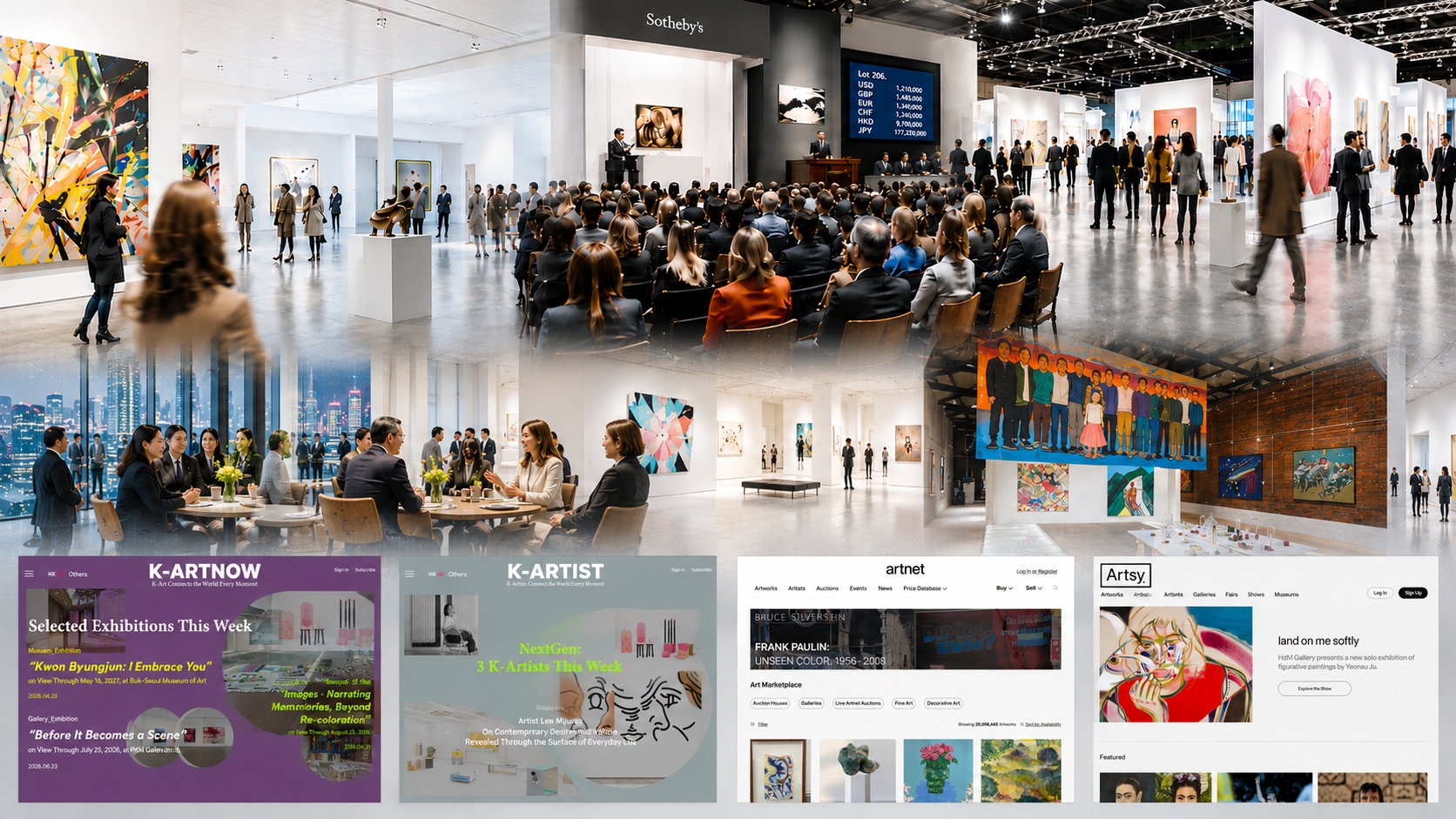

In contemporary
art, galleries, art fairs, and auctions are no longer merely channels of
distribution. They are the structures through which works enter the market,
gain visibility, acquire prices, and determine the position of artists.
Under the
conditions of the post-contemporary, the importance of these structures becomes
even more pronounced. When the meaning and value of a work can no longer be
secured by internal aesthetic criteria alone, the routes and networks through
which it circulates become conditions that define its position. In this sense,
distribution is no longer an external environment surrounding the work, but an
internal condition that helps organize its social meaning and market standing.
The problem is
that, in the current Korean art market, this structure is oriented less toward
discovering and accumulating new value than toward repeatedly reaffirming value
that has already been sanctioned and prices that are already legible. On the
surface, the market appears to be expanding. In reality, however, repeatable
visibility and repeatable transactions are operating far more powerfully.
Gallery
— A Subject of Accumulation or an Intermediary of Distribution?
Traditionally,
the gallery’s role has been to help artists gradually secure their place in the
market through sustained exhibitions, long-term relationships, and the
accumulation of critical language, while also coordinating and shaping that
process.
Yet in the
current Korean art market, many galleries are being reorganized less as
independent structures of distribution than as subordinate operating units
within art-fair-centered networks.
As a result,
rather than building sustained relationships with artists, they often function
more like intermediaries that repeatedly place artists who already generate
fast market responses across multiple platforms. In such cases, exhibitions no
longer serve as spaces that present an artist’s world in depth, but instead
begin to operate as preliminary showrooms for testing market response.
The Korean art
market remains structurally too thin for galleries to nurture artists over the
long term, and criticism and institutions likewise do not sufficiently support
that process of accumulation. This is not simply because individual galleries
lack strategy. What is needed is judgment about when, where, and how to expose
which artists, and how to design a balance between scarcity and accumulation.
What Korean galleries lack today is not activity itself, but editorial capacity
and the density of judgment required for long-term development.
Art
Fair — A Site of Activation or a Mechanism for Accelerating Repetition?
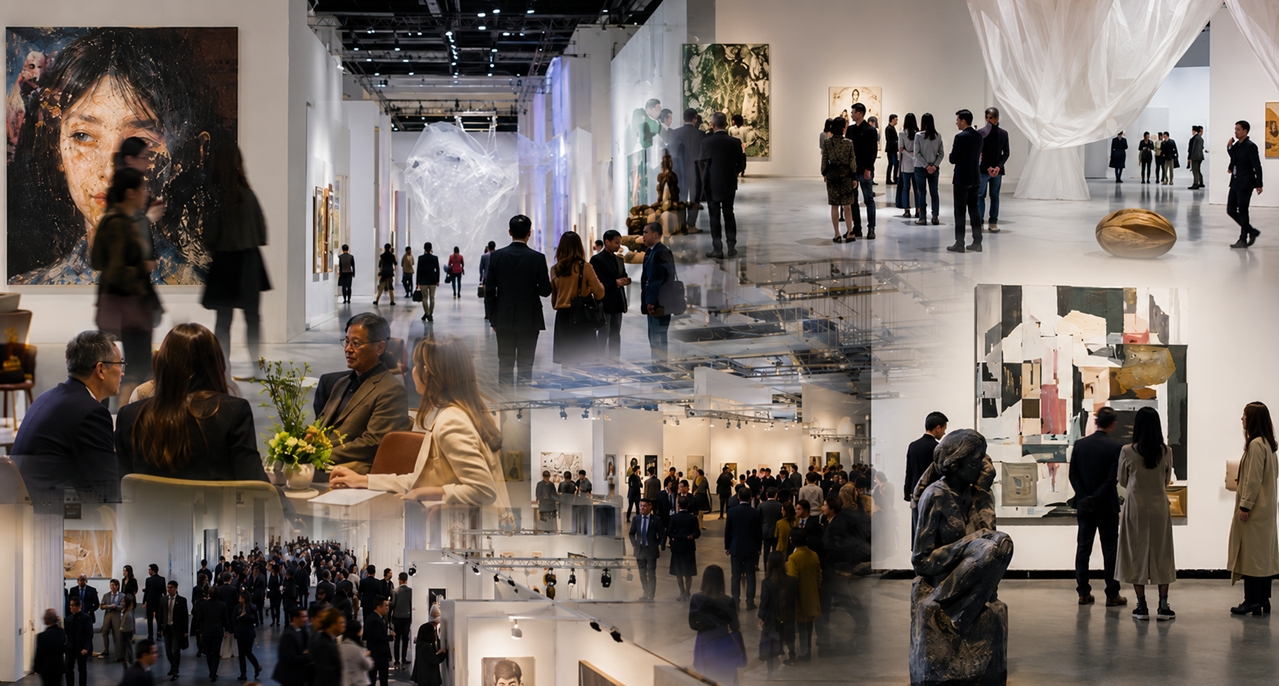
An art fair is a
device that gathers numerous galleries, artworks, and collectors into a single
space within a short period of time and concentrates transactions there.
Its logic is not
accumulation but compression. Rather than being read slowly through a long
process of formation, works are exposed intensively at specific moments in
order to generate market response. In that sense, art fairs clearly possess a
certain efficiency, particularly in enabling rapid contact, transactions, and
international networking.
However, the
growth of art fairs in the Korean art market does not necessarily indicate
qualitative maturity. Many of the art fairs currently taking place in Korea
appear lively on the surface, but internally they often repeat similar
galleries, similar artists, similar price ranges, and similar modes of
consumption. This suggests not so much that the market is broadening, but that
a limited pool of artists and collectors is being repeatedly circulated across
multiple platforms.
When a single
gallery participates in numerous fairs throughout the year, and the same artist’s
works appear in multiple venues within a short period, visibility may increase
in the short term. In the long run, however, such repetition weakens price
stability and scarcity while blurring the artist’s distinctiveness.
A high frequency
of exposure cannot in itself be called meaningful accumulation. Repetitive
exposure without strategy risks rapidly exhausting the artist.
The issue with
art fairs, then, is not how many are held, but what kinds of artists are
presented within them, in what contexts, and how those presentations are linked
to the long-term formation of an artist’s market through growth.
If Korean art
fairs are to contribute to the qualitative maturation of the market, they must
move beyond the repetitive circulation of participating galleries and artists
and begin to construct differentiated contexts and structures for long-term
relationship-building.
Auction
— Not the Discovery of New Value, but the Fixing of Price
This structure
becomes even clearer in the secondary market of auctions. Every major auction
season in Seoul gives rise to a similar question: why do the same artists
continue to appear in Korea’s major auctions? This is not simply a matter of
conservative selection. Rather, it is the result of the operating logic of the
auction system combined with the structural limitations of the Korean art
market.
An auction is not
a platform for discovering new artists. If the gallery, as the primary market,
discovers the artist and constructs a narrative around them, the auction, as
the secondary market, confirms and fixes that result in the form of price.
What matters here
is not the work’s potential or experimental quality, but whether there already
exists a price and transaction history that can be explained. In other words,
the auction is not a space for testing artistic possibility, but a mechanism
that operates according to price stability and transactional predictability.
Accordingly, the
artists who repeatedly appear at auction are selected not simply because they
are famous, but because they are figures for whom sufficient price data has
already accumulated. Once an artist has been traded at auction, the conditions
are in place for that artist to be traded again, and through repetition, prices
become more stable. By contrast, an artist without sufficient transaction
history enters the auction carrying uncertainty from the outset.
That uncertainty
is immediately translated into risk, and within the auction system, risk
becomes something to be avoided. As a result, auctions operate not by
incorporating new artists, but by repeatedly calling back those who have
already been validated.
There is also a
specifically Korean vulnerability at work here. The secondary market lacks
sufficient depth, the range of artists circulating within it remains limited,
and the path through which artists who have grown within the gallery system
move into a broader auction market is not sufficiently structured.
In a situation
where institutions and criticism remain weak, price data functions far more
powerfully than external discourse in explaining and legitimizing the value of
a work. This produces a cycle in which only those artists whose prices have
already been formed are repeatedly summoned, and through that repetition those
prices are strengthened once again.
The problem is
that this is not merely a matter of conservatism. It indicates that the market
has failed to adequately perform the function of evaluating and absorbing new
value, and has instead come to rely on already agreed-upon prices as a
substitute for judgment.
In other words,
the repeated appearance of the same artists in Korea’s major auctions is not
simply the result of popularity, but the result of a structure that has
transferred responsibility for judging artistic value to the price system. If
this continues, the auction risks becoming not a mechanism for confirming
market confidence, but one for reproducing market stagnation.
The
Problem Lies Not in Individual Channels, but in the Structure as a Whole
Ultimately,
galleries, art fairs, and auctions are not separate channels, but parts of a
single continuous structure. Galleries discover artists, art fairs expose those
artists intensively within compressed periods of time, and auctions confirm the
result in the form of price data.
The problem is
that this overall structure is tilted less toward judging and absorbing new
value in ways that might expand the market, and more toward repeatedly
confirming value that has already been formed.
As repetitive
transactions intensify across both the primary and secondary markets, the
market as a whole becomes more accustomed to circulating already legible prices
and already recognizable artist groups than to structurally incorporating new
artists.
This is not
simply a problem of overexposure affecting a few artists. It is a fundamental
problem concerning the very way value is formed in the Korean art market.
Institutional
systems of validation remain limited, criticism does not sustain sufficient
tension with the market, and distribution actors themselves are easily drawn
toward short-term response rather than long-term accumulation. As a result,
price and frequency of exposure operate far more quickly and forcefully than
the language that explains the meaning and position of the work.
The market
therefore reads price rather than works, and follows already formed responses
rather than making judgments about artists. This is better understood not
simply as conservatism, but as the weakening of judgment itself — more
precisely, as a suspension of judgment.
It is precisely
at this point that the conditions of the post-contemporary connect directly to
the future of Korean contemporary art. The real issue is not whether more
artists advance abroad, or whether more fairs and auctions are held. More
fundamentally, it is whether the Korean art market can develop a structure
capable of judging and accumulating new value on its own.
If repeatable
visibility and repeatable prices continue to function as the market’s central
principle, then Korean contemporary art, despite its outward vitality, will
inevitably become thinner internally.
If, however, it
can move beyond this structure and create a system capable of sustaining new
artists, new languages, and new forms of judgment, then Korean contemporary art
may finally move beyond quantitative growth toward a stage of qualitative
maturity.
What
Is Needed Now Is Not Expansion, but Redesign
What is needed
now is not more platforms or more participation, but a redesign of the
structure itself.
Galleries must
move beyond simply increasing an artist’s exposure and become agents capable of
shaping the timing and context of visibility, as well as the balance between
scarcity and accumulation. Art fairs must move beyond functioning merely as
platforms for short-term transactions and demonstrate what kinds of
relationships and what forms of market trust they can build over the long term.
Auctions, too,
must move beyond merely repeating already established prices and be discussed
in relation to how the market’s layers might be thickened so that a broader
range of artists can enter the secondary market.
At the same time,
institutions and criticism must also take on a more active role. Unless they
strengthen their capacity to explain the meaning of new artists and new works
in a language prior to price, and to socially legitimize values the market has
not yet absorbed, the Korean art market will likely remain trapped in a
structure that keeps repeating familiar artists and familiar prices.
The fundamental
problem of the Korean art market today is this: circulation is abundant, but
accumulation is weak; response is fast, but judgment remains shallow.
Ultimately, the future of Korean contemporary art depends not on how widely it
circulates, but on whether it can build structures capable of judging and
accumulating new value.
Jay Jongho Kim graduated from the Department of Art Theory at Hongik University and earned his master's degree in Art Planning from the same university. From 1996 to 2006, he worked as a curator at Gallery Seomi, planning director at CAIS Gallery, head of the curatorial research team at Art Center Nabi, director at Gallery Hyundai, and curator at Gana New York. From 2008 to 2017, he served as the executive director of Doosan Gallery Seoul & New York and Doosan Residency New York, introducing Korean contemporary artists to the local scene in New York. After returning to Korea in 2017, he worked as an art consultant, conducting art education, collection consulting, and various art projects. In 2021, he founded A Project Company and is currently running the platforms K-ARTNOW.COM and K-ARTIST.COM, which aim to promote Korean contemporary art on the global stage.