
The previous two essays examined the
anachronism of Korean contemporary art. The first identified the problem of
explaining the present through the languages of the past. The second examined
the structure through which past models of success continue to be repeated as
strategies for the future.
The question must now move to the next
stage. What new conditions should Korean contemporary art design?
Korean art has already entered the
international field. Overseas exhibitions have increased, participation in
international art fairs has become more frequent, and encounters with Korean
artists in overseas museums and biennials are no longer exceptional events.
Institutions have expanded, the market has grown, and global interest in Korean
culture has intensified. Yet these changes do not automatically mean that
Korean contemporary art has become globalized.
Recent changes in the global art world make
this issue even clearer. Pace Gallery’s significant reduction of its artist
roster and staff, along with adjustments to its spatial operations, shows that
the mega-gallery model can no longer function in the same way it once did. The
integrated restructuring of Artnet and Artsy likewise reveals that the
structures of information, data, distribution, and platforms in the art market
are being rapidly reorganized.
These are not merely changes within individual
companies. They are signs that the global art world has entered a phase in
which the structures of exhibitions, markets, platforms, data, and trust must
be redesigned.
If the age of internationalization was an
age of movement and contact, the age of globalization is an age of
interpretation and structure. The question Korean art must now ask is no longer
only “how to go abroad.” The more important questions are “how it will be read
after arriving abroad,” “through what languages and records it will be
accumulated,” and “through what institutions and platforms it will remain
continuously accessible.”
Under the post-contemporary condition, the
future of Korean contemporary art will not be made through more exhibitions,
more overseas expansion, or more promotion alone. What is needed is the design
of new conditions for the future. Those conditions emerge only when critical
language, archives, data, translation, research, institutions, platforms, and
market trust are connected into a single structure.
Reconstructing Critical
Language
The first condition Korean contemporary art
needs in order to secure a sustainable position within the global art world is
the reconstruction of critical language. There are already strong artists.
There are important exhibitions and works that deserve attention. But good work
does not automatically generate good language. For a work to be read within the
global art world, it needs a language that can explain, interpret, and position
it.
Many texts that explain Korean art have
remained at the level of exhibition introductions, artist biographies, press
releases, or impressionistic commentary. These forms of writing are, of course,
necessary. But they are not sufficient. It is necessary to explain what
questions an artist begins from, what formal structures organize the work, what
art-historical genealogies it connects to, and what social, philosophical, or
technological conditions it engages.
Criticism is not simply the act of
evaluating artworks. Criticism structures the questions posed by a work and
positions an artist’s practice within the contexts of art history, contemporary
society, media, institutions, perception, and sensibility. Criticism is not a
promotional language for artists. It is an intellectual infrastructure that
allows artists to be read within the global art world.
What Korean contemporary art needs for its
future is not more adjectives. It does not need more descriptions such as “sensuous,”
“lyrical,” “material,” or “original.” What is needed is a precise language
capable of reading an artist’s practice within the complex structures of
concept, form, history, medium, society, technology, and institution.
Globalization is not a matter of
translation alone, but a matter of interpretation. Translating a Korean text
into English is not enough. What is needed is critical translation that can
reconfigure the practice of Korean artists so that it can be read within the
conceptual systems of global art. In this sense, translation is not merely the
movement of language, but the reconstruction of meaning.
Standardizing Artist Archives
and Artwork Data
The second condition is the standardization
of artist archives and artwork data. Art belongs to the realm of perception and
experience, but the global circulation and study of contemporary art
increasingly operate on structures of materials and data. Curators,
researchers, collectors, galleries, museums, and the media confirm and assess
artists through exhibition histories, artwork images, work information,
critical materials, collection records, interviews, catalogues, and video
documentation.
Yet in the Korean art world, artist
materials and artwork data remain insufficiently systematized. Many artists’
materials are dispersed across personal computers, gallery press releases,
scattered articles, exhibition catalogues, and old image files. The ways in
which artwork information is recorded are also often inconsistent. Titles,
production years, materials, dimensions, editions, installation formats,
collection information, exhibition histories, and image copyright details are
frequently not standardized.
This is not merely an administrative issue.
If materials are not organized, artists are difficult to study. If artwork data
is not standardized, market trust weakens. If exhibition records are not
accumulated, it becomes difficult to establish an art-historical position. If
images and texts are not managed over the long term, it becomes difficult for
the global art world to access an artist’s practice.
An artist archive is not simply a
portfolio. It is a knowledge structure for understanding an artist’s world over
time. Artwork data is not simply a list. It is the basic unit through which an
artist’s value is recorded, verified, and accumulated. Under the
post-contemporary condition, an artist’s presence does not exist only in the
exhibition space. Artists also exist through the ways they are searched,
recorded, compared, studied, and datafied.
For Korean contemporary art to be read
continuously within the global art world, the standardization of artist
archives and artwork data is essential. This is not a task for individual
artists alone, but an infrastructural task for the entire art ecosystem.
Artists, galleries, museums, archival institutions, and platforms must build
this basic condition for the future together.
Sustained Production of English
Criticism and Artist Monographs
The third condition is the sustained
production of English criticism and artist monographs. One of the greatest
deficiencies when Korean artists are introduced abroad is the lack of reliable
English-language materials. Exhibition statements may exist. Brief artist
biographies may exist. Yet English criticism, artist monographs, interviews,
and research materials that explain an artist’s practice in depth remain
insufficient.
In the global art world, artists are not
understood through images alone. Works may first be encountered visually, but
for those works to be continuously studied, exhibited, and collected, language
is necessary. In particular, if Korean artists are to secure specific positions
within the global art world, English-language texts explaining their practices
must be produced continuously.
What matters here is not one-off
translation. Translating a press release into English whenever an exhibition
takes place is not enough. What is needed are artist monographs that organize
early works, major turning points, representative works, experiments with
media, art-historical contexts, and contemporary significance over time.
Critical texts that explain an artist’s entire practice beyond individual
exhibitions must also be accumulated.
English criticism is not an additional
service for overseas readers. It is a basic language through which Korean
contemporary art can operate within the global art world. Even if an artist
participates in an overseas exhibition, the work will be difficult to read
fully without English criticism that explains it. Conversely, when accurate
English texts on an artist’s practice are accumulated, the possibilities of
research, curating, institutional collection, and market trust after the
exhibition are significantly strengthened.
The globalization of Korean art depends not
on the quantity of English information, but on the quality of English
interpretation. What is needed is not simply English-language introduction, but
a critical language that allows the work of Korean artists to be read within
the concepts and histories of global art. Only when this language is produced
continuously can Korean contemporary art move beyond temporary exposure and
secure a long-term position.
Records and Research Systems
After Exhibitions
The fourth condition is a system of records
and research after exhibitions. Exhibitions are central scenes of contemporary
art. Yet exhibitions disappear the moment they end. What remains is the record.
Only when that record leads to research does an exhibition become an
art-historical event.
The Korean art world has produced many
exhibitions. However, records and research after exhibitions have not been
sufficiently systematized. In many cases, what remains after an exhibition is
little more than a press release, a few installation images, and a short
review. Integrated accumulation of work lists, installation structures,
curatorial statements, artist interviews, critical essays, visitor materials,
video documentation, and related research remains relatively rare.
Exhibitions must now be designed not only
as events, but as structures that include subsequent accumulation. From the
planning stage, it is necessary to consider what materials will remain, in what
language they will be recorded, in what format they will be made public, and
through what platform they will become accessible. Records should not be
organized only after an exhibition ends; records and research should be
structured from the planning stage.
Post-exhibition records matter to artists,
institutions, and art history. For artists, they become the foundation on which
their practice is accumulated. For institutions, they allow exhibitions to
expand beyond short-term programs into knowledge production. For art history,
they become materials that future researchers can access.
A large number of exhibitions represents
possibility. But without records and research after exhibitions, that
possibility does not accumulate. Under the post-contemporary condition, an
exhibition must be not a one-time event but the starting point of knowledge
production. The future of Korean contemporary art depends not on how many
exhibitions are held, but on what remains after them and how those remains are
expanded into research.
The Knowledge-Producing
Function of Museums and Institutions
The fifth condition is the strengthening of
the knowledge-producing function of museums and institutions. Museums can no
longer remain spaces that simply present exhibitions and receive audiences.
Under the post-contemporary condition, museums and institutions must be
exhibition spaces, research centers, archives, translation agencies,
educational platforms, and nodes of international networks at the same time.
Korean museums and public institutions have
built important foundations for contemporary art over the past several decades.
They have organized exhibitions, collected works, supported artists, and
expanded audiences. But the role of institutions must now expand to another
level. Institutions must transform exhibitions into research, preserve research
as records, structure records as data, and turn that data into internationally
accessible systems of knowledge.
The futurity of an institution cannot be
judged solely by scale or visitor numbers. What exhibitions it organizes is
important, but what materials are accumulated through those exhibitions, what
research is produced, and what artist information becomes internationally
accessible are becoming even more important. Institutions should not merely
produce events. They should produce knowledge.
To do so, museums and institutions must
play a greater role in standardizing artist materials, systematizing exhibition
records, continuously managing English-language information, building research
networks, and expanding public archives. Exhibitions should not end as
programs, but should lead to research, education, archives, and international
collaboration.
The globalization of Korean contemporary
art cannot be achieved by individual artists or galleries alone. When museums
and institutions function as centers of knowledge production, artists’
practices can be accumulated within broader historical contexts. Institutions
are devices that produce the art history of the future. The depth with which
they perform this role will determine the next stage of Korean contemporary
art.
The Necessity of Platform-Based
Infrastructure
The sixth condition is the construction of
platform-based infrastructure. Today, art does not exist only within exhibition
spaces. Artists and works are searched, shared, translated, recorded, datafied,
and archived. Curators, researchers, galleries, collectors, and media
professionals in the global art world verify artist information, review artwork
images, and search exhibition histories and critical materials within digital
environments.
Under these conditions, a platform is not
merely a promotional tool. A platform is art infrastructure. It accumulates
information on artists and works, connects criticism and records, and links
exhibitions and institutions with researchers and readers. Without platforms,
information becomes dispersed. When information is dispersed, interpretation
weakens. When interpretation weakens, the position of artists within the global
art world becomes unstable.
The Korean art world already has a great
deal of information. But that information is dispersed across articles, press
releases, catalogues, artist websites, gallery pages, institutional materials,
and social media. The problem is not only the absolute lack of information, but
the lack of platforms that connect, structure, and continuously manage it.
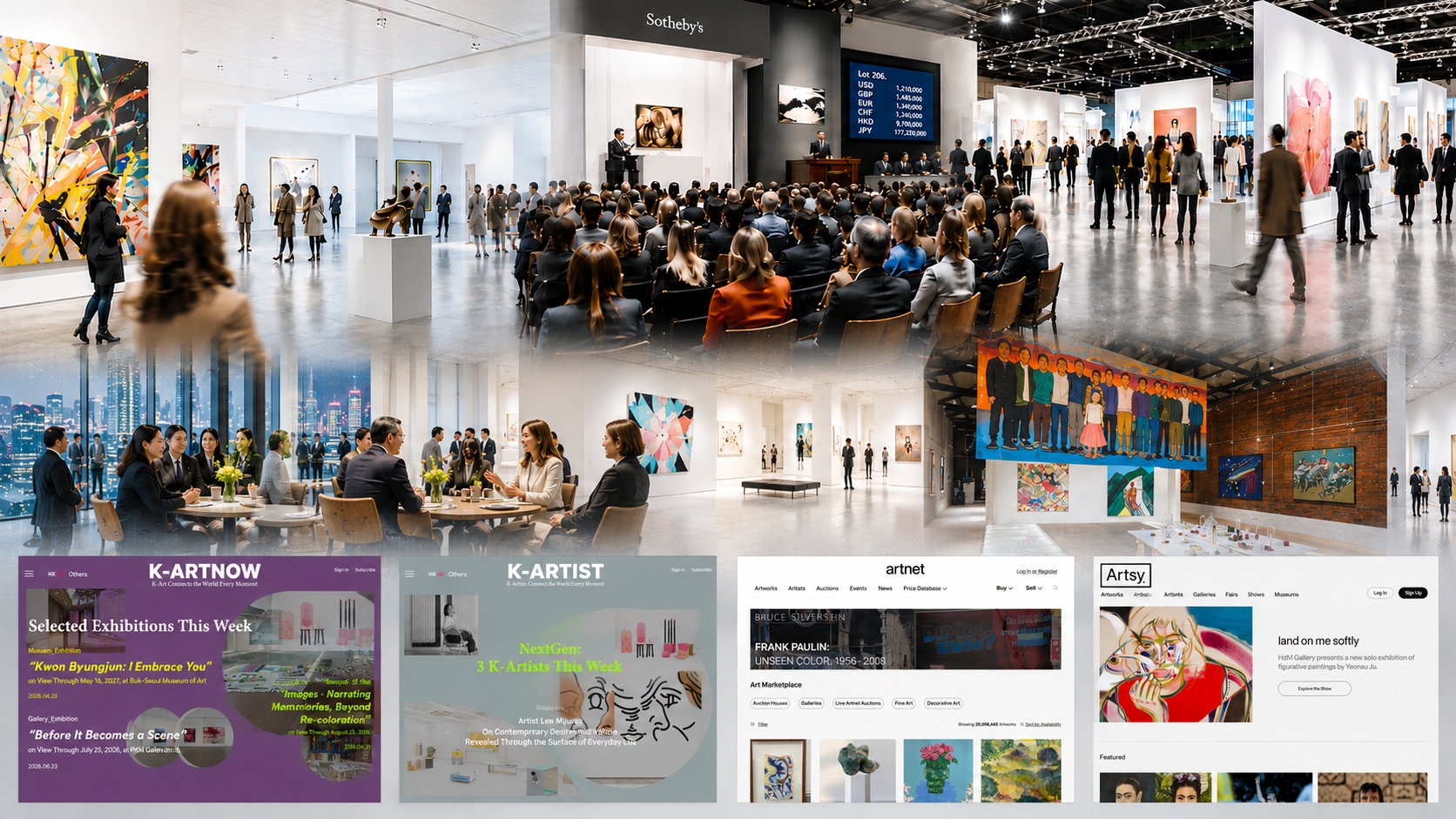
This is also why platform-based
infrastructures with a global orientation, such as K-ARTNOW and K-ARTIST, are
necessary.
Such platforms should not remain spaces
that merely introduce artists or publish articles. They must function as
knowledge infrastructures that connect criticism, records, archives, artist
information, artwork data, English-language content, and international networks
for Korean contemporary art.
A platform does not replace exhibitions. It
accumulates the records that remain after exhibitions, presents artists’
practices over the long term, and provides the language and structure through
which the global art world can access them. A platform does not replace museums
either. Rather, it should become a public knowledge base that connects museums,
galleries, artists, critics, researchers, and collectors.
Under the post-contemporary condition,
platforms are not optional. They are essential. For Korean contemporary art to
be read continuously within the global art world, platform-based infrastructure
must connect artists and works, criticism and records, institutions and
research, translation and international networks.
From Internationalization to
Globalization
All of these conditions converge in one
direction: the transition from internationalization to globalization.
Internationalization was the process through which Korean art contacted, moved
toward, and exchanged with the world beyond Korea. This process was important
and remains necessary. But it is not enough. Korean art must now design
interpretation after movement, structure after contact, and accumulation after
introduction.
Globalization is not a matter of going
abroad more often. It is the creation of a condition in which Korean art can be
read within the language of global art, studied within institutions,
accumulated within archives, and made continuously accessible through
platforms.
This transition requires structural
conditions beyond individual achievement. A system in which artists must
organize all their materials alone, translate everything on their own, build
overseas networks independently, and explain their own practices by themselves
is not sufficient. Globalization cannot be completed through individual
capacity alone. It becomes possible only when criticism, archives, translation,
research, institutions, and platforms operate together.
Korean contemporary art already has
significant potential. There are strong artists, important exhibitions, growing
institutions, and international interest. But possibility becomes sustainable
only when it becomes structure. If possibility is not structured, it disperses
into individual cases. When it is structured, it becomes an art-historical
current.
What the Korean art world must now design
is not simply a strategy for overseas expansion. What is needed is a
comprehensive structure for how Korean contemporary art will be read, studied,
accumulated, and positioned sustainably within the global art world.
Building Structures of Market
Trust
The final condition is the construction of
market trust. The art market is not simply a place where works are bought and
sold. It is a structure in which the value of artists is formed, verified, and
sustained. Price is an important market indicator, but price alone cannot
explain an artist’s value.
The Korean art market has already gained a
certain scale and speed. Art fairs, auctions, galleries, and the collector base
have expanded. Yet as the market grows, what becomes more important is not
price increase but the formation of trust. Why a price has been formed, what
structure of exhibitions, criticism, collections, and research sustains that
price, and how the long-term value of an artist is protected all become crucial
questions.
Market trust is not created in a short
period of time. An artist’s major works and periods must be organized,
exhibitions and criticism must be accumulated, and galleries must maintain
consistency in price management. Auction consignments must also be handled with
consideration for the artist’s long-term value and market stability.
Institutional collections, critical evaluation, the collector base, the
scarcity of works, and the transparency of distribution channels must operate
together.
The idea that the market exists outside art
is an old way of thinking. Today, the market is closely connected to the
structure through which artistic value is formed. But the market must not
become the entirety of art. The market becomes healthy only when it operates
together with criticism, research, exhibitions, archives, and institutions.
Price may be an outcome of that structure, but it cannot replace the structure
itself.
In this sense, the market is also the final
test of the conditions of the future. If critical language is absent, artist
archives remain unorganized, records after exhibitions do not remain, and
institutions and platforms fail to create knowledge structures, market prices
can easily become unstable. Conversely, when artists’ practices are accurately
interpreted, materials are accumulated, research and collections follow, and
platforms make them continuously accessible, the market can mature beyond
short-term transactions into a structure of long-term trust.
For Korean contemporary art to gain trust
within the global art world, the market too must become more sophisticated.
What is needed is not short-term price increases, but long-term value
formation; not speculative trends, but sustainable collecting; not individual
transactions, but trustworthy distribution structures. The future of the market
lies not in higher prices, but in deeper trust.
Designing the Conditions of the
Future
To overcome anachronism is not to erase the
past. It is to analyze past achievements accurately and to reconstruct the
conditions that produced them within the changed environment of the present.
Past modes of internationalization, exhibition-centered thinking, market growth
models, national branding strategies, and institutional operating models all
played certain roles. But they cannot simply become the conditions of the
future as they are.
The conditions of the future will not be
made through more exhibitions or more overseas expansion. They will emerge when
critical language, artist archives, artwork data, English-language artist
monographs, post-exhibition records, institutional knowledge production,
platform-based infrastructure, and market trust are connected into one
structure.
This is not an idealistic argument, but a
practical task that Korean contemporary art must address at the stage it has
already reached. What Korean art lacks now is not possibility, but structure.
Strong artists, important exhibitions, a growing market, and international
attention already exist. What has not yet been sufficiently established is the
system that can read, record, accumulate, and connect them.
If the age of internationalization was an
age of movement and contact, the age of globalization is an age of
interpretation and structure. Korean contemporary art must now move beyond the
stage of heading toward the world and design how it will be understood,
accumulated, and trusted within the global art world.
To move beyond anachronism is to build
precisely this structure. The future of Korean contemporary art begins not with
the repetition of past models of success, but with the design of the conditions
of the future.
Jay Jongho Kim graduated from the Department of Art Theory at Hongik University and earned his master's degree in Art Planning from the same university. From 1996 to 2006, he worked as a curator at Gallery Seomi, planning director at CAIS Gallery, head of the curatorial research team at Art Center Nabi, director at Gallery Hyundai, and curator at Gana New York.
From 2008 to 2017, he served as the executive director of Doosan Gallery Seoul & New York and Doosan Residency New York, introducing Korean contemporary artists to the local scene in New York. After returning to Korea in 2017, he worked as an art consultant, conducting art education, collection consulting, and various art projects.
In 2021, he founded A Project Company and is currently running the platforms K-ARTNOW.COM and K-ARTIST.COM, which aim to promote Korean contemporary art on the global stage.