
The
Institutional Position of the Museum
The museum is the most stable
institution in contemporary art and one of its most powerful mechanisms of
selection.
In contemporary art, the museum has
functioned not simply as a space for collecting and exhibiting works, but as a
key institution that determines what is recognized as contemporary art, which
forms and languages acquire public visibility, and which exhibitions are
granted institutional legitimacy.
Accordingly, the museum
should be understood not merely as an exhibition space, but as an institutional
apparatus that forms and maintains the standards of contemporary art.
State-run art museums, in
particular, are representative institutions that reveal the level at which a
society understands and institutionalizes contemporary art.
For this reason, a museum’s
exhibition strategy is not merely a matter of program organization, but is
directly tied to the cultural structure of judgment and the level of public
understanding of art in that society.
Changes
in the Function of Producing Discourse
Given this institutional position, one
of the museum’s key functions should be the production and renewal of
discourse.
At present, however, museums are
increasingly operating in ways that weaken this function. Today, museums
address contemporary issues such as politics, society, ecology, technology,
gender, and postcoloniality, yet in actual exhibition practice these issues
tend to be stably placed within already approved formats rather than leading to
art-historical judgment or institutional reconfiguration.
As a result, even when exhibitions
include critical content, they often fail to reach the point where they alter
the institution’s operating structure or its system of judgment. Consequently,
museums come to function less as sites that produce discourse and more as sites
that arrange discourse within limits already deemed institutionally acceptable.
This should be understood not
simply as the choice of an individual institution, but as the result of an
institutional structure accumulated over a long period of time.
The
Opacity of Selection and Judgment Criteria
These changes in turn lead to a
transformation in the structure of selection and judgment.
Museums still plan exhibitions,
select artists, and allocate space. Yet the explanations of the criteria
according to which those selections are made, and of why those judgments are
valid, have gradually weakened.
As a result, exhibitions continue
to be produced, but what was achieved, what their limitations were, and how
those judgments might be accumulated as standards for the future are not
sufficiently discussed.
In this way, museums move toward a
structure in which they carry out judgment without allowing that judgment to
accumulate. Institutional authority remains intact, but the standards on which
that authority rests become increasingly unclear.
Long-Term
Exhibitions and the Mode of Institutional Operation
This structure is also revealed
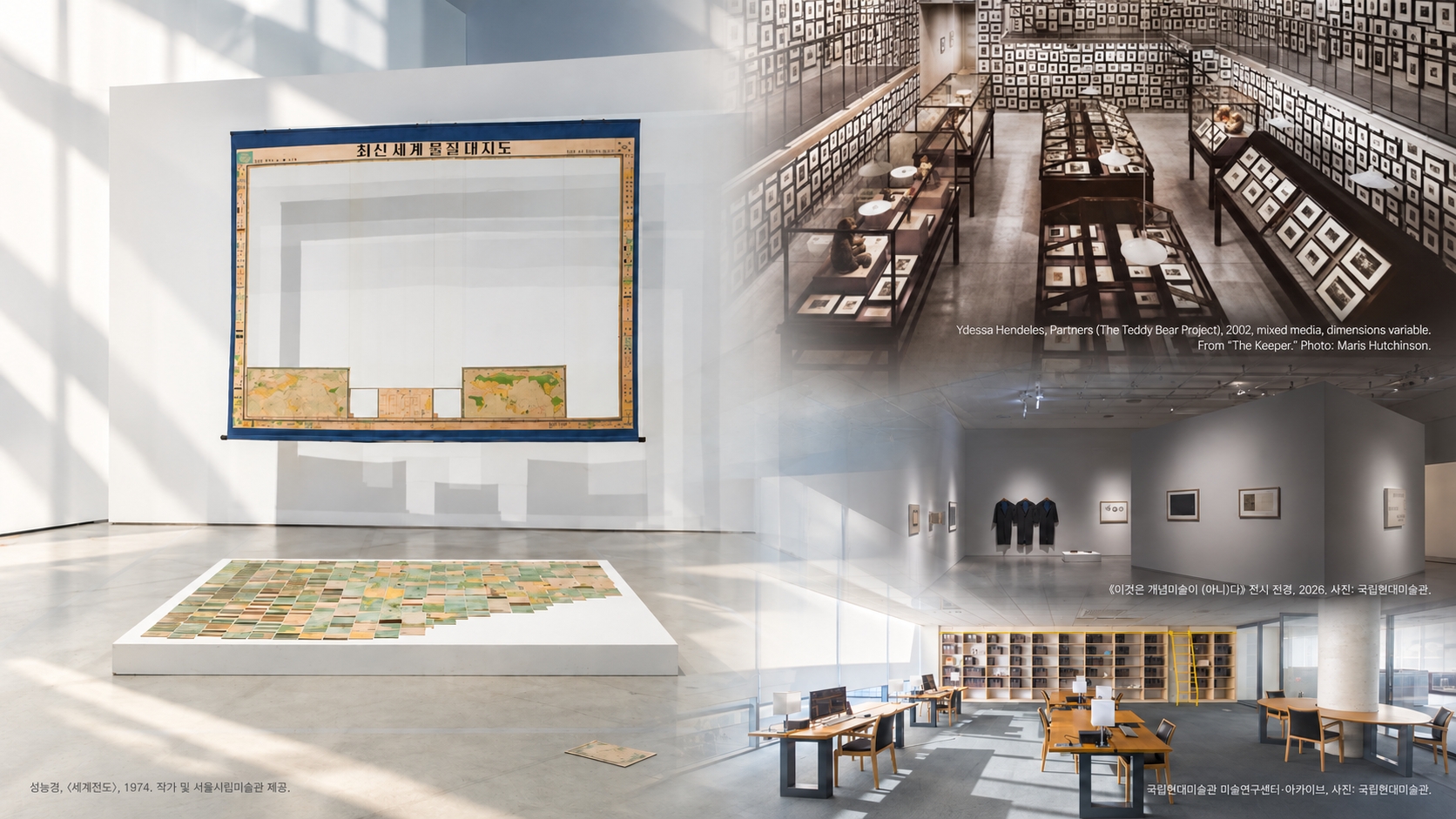
concretely in the way exhibitions are operated. Recent exhibitions at the Seoul
branch of the National Museum of Modern and Contemporary Art demonstrate this
clearly.
Ron Mueck’s solo exhibition (April
11–July 13, 2025) and the Damien Hirst exhibition (March 20–June 28, 2026) each
ran for more than three months, while《Korea Artist
Prize 2024》(October 25, 2024–March 23, 2025) and《Korea Artist Prize 2025》(August 29,
2025–February 1, 2026) each continued for roughly five months.
The long duration of such
exhibitions is not in itself the problem. However, because long-running
exhibitions occupy a museum’s core spaces and time so intensively, they
necessarily call for careful examination of what they leave behind and what
kinds of judgments they produce.
And yet such examination is not
sufficiently carried out. As a consequence, exhibitions continue, but a
structure is repeated in which judgment is never accumulated.
Major
Exhibitions and the Structure of Consumption
This problem becomes even clearer
in the case of major exhibitions.
The Ron Mueck exhibition drew very
high visitor numbers and was a major box-office success, while the Damien Hirst
exhibition is likewise being presented amid strong public interest.
Yet the function of a public art
museum does not end with increasing visitor numbers. An exhibition must be
assessed in terms of what kinds of judgment and discussion it generates after
the act of viewing, and whether these can in turn lead back into cultural
production. At this point, a more fundamental question becomes necessary:
Other
than increased attendance and box-office success, what has the Ron Mueck
exhibition left behind for the Korean art world?
If the answer to this question is
not clear, the exhibition comes to function less as a public asset than as an
event centered on consumption. In other words, if viewing takes place but that
experience does not lead back into judgment and production, the role of the state-run
art museum is inevitably reduced at a structural level.
The
Repetitive Structure of Annual Exhibitions
Annual exhibitions reveal the same
structure.
《Korea Artist
Prize》is an important mechanism that offers artists
major opportunities. Yet it remains unclear what standards such an exhibition
establishes and what it actually accumulates.
A long exhibition period may
enhance an exhibition’s significance, but duration alone does not guarantee the
formation of standards. The longer an exhibition continues, the more clearly a
structure of judgment is required regarding what that exhibition has left
behind.
If this demand is not met, the
annual exhibition is likely to function less as a site for producing new
standards and more as a mechanism for repeating an existing structure.
Distinguishing
Popularity from Publicness
In order to understand this issue,
it is necessary to distinguish popularity from publicness.
It is a positive phenomenon when
large numbers of people visit museums. But publicness is not established simply
through the expansion of viewership.
Publicness comes into operation
only when viewing leads back into judgment, research, criticism, and
production. If this connection is not made, culture and the arts remain caught
in a repetitive structure centered on consumption. At that point, culture
exists, but it is not produced; instead, it tilts toward a structure in which
what is produced elsewhere is merely consumed.
The
Operation of Institutionalization and Power
At this point, the
institutionalization and empowerment of state-run art museums become
structurally visible.
An institution grounded in
publicness and expertise accumulates legitimacy over time through long-term
operation. Yet the more this legitimacy is repeated, the more selection becomes
internalized, and the less visible become the standards that justify it.
As a result, the boundary between
the role of cultural production and the operation of institutional authority
becomes blurred, and the museum comes to function not as a productive
institution but as an institution of approval.
The
Role of State-Run Art Museums in the Megacity
This structure becomes even more
significant in large cities. A large city is a space where museums,
institutions, and resources are concentrated, and the selections and judgments
made there expand beyond the level of a local event to become standards for
Korean contemporary art as a whole.
Accordingly, institutions such as
the National Museum of Modern and Contemporary Art and the Seoul Museum of Art
in the megacity of Seoul must function not simply as exhibition venues but as
core institutions that shape the standards of contemporary art.
Yet while the number and scale of
exhibitions have expanded, discussion of what kinds of standards of judgment
and discourse those exhibitions actually produce remains relatively weak.
As a result, state-run art museums
are increasingly likely to tilt away from being centers of discursive
production and toward becoming spaces that provide consumable exhibition
experiences.
Artist
Resources and the Institution’s Mode of Selection
There are ample artist resources
within the Korean art world.
The issue, therefore, is not the
number of artists, but according to what criteria the institution selects them
and how it sustains them.
When state-run art museums
repeatedly choose already stabilized forms and well-known names rather than
discovering and experimenting with new artists, exhibitions increasingly come
to be composed of the same groups of artists and similar modes of practice.
As a result, new artists find it
difficult to gain entry into the institution, and exhibition opportunities
become concentrated on particular artists and particular types of work. In this
process, exclusion does not appear explicitly, but proceeds gradually within
institutional criteria.
Repetition
of Structure and the Problem of Judgment
Ultimately, the problem is not what
is exhibited, but what kind of structure is being repeated.
Museums still select works and
organize exhibitions. But unless they examine what sort of structure of
judgment those selections create, what conditions of production they produce,
and which artists and discourses they incorporate into the institution, museums
will come to function not as centers of cultural production but as institutions
that regulate cultural consumption.
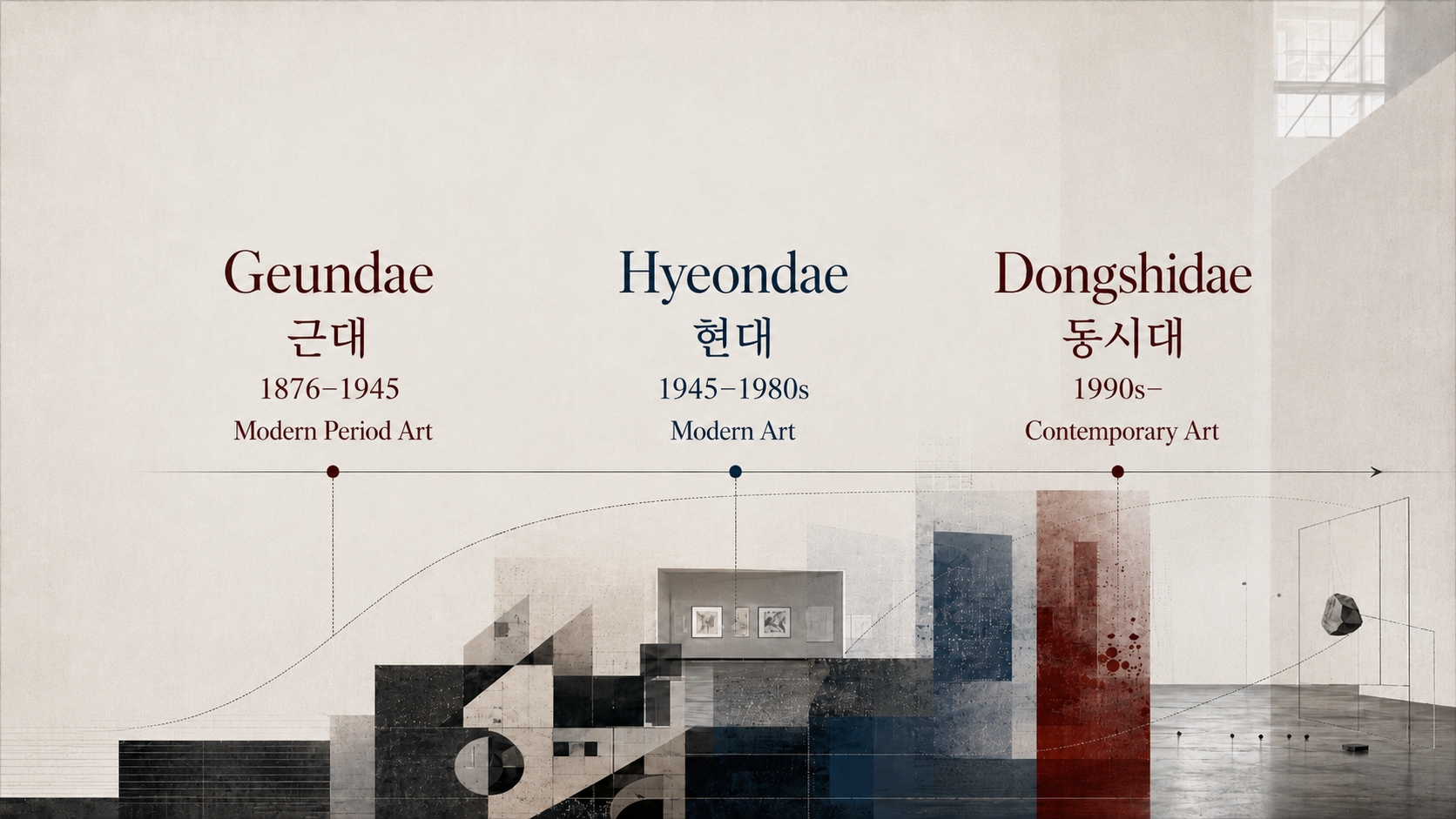
This condition demonstrates how the
post-contemporary operates within the institution. Judgment exists, but its
standards are not visible; exhibitions exist, but their achievements are not
accumulated.
Conclusion
This structure is the result of the
institutionalization and empowerment that state-run art museums have built up
over a long period of time. When selection continues but the judgments that
selection leaves behind are not made visible, judgment ceases to accumulate,
and the institution moves toward a state in which it can no longer produce its
own standards.
If this condition continues, then
even though Korean contemporary art possesses abundant artist resources and a
strong basis of production, its achievements will be unable to accumulate
within an internal structure of judgment and will instead be increasingly
forced to rely on external standards or on structures centered on visibility.
This is not a problem of production, but of judgment and accumulation.
Ultimately, the issue is not what
museums exhibit, but what kinds of standards they create and how those
standards are retained. If this condition does not change, state-run art
museums will remain at the institutional center while gradually drifting away
from the real center of judgment; and as a result, Korea will remain not a
global cultural producer in the twenty-first century, but a country that
imports and consumes foreign culture that has already become famous.
Jay Jongho Kim graduated from the Department of Art Theory at Hongik University and earned his master's degree in Art Planning from the same university. From 1996 to 2006, he worked as a curator at Gallery Seomi, planning director at CAIS Gallery, head of the curatorial research team at Art Center Nabi, director at Gallery Hyundai, and curator at Gana New York. From 2008 to 2017, he served as the executive director of Doosan Gallery Seoul & New York and Doosan Residency New York, introducing Korean contemporary artists to the local scene in New York. After returning to Korea in 2017, he worked as an art consultant, conducting art education, collection consulting, and various art projects. In 2021, he founded A Project Company and is currently running the platforms K-ARTNOW.COM and K-ARTIST.COM, which aim to promote Korean contemporary art on the global stage.