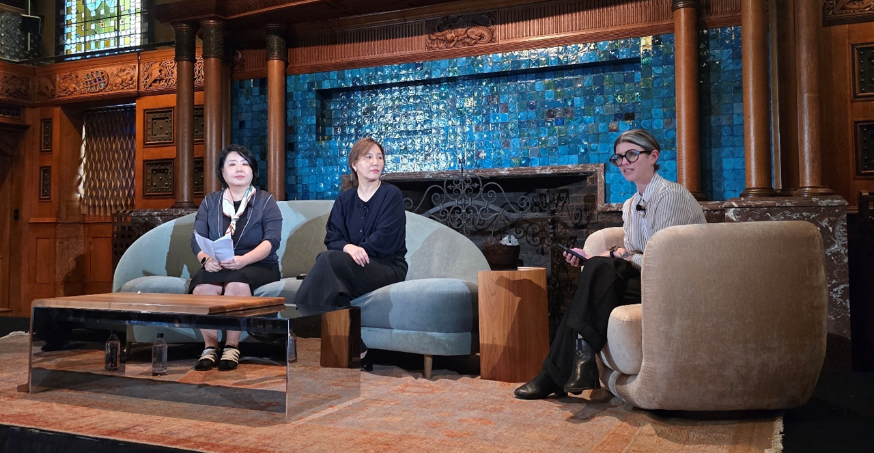

Over the past few
years, the landscape of the Asian art market has been rapidly reshaped. Seoul
has drawn increasing attention from the international art world through Frieze
Seoul, Kiaf Seoul, and Seoul Art Week, while Hong Kong, despite political changes
and the impact of China’s economic slowdown, continues to maintain its position
as a powerful transactional hub.
Within this
structure, the central question is not simply whether “Seoul has replaced Hong
Kong”. A more precise question is how Seoul and Hong Kong each perform the
function of a center within the Asian art market.
To put it simply,
Seoul has already emerged as a key hub in the Asian art market. However, it is
still difficult to regard it as the single dominant center that has replaced
Hong Kong. The current Asian art market is more accurately understood as a
dual-hub structure in which ‘the Rise of Seoul’ and ‘the Persistence of Hong
Kong’ are operating simultaneously.
Hong Kong remains
strong in transactions. Seoul is rapidly securing cultural centrality. If Hong
Kong’s strength comes from taxation, logistics, finance, and its international
business environment, Seoul’s strength comes from exhibition infrastructure,
urban culture, institutional networks, and growing international interest in
Korean art and Korean culture as a whole. The two cities compete within the
same market, but they operate in different ways.
Hong
Kong, the Established Center of the Asian Art Market Built as a Transactional
Hub
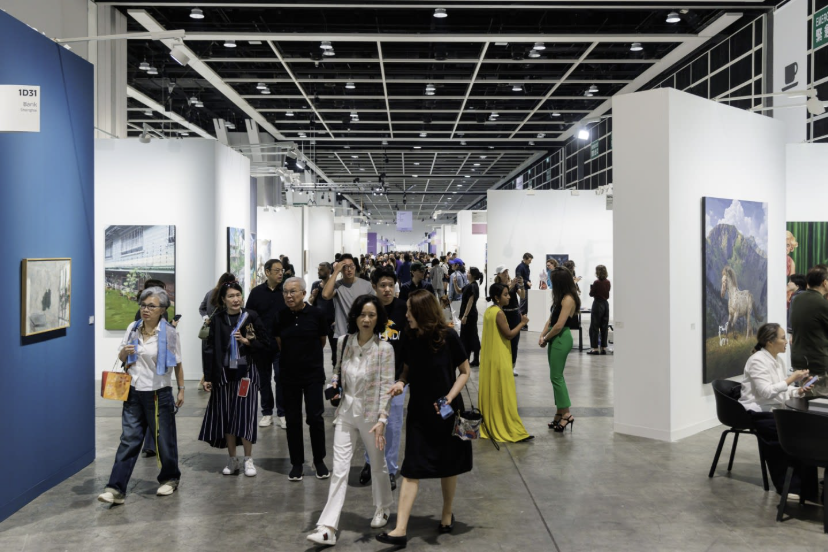
Art Basel Hong Kong 2026 / Courtesy Art Basel
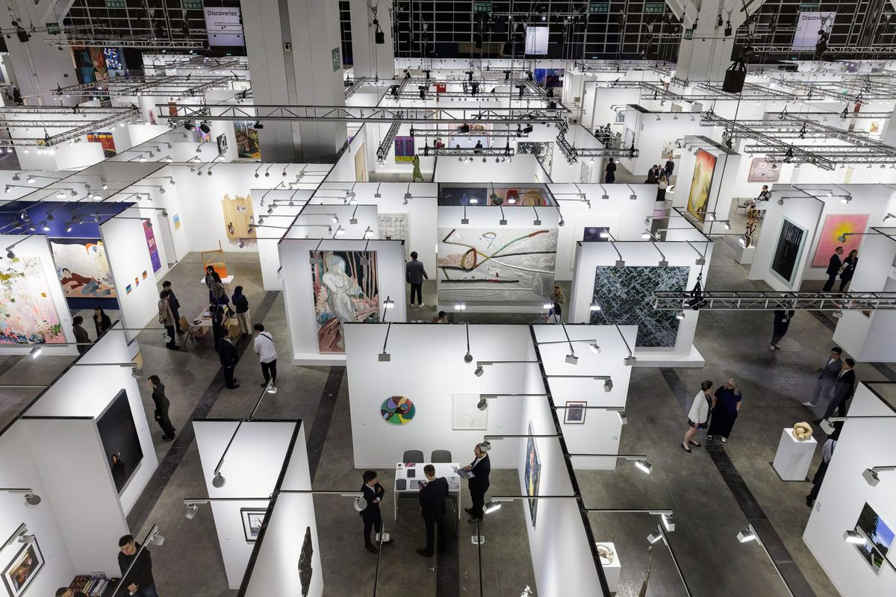
Installation view of Art Basel Hong Kong / Courtesy Art Basel
The reason Hong
Kong has long functioned as the center of the Asian art market is clear. Hong
Kong has maintained a free-port structure in which there are no customs duties
on the import and export of artworks, and no value-added tax or sales tax is
imposed.
This has been
combined with its foundation as an international financial city, free capital
movement, an English-based business environment, and an efficient port and
airport logistics system. InvestHK also emphasizes that Hong Kong’s duty-free
and VAT-free structure, together with its world-class logistics infrastructure,
has created an environment favorable for international collectors, galleries,
and auction houses.
This is Hong Kong’s
essential strength. Art Basel Hong Kong did not create Hong Kong as an
art-market center. Rather, the urban structure that makes transactions easy
enabled the strength of Art Basel Hong Kong. Hong Kong’s hub status has been
built not on the success of a single event, but on a transactional system where
taxation, logistics, finance, law, private sales, and the auction industry are
integrated.
Hong
Kong’s Market Function After Political Uncertainty
Of course, Hong
Kong’s weakening is also a reality. Since the enactment of the National
Security Law, the political environment has changed, and the international
community no longer places the same level of trust in Hong Kong’s openness and
autonomy as it once did. Concerns over freedom of artistic expression and the
possibility of censorship also continue. Yet political risk does not
immediately mean the disappearance of market function. Hong Kong remains one of
the strongest art-market platforms in Asia.
According to the
2026 Art Basel & UBS Global Art Market Report, China accounted for 14
percent of the global art market in 2025, maintaining its position as the
third-largest market after the United States and the United Kingdom. Despite
volatility in the mainland Chinese market, Hong Kong continues to function as a
key gateway where Chinese-speaking collectors, international auctions, global
galleries, and Asia-Pacific capital converge.
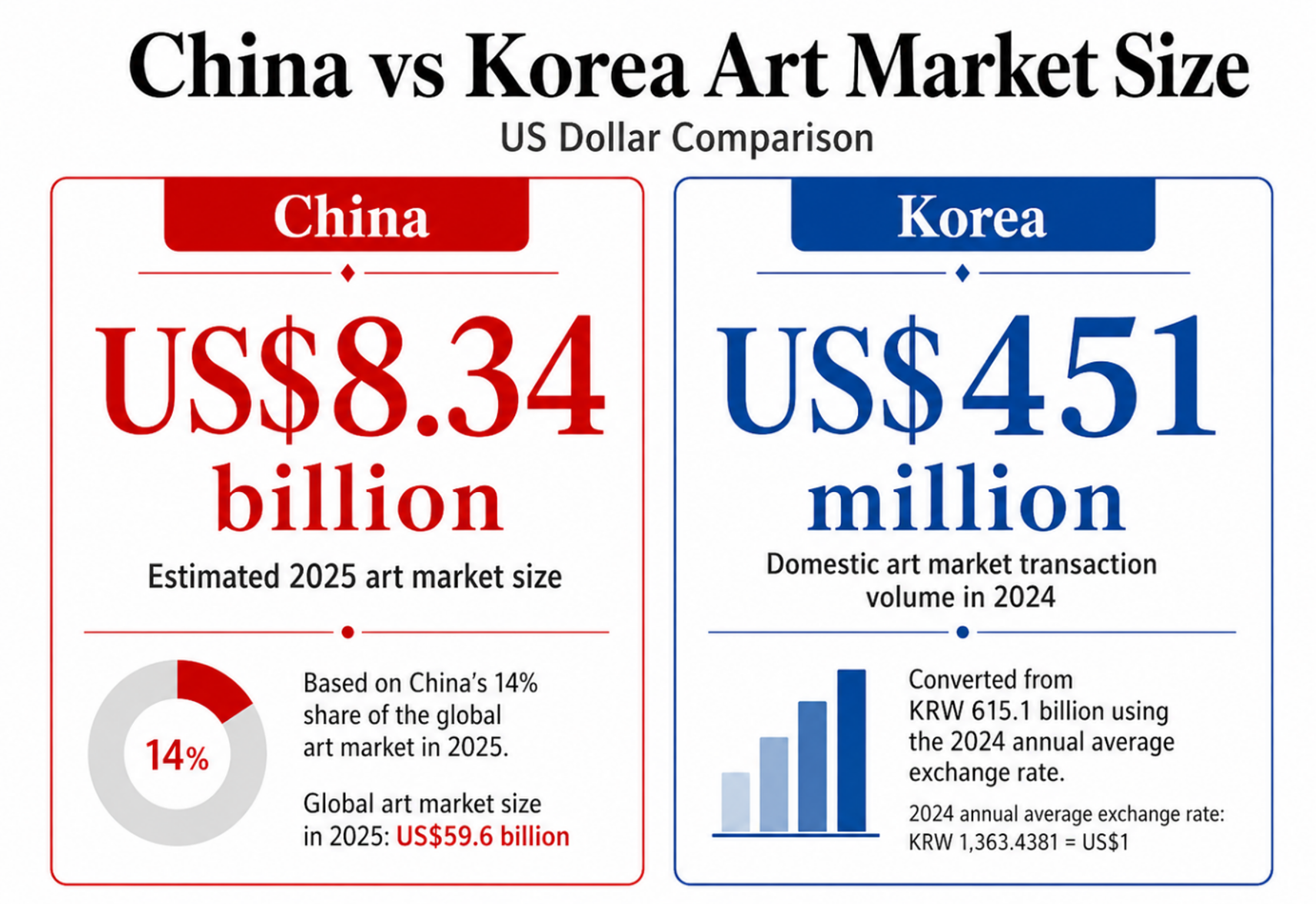
Sources: Art Basel & UBS Global Art Market Report 2026; Korea Arts Management Service, 2025 Art Market Survey (based on 2024 data); FRED annual exchange rate data.
The results of
Art Basel Hong Kong 2026 also demonstrate this. The 2026 fair attracted 91,500
visitors, and the Hong Kong government officially announced that it would
continue its partnership with Art Basel for the next five years. This signals
that Hong Kong is not merely a hub of the past, but a city that is
institutionally maintaining its position as a platform for high-value art
transactions in Asia.
Seoul,
a New Center Emerging as a Cultural Platform
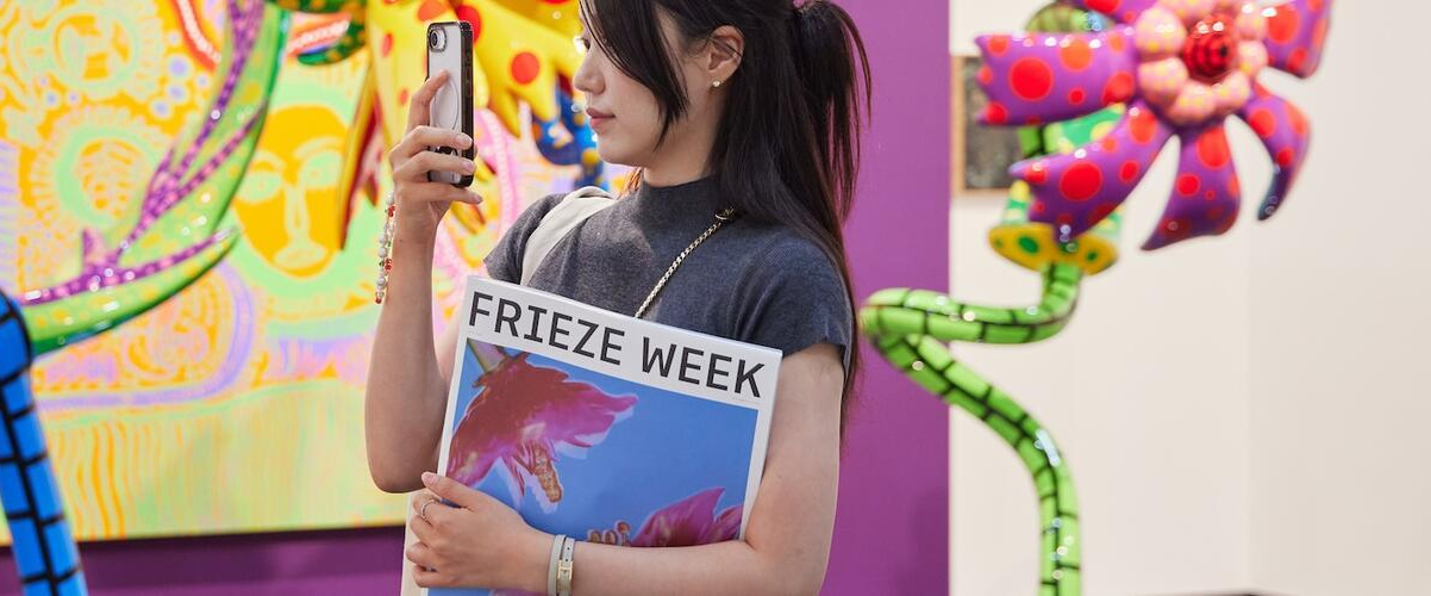
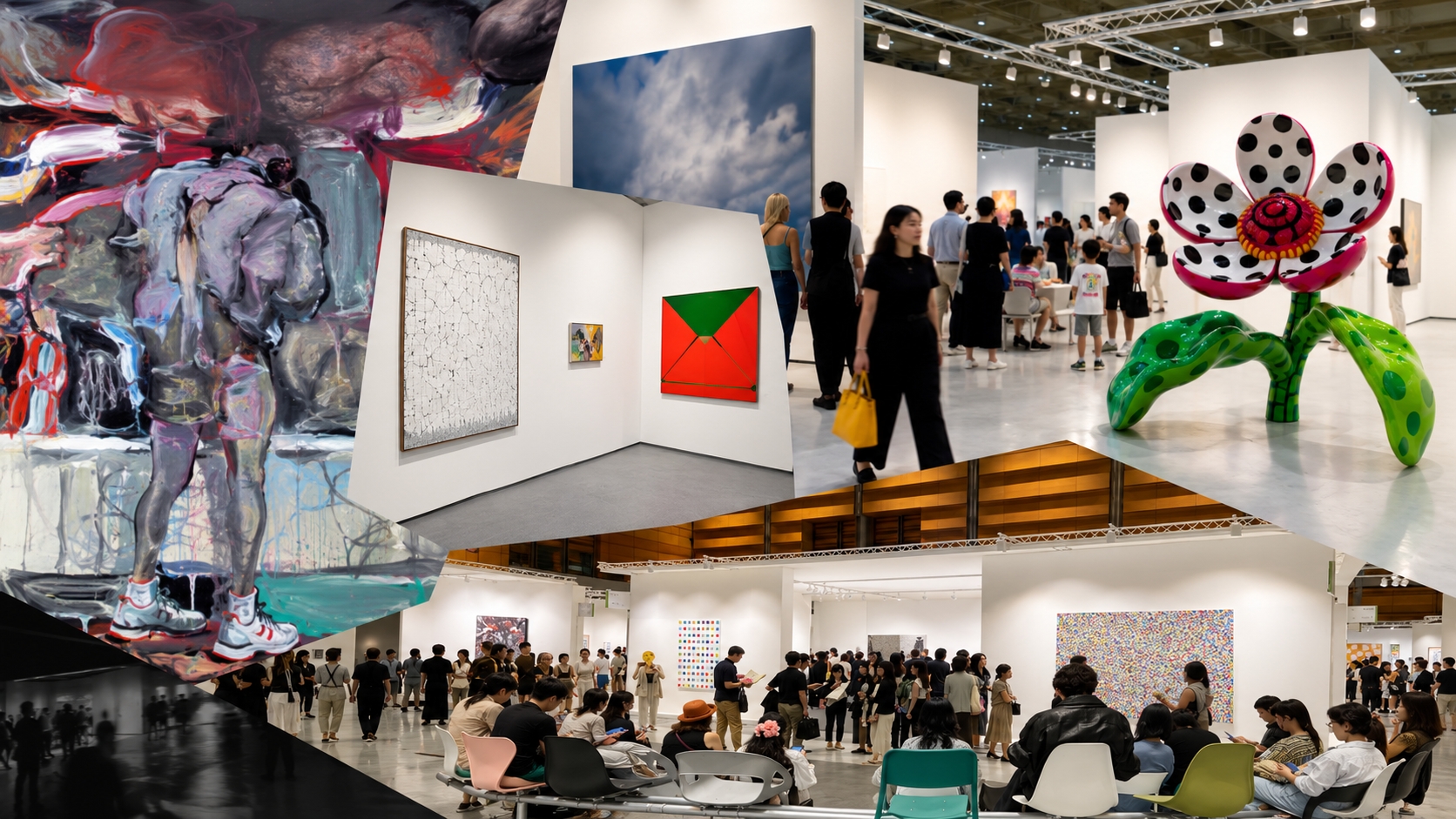
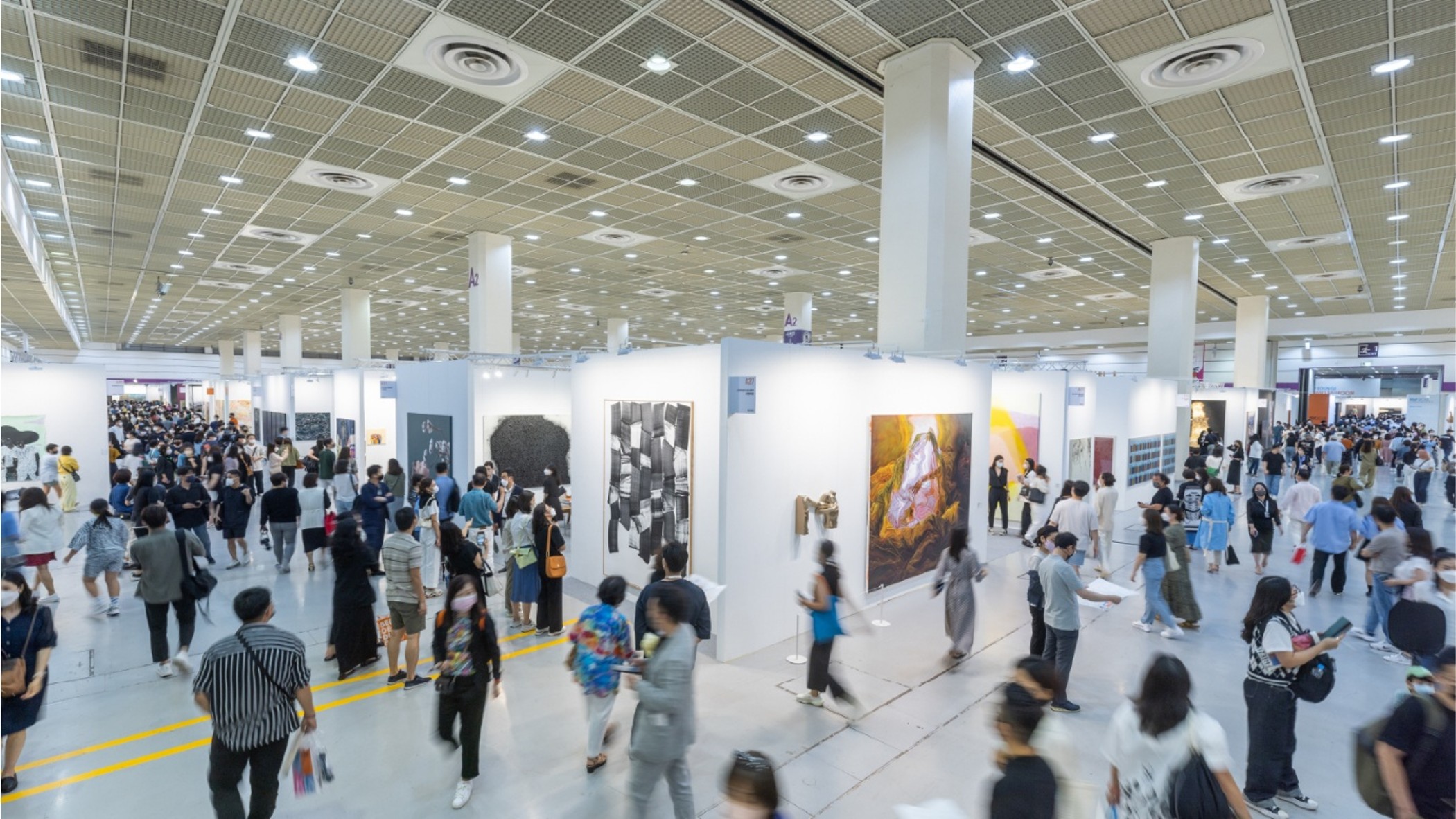
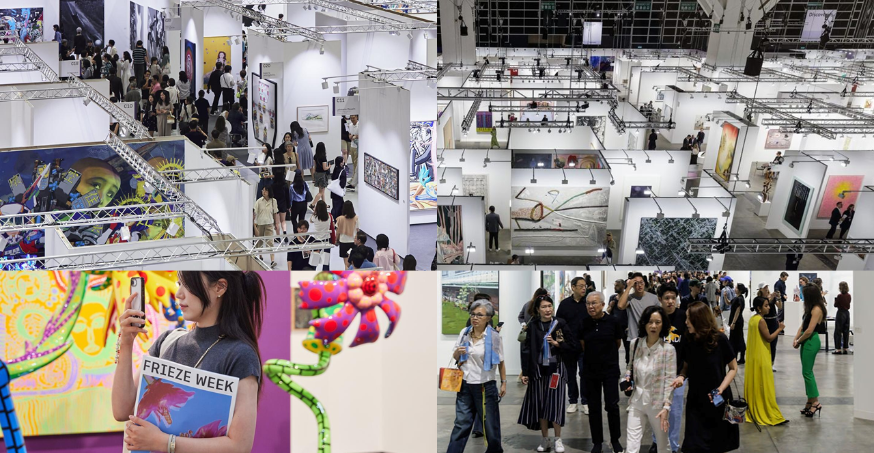
Visitors at Frieze Seoul 2025 / Photo: Frieze
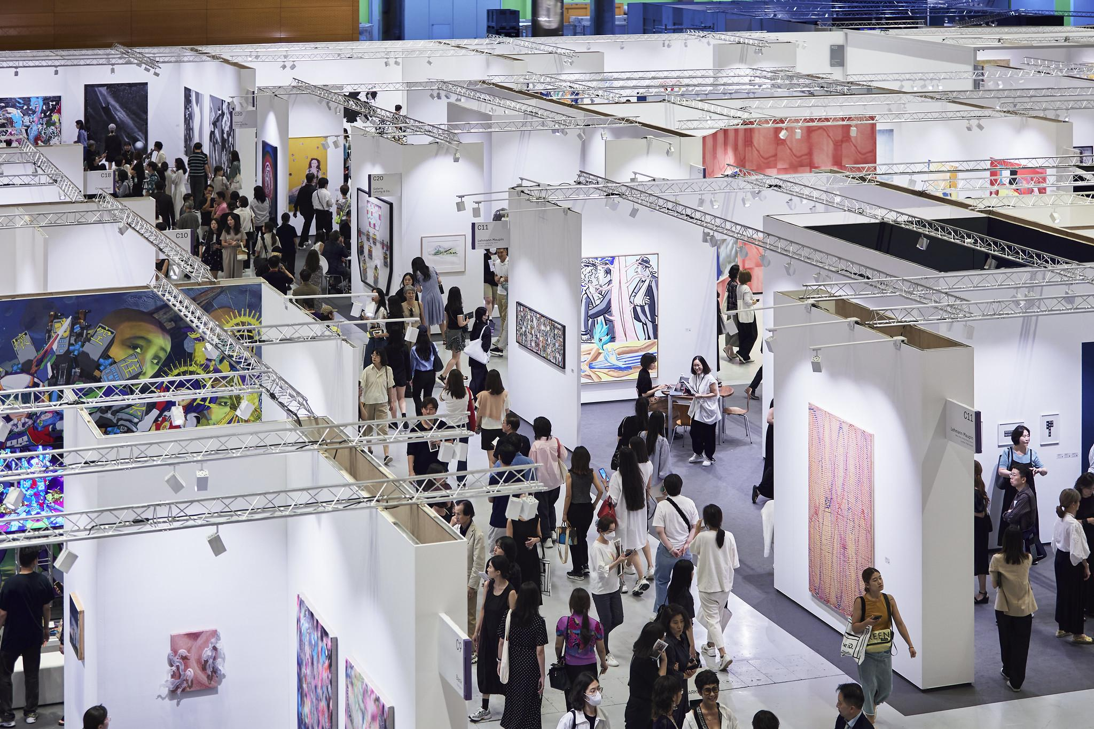
Installation view of Frieze Seoul 2025 / Photo: Frieze
Seoul’s rise, by
contrast, is unfolding in a different way. Seoul is not a transactional city
with a free-port structure like Hong Kong. Instead, Seoul is emerging through a
model in which the entire city operates as a cultural platform.
Frieze Seoul 2025
brought together 121 galleries from 28 countries and attracted 70,000 visitors
from 48 countries, along with representatives from more than 160 major museums
and institutions. This shows that Seoul is no longer merely a local market for
domestic art consumption, but a major city that the international art world
visits intensively during a specific period.
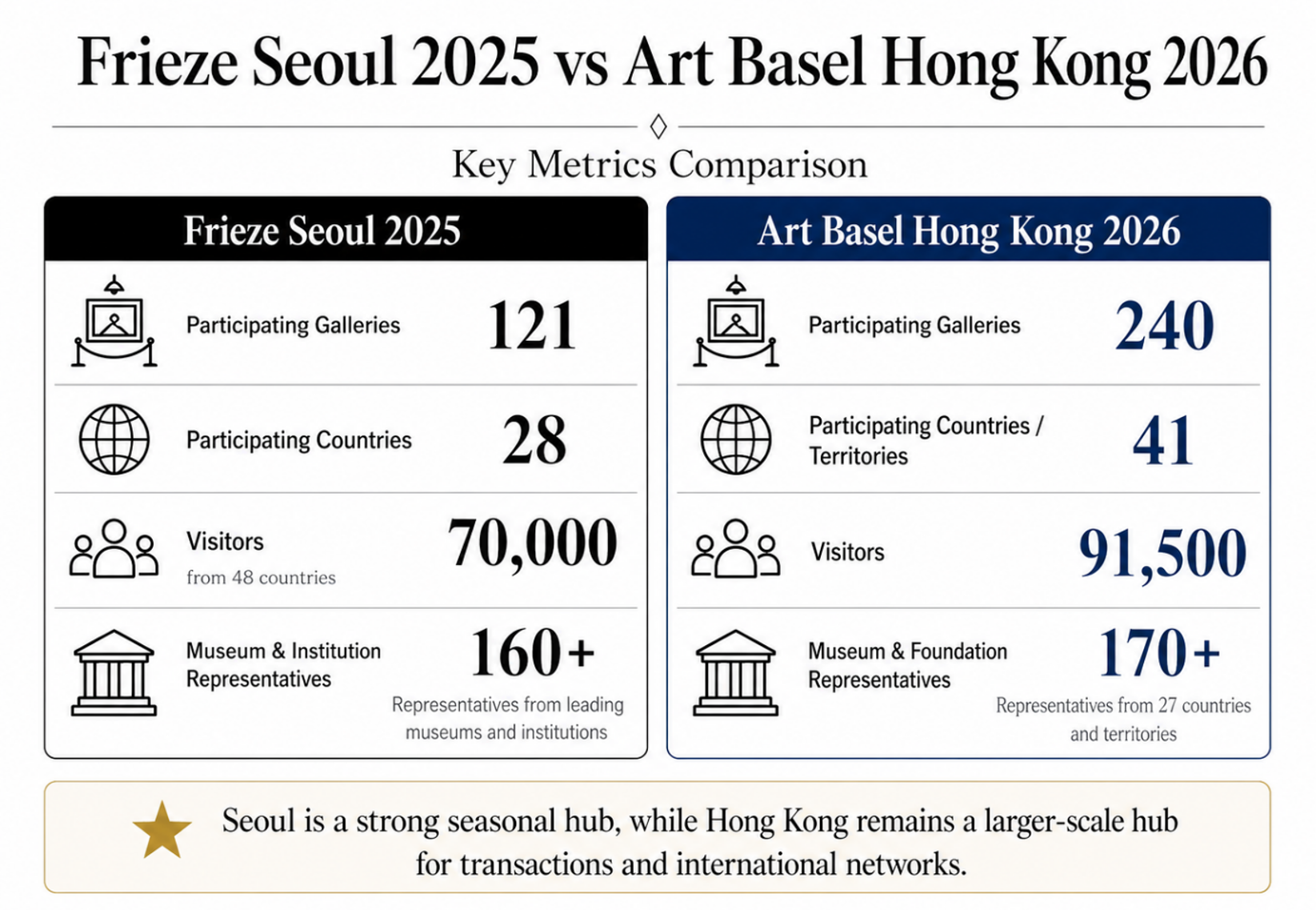
Sources: Frieze official press release (Sep, 2025), Art Basel official release (Mar, 2026)
During the same
period, Seoul Art Week connected 107 museums and galleries across the city and
presented more than 100 exhibitions and programs. With Frieze Seoul, Kiaf
Seoul, the Seoul Mediacity Biennale, the Seoul Sculpture Festival, and major
museum exhibitions taking place at the same time, Seoul created a structure in
which the city as a whole became a stage for contemporary art, rather than
simply a host city for art fairs.
Seoul’s
Institutional Base and Capacity to Absorb International Audiences
Seoul’s
institutional foundation is also strengthening rapidly. In 2025, the National
Museum of Modern and Contemporary Art, Korea recorded more than 3.37 million
visitors, reaching its highest level since opening, while the National Museum
of Korea recorded 6,507,483 visitors. These figures show that Seoul has the
large-scale institutional infrastructure needed to absorb international
audiences and cultural consumption.
These numbers are
not merely indicators of popularity. An art-market hub cannot be established
through transactions alone. What matters is whether a city can produce
exhibitions, attract audiences, generate discourse, and create a structure in
which institutions and the market move together. In this sense, Seoul has
clearly entered a new phase. Seoul is now moving beyond being a city that
attracts attention in the Asian art market and becoming a city that must be
visited.
Seoul
as a Seasonal Hub and the Limits of Its Still-Thin Market Structure
Yet this is
precisely where Seoul’s limitations become visible. Seoul is a powerful
seasonal hub. During the period of Frieze Seoul and Kiaf Seoul, the city’s
presence expands dramatically. However, the true measure of an art-market hub
is not the success of a fair week alone. It requires year-round transactions, a
permanent base for international galleries, depth in the secondary market, and
a dense ecosystem of appraisal, storage, insurance, shipping, law, finance,
publishing, criticism, and archives. In this respect, Seoul remains thinner
than Hong Kong.
The internal
structure of the Korean market also needs to be examined with a clear view.
According to reports citing the Korea Arts Management Service’s 2025
Art Market Survey (Based on 2024 data), the domestic art transaction
volume in 2024 was approximately KRW 615.1 billion, down 11.2 percent from the
previous year. While the number of art fairs and exhibition events in Korea
continues to increase, the overall transaction volume and market stability have
entered a period of adjustment.
This point is
important. An increase in the number of art fairs is not the same as a
deepening of the market. A city does not become a hub simply because it hosts
many events. A hub is a city where international capital, artworks, collectors,
galleries, institutions, criticism, archives, and service industries are
connected with high density. Seoul is quickly building these conditions, but it
has not yet reached a fully mature stage.
Structural
Differences Between Hong Kong and Seoul in Taxation and Logistics
In terms of
taxation and customs procedures, Seoul also operates under different conditions
from Hong Kong. Hong Kong maintains a structure in which customs duties and
value-added tax are not imposed on art transactions. Korea, by contrast,
applies a value-added tax system to general imports, and detailed rules and
exceptions operate in complex ways depending on the type of artwork and the
conditions of the transaction.
From the
perspective of international art distribution, the key to urban competitiveness
lies in how freely and at what cost artworks can move. In this respect, Hong
Kong still holds an advantage over Seoul.
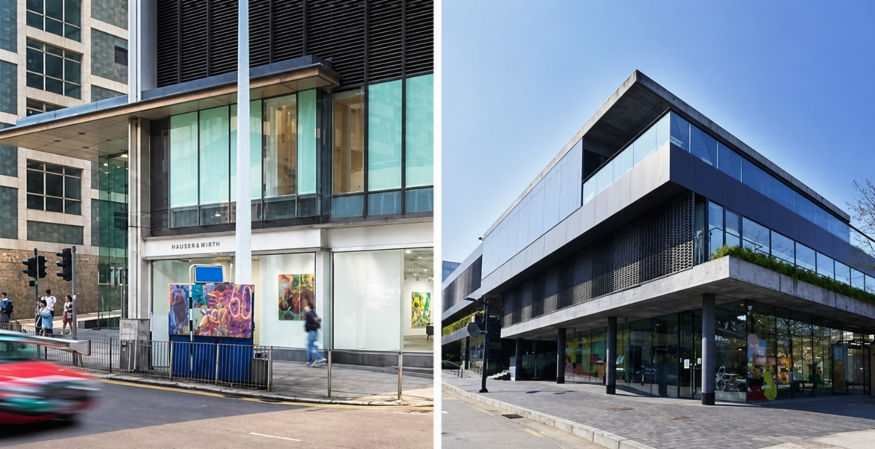
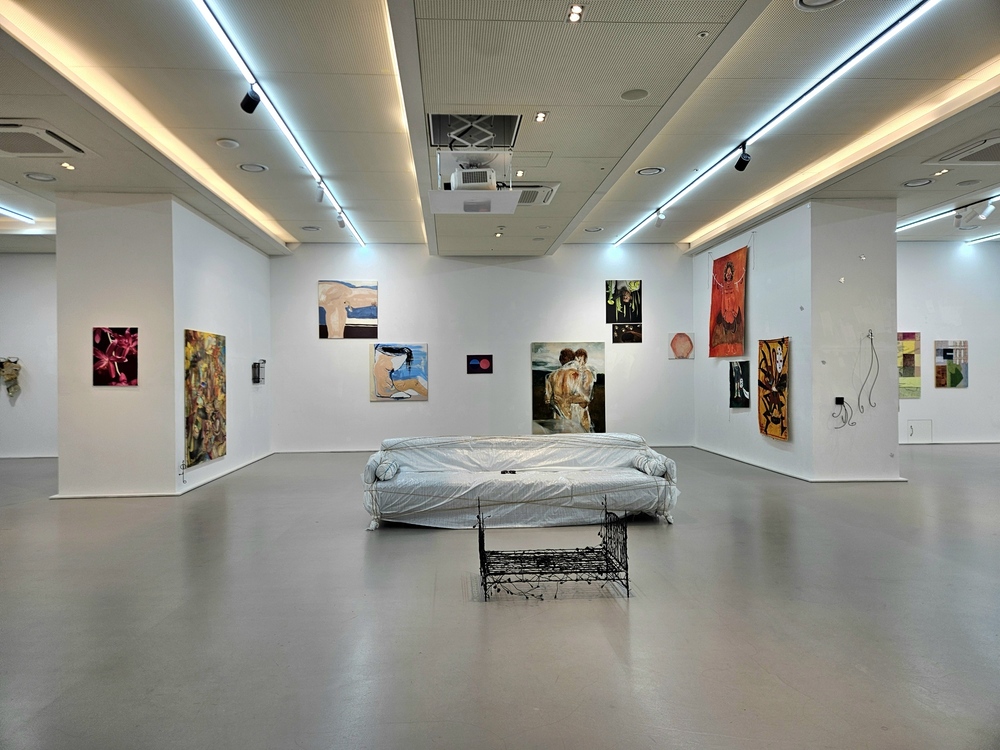
(left) Hauser & Wirth Hong Kong, (right) Pace Gallery Seoul / Photos courtesy of each gallery
Seoul’s
Competitiveness Lies Not in a Free-Port Model but in Its Cultural Ecosystem
Seoul’s strength,
therefore, does not lie in imitating Hong Kong. Seoul is growing not as a
free-port transactional hub, but as a cultural, institutional, and
content-driven hub. Public museums, private museums, non-profit spaces,
commercial galleries, international art fairs, urban festivals, and
international interest in K-culture are coming together to position Seoul as a
city with a high density of exhibition experience and cultural energy. Seoul’s
rise is not simply a phenomenon of the art market. It is a sign that the city
as a whole has begun to function as a cultural platform.
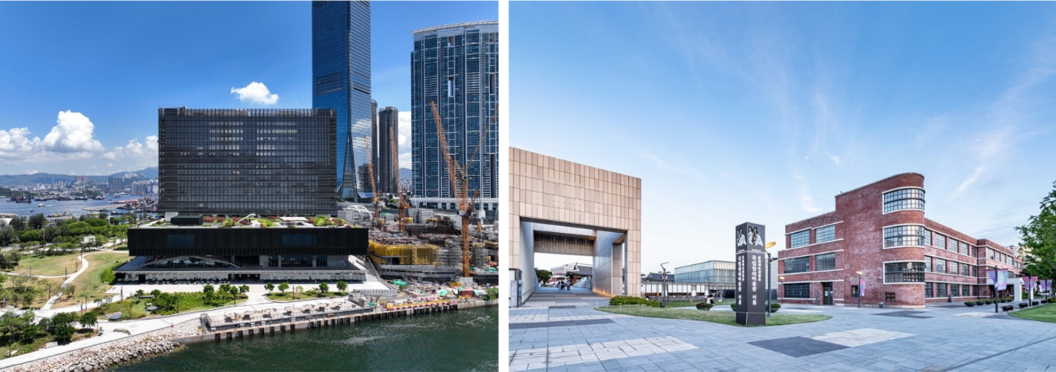
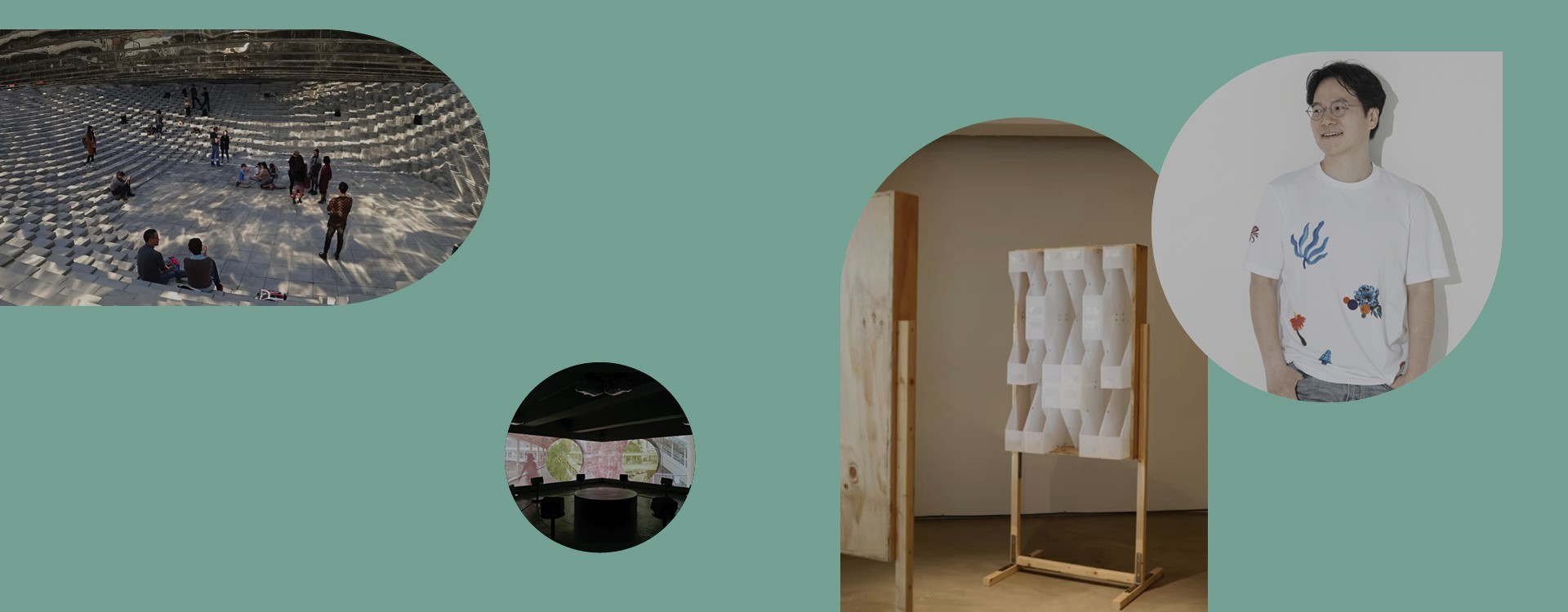
(left) M+ Museum Hong Kong, (right) National Museum of Modern and Contemporary Art, Seoul / Photos courtesy of each institution
The
Structure After the Event Is Seoul’s Next Task
However, becoming
a center requires a structure that continues after the event. Overseas
galleries and collectors must become part of a sustained network rather than
one-time visitors, and Seoul must develop an ecosystem in which not only
artwork sales but also appraisal, storage, shipping, insurance, law, finance,
private sales, publishing, criticism, and archives operate together. Markets
open through events, but hubs are sustained by structure.
Seoul’s next
tasks are clear. It must refine its taxation and customs environment for
international art distribution. It must strengthen the secondary market,
private sales, and service industries such as appraisal, storage, shipping, and
insurance. It must encourage major international galleries and collectors ‘to
perceive Seoul not merely as a city to participate in, but as a city in which
to maintain a presence and build relationships’.
It must also
strengthen criticism, publishing, archives, and English-language art discourse
so that Seoul can become not simply a place of sale, but a knowledge hub that
produces interpretation and records.
The
Asian Art Market Is Being Reshaped Not Around a Single Center but Through a
Dual-Hub Structure
Ultimately, the
current Asian art market cannot be explained through the simple binary of “Hong
Kong or Seoul.” Hong Kong remains a transactional hub. Seoul is the
fastest-rising cultural and institutional hub. Hong Kong is a city where
artworks are easy to buy and sell, while Seoul is a city where artworks are
shown, interpreted, and able to gain new attention.
In the long term,
the outcome will not be determined by which city first declares itself the
center. The key will be which city builds a more stable ecosystem, a stronger
international network, a more sustainable institutional foundation, and a more
persuasive art discourse.
Seoul has already
entered that competition. However, structural thresholds still remain before it
can become the center of the Asian art market. Seoul is not yet a city that has
fully replaced Hong Kong. Rather, it is a city redefining the center of the Asian
art market in a different way from Hong Kong. And it is precisely at this point
that Seoul’s potential is greatest.
References
- Frieze. “Frieze
Seoul 2025: Expanding Korea’s Cultural Presence and the Fair’s Role as a Hub
for the Asian Art Market.” Frieze Press Release, September 2025. (Frieze)
- Seoul
Metropolitan Government. “Seoul Art Week with Kiaf Seoul, Frieze Seoul, and
Seoul Sculpture Festival Starting Sep. 1.” Seoul Metropolitan Government,
August 27, 2025. (Official Website
of the Seoul Metropolitan Government)
- Art Basel. “Art
Basel Hong Kong 2026 Concludes with Strong Sales and Global Engagement.” Art
Basel, March 2026. (Art Basel)
- The Government of
the Hong Kong Special Administrative Region. “HK to Host Art Basel for 5 Years.”
news.gov.hk, March 25, 2026. (news.gov.hk)
- Art Basel &
UBS. The Art Basel and UBS Global Art Market Report 2026.
Art Basel / UBS, 2026. (Art Basel)
- InvestHK. ART:
Hong Kong’s Art Market and Cultural Sector. InvestHK, 2026. (Invest Hong Kong | InvestHK)
- Korea Arts
Management Service. 2025 Art Market Survey: Based on 2024 Data.
Korea Arts Management Service, 2025. (Korea Arts Management Service)
- Newsis. “Korean
Art Market Maintains KRW 600 Billion Range as Art Fairs Continue to Increase.”
Newsis, November 28, 2025. (Newsis)
- The Korea Times. “National
Art Museum Draws Record 3.3 Million Visitors This Year.” The Korea Times,
December 24, 2025. (Korea
Times)
- Korea.net. “National
Museum of Korea in 2025 Ranks Third Worldwide in Visitors.” Korea.net, April
2026. (Korea.net)