
K-ARTNOW conducted a special written interview
with Jessie Kleemann, a Greenland-born, Denmark-based artist participating in
Kalaallit Illuutaat (Greenlandic House), a pavilion of the 16th Gwangju
Biennale.
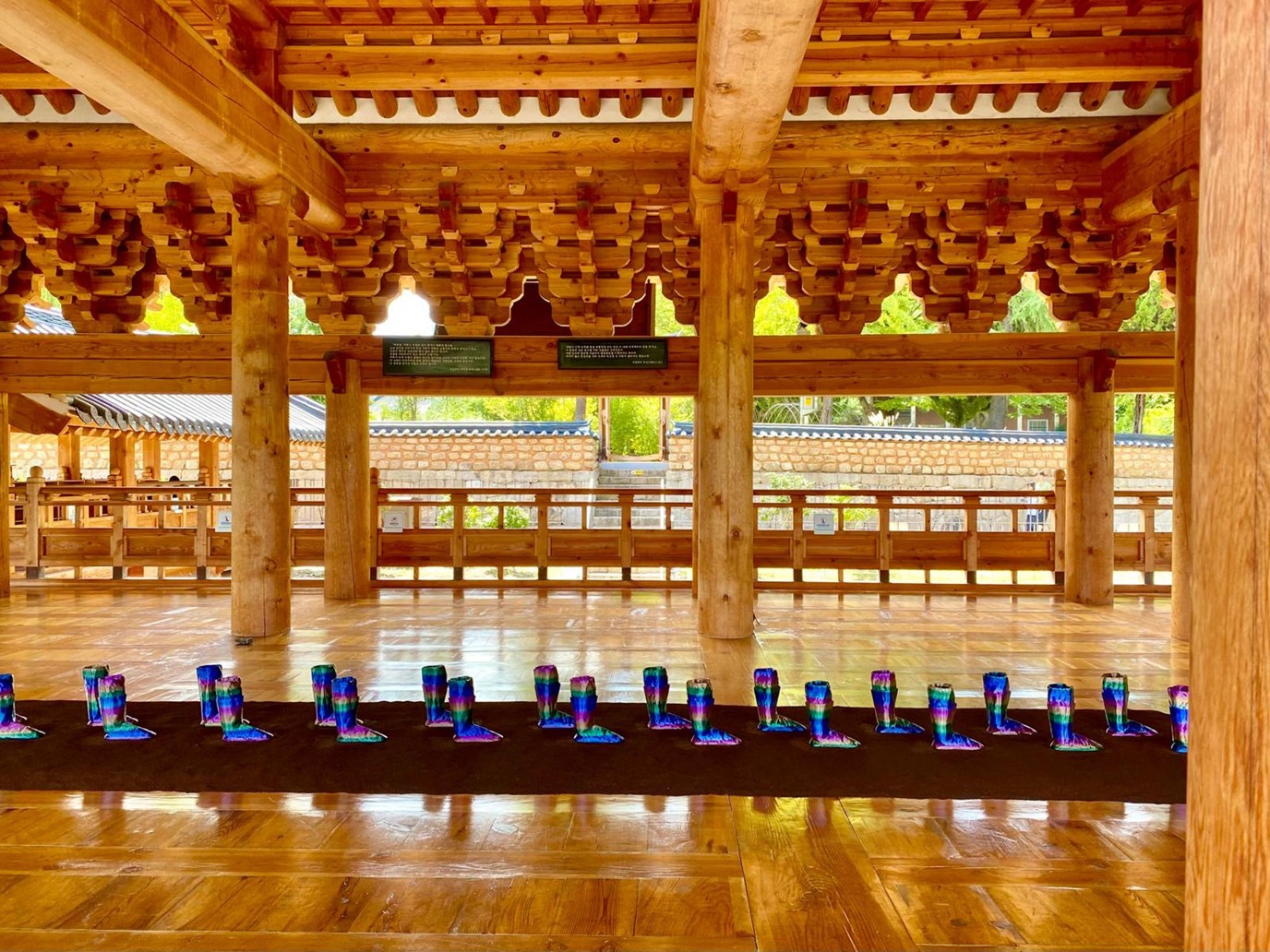
Colourful boots trace a path of coffee at
Heekyungru. Jessie Kleemann’s installation Kamiit Walking
(2026) uses 3D-printed replicas of kamiit inherited from her family. Through
these boots, she reflects on the work of her ancestral foremothers and on how
cultural memory lives on today.
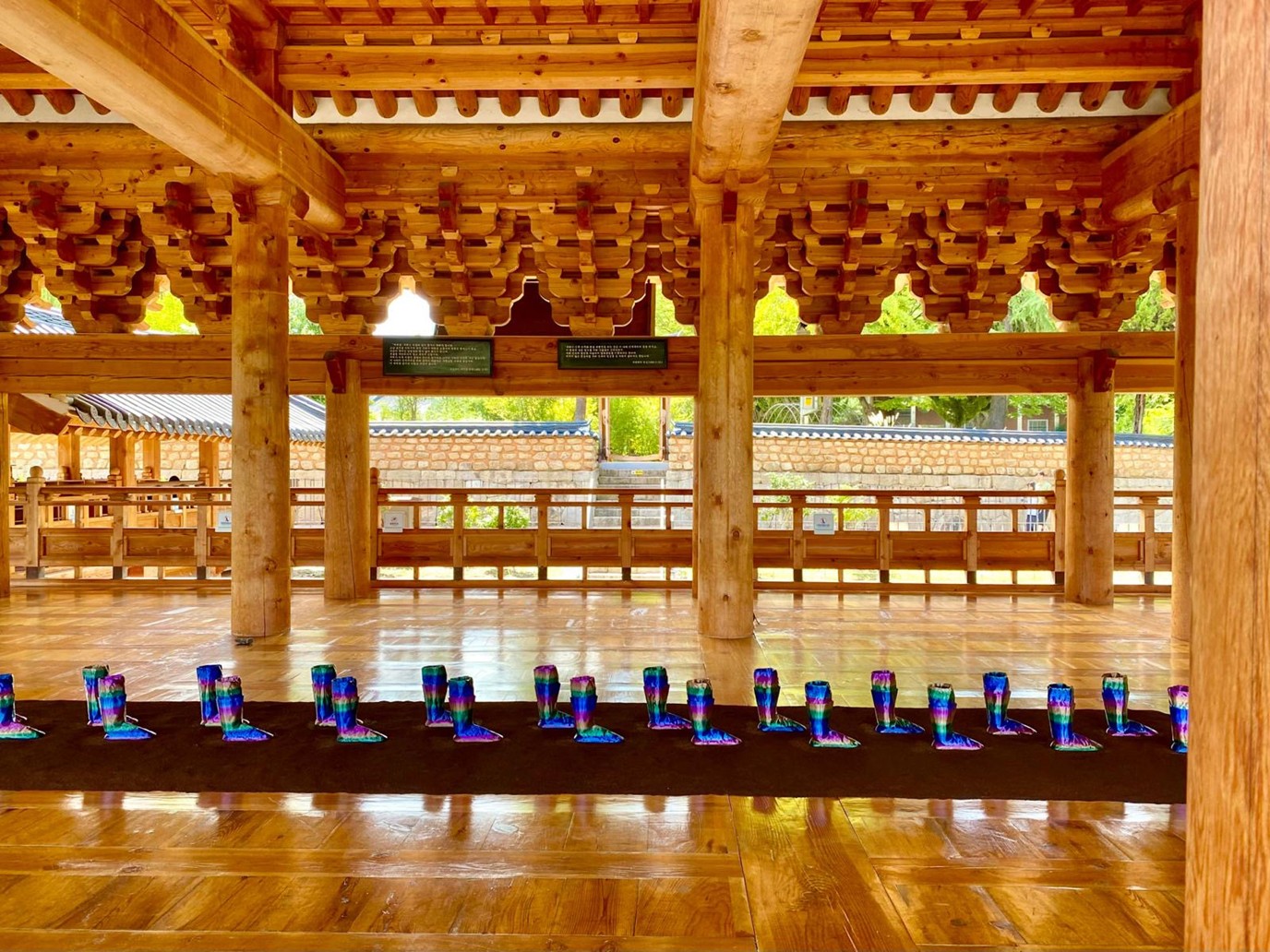
Jessie Kleemann, Kamiit Walking, 2026. Installation view, Kalaallit Illuutaat Pavilion at Heekyungru, 16th Gwangju Biennale. Courtesy of the artist and the Kalaallit Illuutaat Pavilion.
1. What is the central question you hope to share through this
presentation in Gwangju?
《Kamiit Walking》 begins with boots inherited
from your family, inviting viewers to imagine the bodies that wore them and the
lives lived in them. What do you hope audiences might come to see differently
through this work?
I wanted to share that what we inherit is not only physical. A pair of
kamiit, for example, can carry more than meets the eye. We inherit history. In
this piece, one might say the work invites us to look at the unseen work of
women, from an Inuit woman’s perspective. We walk the path and do the work as
our ancestral foremothers did. Now we do it in this world. I somehow believe
that it is all political: what we do, where we work and live, and who we are.
2. How do your artistic choices reflect your understanding of
inheritance?
Transforming inherited boots into an artwork and placing them in a new
setting involves deciding what to retain and what to change. Could you discuss
a particularly important choice in developing the Gwangju installation, and how
it relates to your understanding of inheritance?
When we replicate something, such as a piece of clothing or a part of it
that has traditionally taken a particular form, we know we are continuing a
tradition in the way it is expected to continue. In making this artwork, I
wanted to take another look. I remembered my aunties’ work, particularly my
mother’s, and how we Kalaallit Inuit women have changed things along the way,
from colonial eras into postcolonial times.
I do not make the kamiit myself. Like many others in my generation, I had
to pursue vocational training and education in other fields. We often inherited
some of our most distinct cultural symbols, including traditional festive
clothing, called the national dress in Danish. When these things still have a
living function, it is difficult to negotiate their place in our lives.
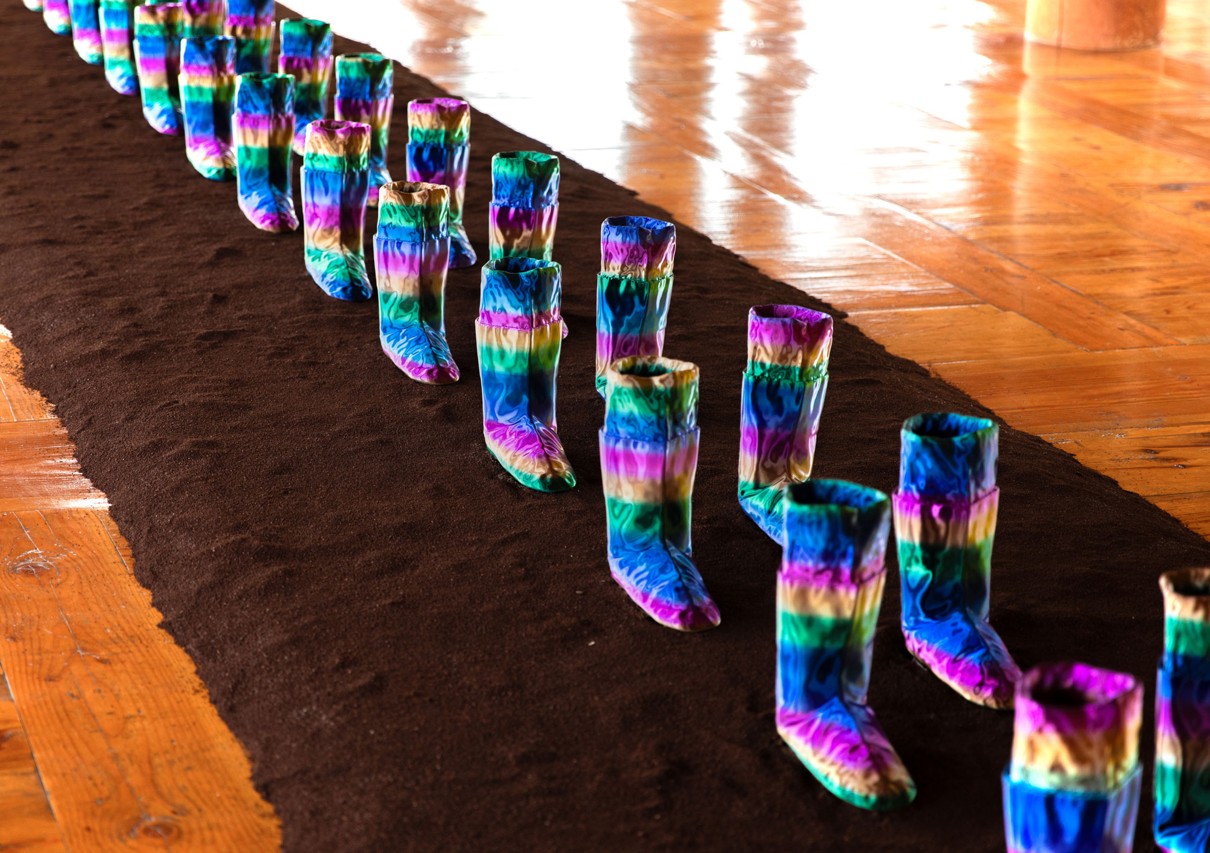
So I decided to make 3D prints of the pair I inherited and place them on a
path of coffee, like soil, as a nod to Soil for Scoresbysund
by the late Pia Arke. By making this visual work as an installation, I point to
an inheritance that is wider and closer to what comes to life through memory.
As a performance artist, I have used things connected to my culture many
times. It is almost an inquiry in itself: have I inherited something tangible
from my culture that is still alive, or have I inherited the symbols?
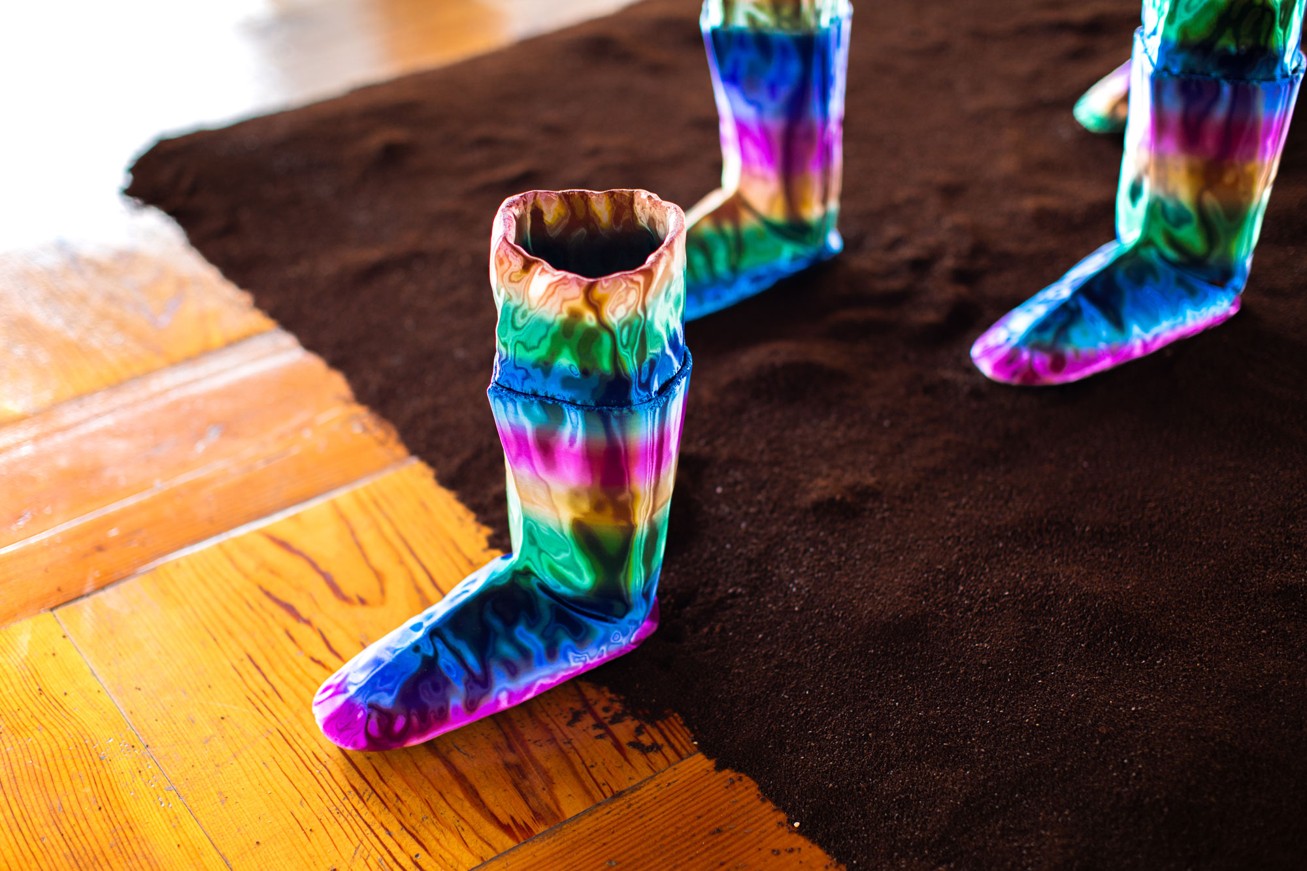
Jessie Kleemann, 《Kamiit Walking》, 2026. Installation view, Kalaallit Illuutaat Pavilion at Heekyungru, 16th Gwangju Biennale. Courtesy of the artist and the Kalaallit Illuutaat Pavilion. © Jaeseo Lee
3. How has the recent international attention on Greenland
affected the way your work is understood?
There can be a distance between how a place enters the international
spotlight and how its people experience their own lives. In presenting Kamiit
Walking in Gwangju, what would you most like audiences to understand beyond the
current headlines?
Interest in and attention to Greenland have increased over time. This is
not only a recent development, as some might think. We have been under pressure
for a long time.
For a very long time, my work was seen as “my work.” I was another
Greenlandic Kalaaleq artist, rather than someone expected to speak on behalf of
others. At the same time, over the years I have spoken about and addressed our
problematic relations with both colonizers. There are also questions that arise
from working and living abroad. I have been lucky to meet and work with kindred
souls over the years.
To say one thing about cultural migration, women are particularly exposed
to prejudice and othering. Of course, this affects not only women but Kalaallit
Inuit more generally. We share human lives, make connections, and create
belonging.
4. How is the body present in this installation?
In your performances, your body encounters the audience directly; here, the
boots and the path evoke bodies that remain unseen. Considering the
installation alongside your opening performance, what possibilities do these
different forms of bodily presence offer for exploring memory and personal
self-determination?
The body is many bodies in one. Or the memories that carry the body
multiply into many. We have an Inuit saying, “All things spirit,” meaning that
everything has a living spirit.
Of course, a performance is often a single action, here and now. But it
could also repeat itself many, many times, or suffer a silent death, left
untouched and unspoken.
I think the performance will decide where it goes. I have only decided to
be in it and share it; then it is free.
At some point, I cannot make “decisions” on behalf of the participants.
Some would call them “spectators,” but when people come to see a performance,
are they not actually participating? That is the beauty of it, and I am very
grateful for that.
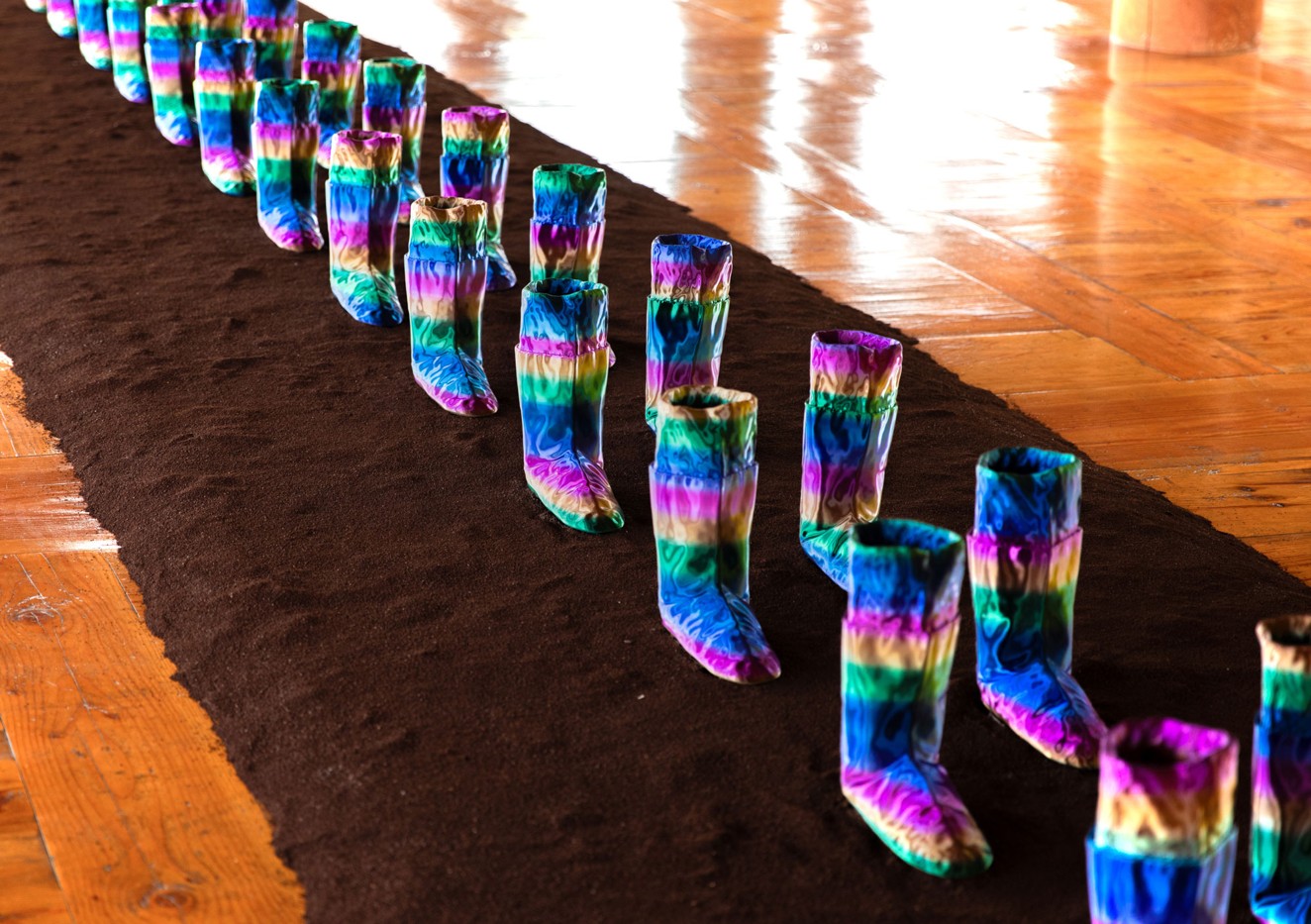
Jessie Kleemann, Kamiit Walking, 2026. Installation view, Kalaallit Illuutaat Pavilion at Heekyungru, 16th Gwangju Biennale. Courtesy of the artist and the Kalaallit Illuutaat Pavilion. © Jaeseo Lee
5. Where does the Biennale’s theme, “You Must Change Your Life,”
intersect with your practice?
Having worked with the body, memory, and identity over many years, what
does changing one’s life mean to you? Did presenting this work in Gwangju lead
you to approach the theme differently?
I believe I try to do things differently, and above all I challenge myself,
so the Biennale’s theme was perfect.
I do not know if I have changed that much. But the performance Kamiit
Walking: Crossing the River connected with the theme by pointing to
life and death through the act of crossing the river. We lost our father in
2013, and only recently have I started looking at his picture and talking to
him regularly. “You must change your life!” Our mother is still with us; she is
now 93. I know change must come, but at some point we also have to prepare for
it.
I am working with the theme “Soul Beautify Thyself,” writing in response
through poetry and chants. I have also started “singing” for it, which is a
huge change in my practice.
Additional note from curator Amy E. Smith: Kleemann filmed a new piece at
Heekyungru, Kamiit Walking: Crossing the River. It is an
homage to her forebears who struggled and fought for social change, and a
meditation on death and the power of cultural memory.
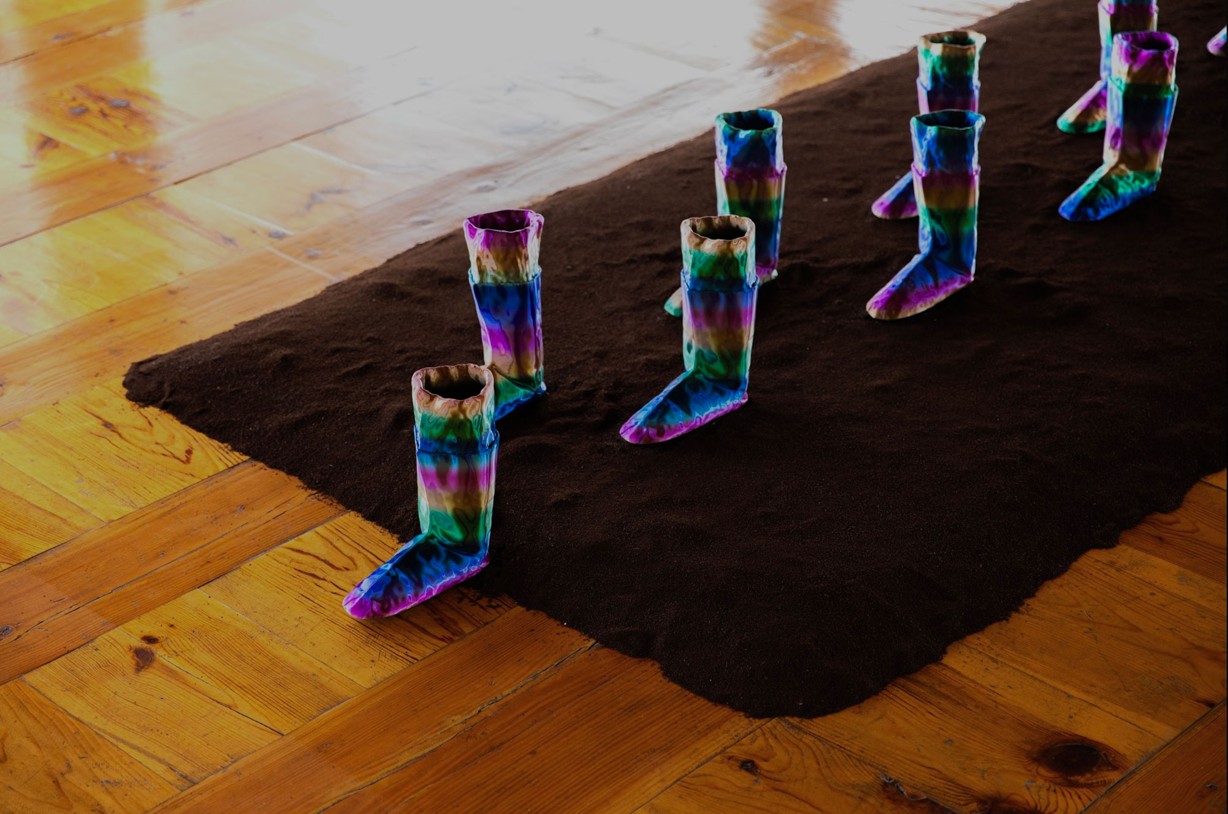
Jessie Kleemann, Kamiit Walking, 2026. Installation view, Kalaallit Illuutaat Pavilion at Heekyungru, 16th Gwangju Biennale. Courtesy of the artist and the Kalaallit Illuutaat Pavilion. © Jaeseo Lee
Additional Comments by Curator Amy E.
Smith:
Kleemann filmed her new work, Kamiit
Walking: Crossing the River, at Heekyeongnu Pavilion. The work is
both a tribute to her ancestors who struggled and fought for social change and
a meditation on death and the power of cultural memory.
6. Which encounter with an artwork or an audience in Gwangju has
stayed with you most strongly? Please focus on a specific encounter. What did
it prompt you to consider about the questions artists share today, or about how
experiences from different places can meet?
The Taiwan Pavilion. There were many interesting and exciting art projects,
artworks, and video installations.
At the Canadian Pavilion, Shelley Niro’s The Shirt
stayed with me: “all you have left is a T-shirt.”
Curatorial Statement
Louise Bjeldbak Henriksen and Amy E. Smith
Jessie’s art practice felt so right for Gwangju. Her work, from the very
beginning, has always been politically engaged around personal
self-determination and national sovereignty. Her language as a performer, poet,
and visual artist continually moves between past, present, and future. She is
well positioned to carry on the Biennale’s commitment to honor the spirit of
the May 18 Movement of 1980 while presenting experimental and innovative works
that speak to the most pressing issues of the day. 〈Kamiit Walking〉 (2026) emerged during the
pavilion’s development from a growing sense of urgency around the climate
crisis and in response to the exhibition site, Heekyungru.
With 〈Kamiit Walking〉 (2026), the Kalaallit Illuutaat
Pavilion examines coloniality and its present-day impact on individuals,
communities, and environments. Its curatorial approach takes its cue from the
Gwangju Biennale’s long-standing commitment to experimental and politically
engaged work and furthers this year’s theme, You Must Change Your Life. The
Biennale and the Kalaallit Illuutaat Pavilion propose that change is created
through sustained actions by many. Jessie Kleemann’s installation and
performance recognize those who carry traditional wisdom across generations
while enacting social change.
About the Artist and Curators
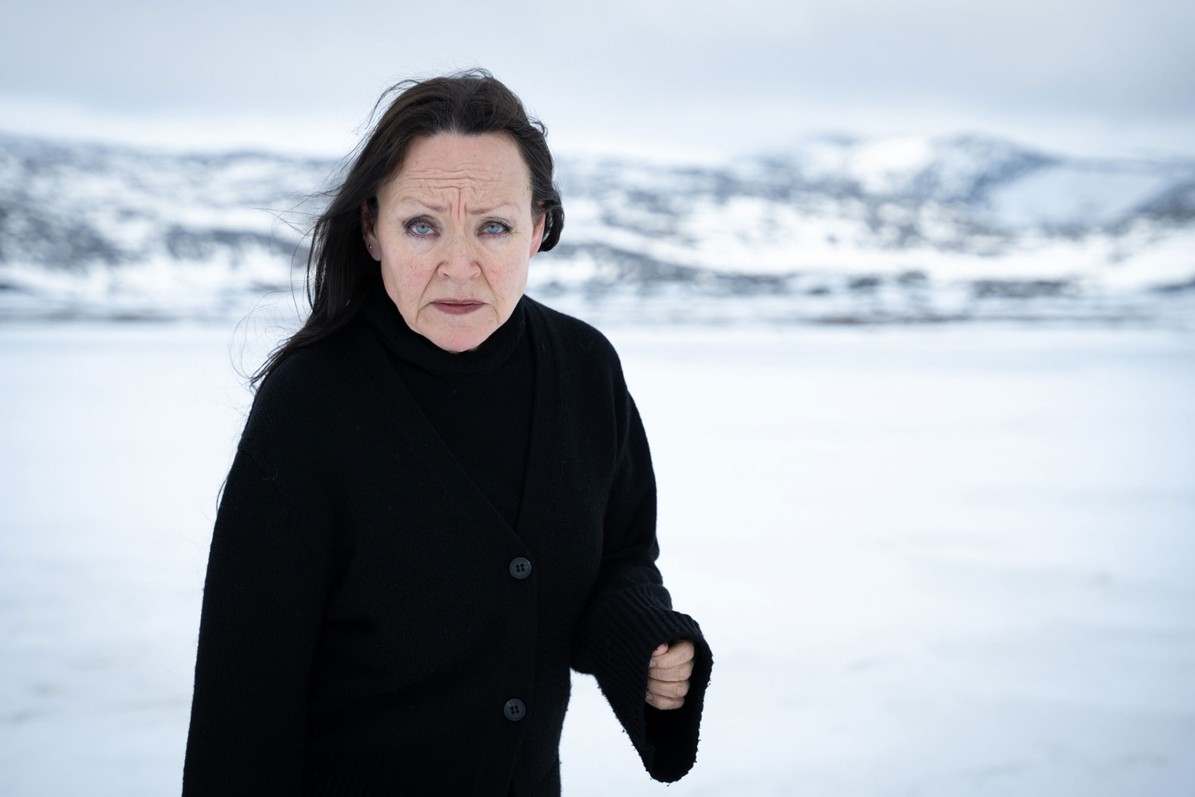
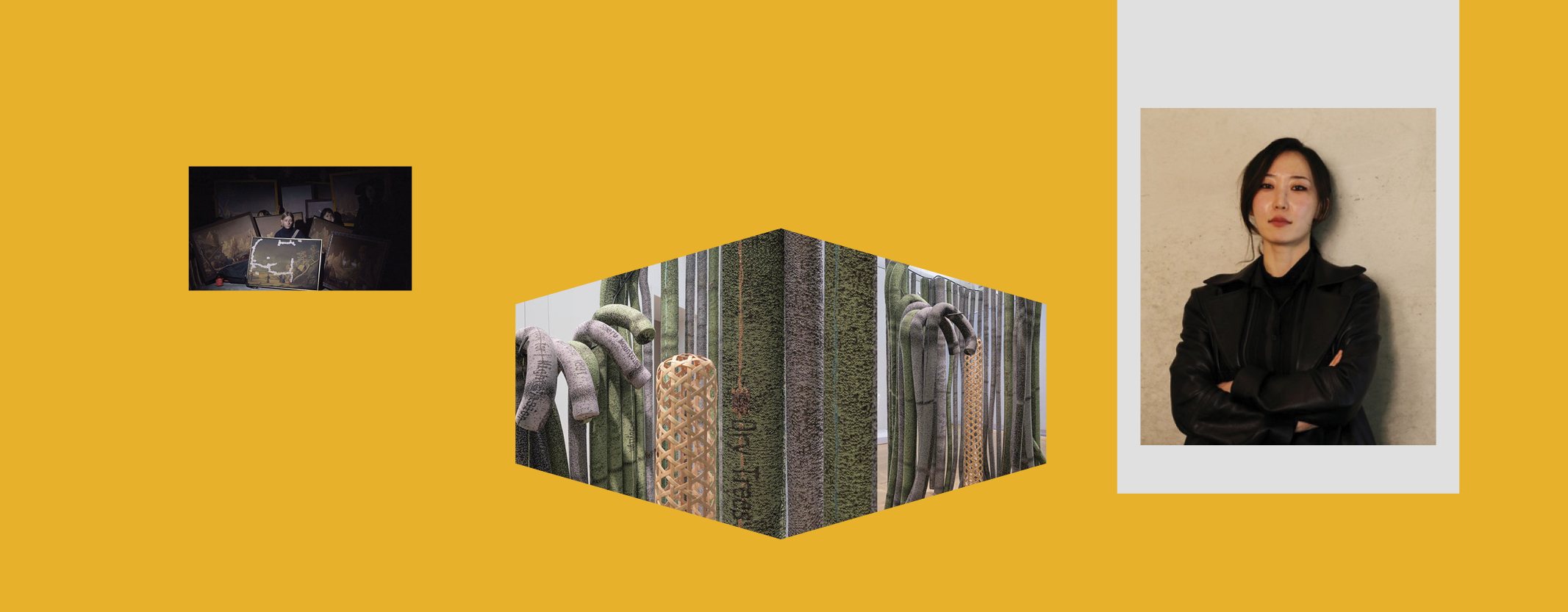
Jessie Kleemann, still from Running Time. Courtesy of the artist. © Christian Brems
Jessie Kleemann
Jessie Kleemann (b. 1959, Upernavik, Kalaallit Nunaat) works across video,
performance, painting, and sculpture. For over four decades, she has examined
questions of land, identity, body, language, memory, and both personal and
national sovereignty. Pairing Kalaallit Inuit cultural practices with
cutting-edge technology, Kleemann treats tradition and history as living tools
rather than fixed inheritances—as available to her as any physical material.
She approaches language in much the same way, moving fluidly between
Kalaallisut, Danish, and English. Her own body remains central to her practice,
alongside recurring materials such as coffee, beads, and blubber, whose role in
shaping Inuit identity she persistently interrogates. Her critique of
colonialism extends beyond people to encompass land and climate alike.
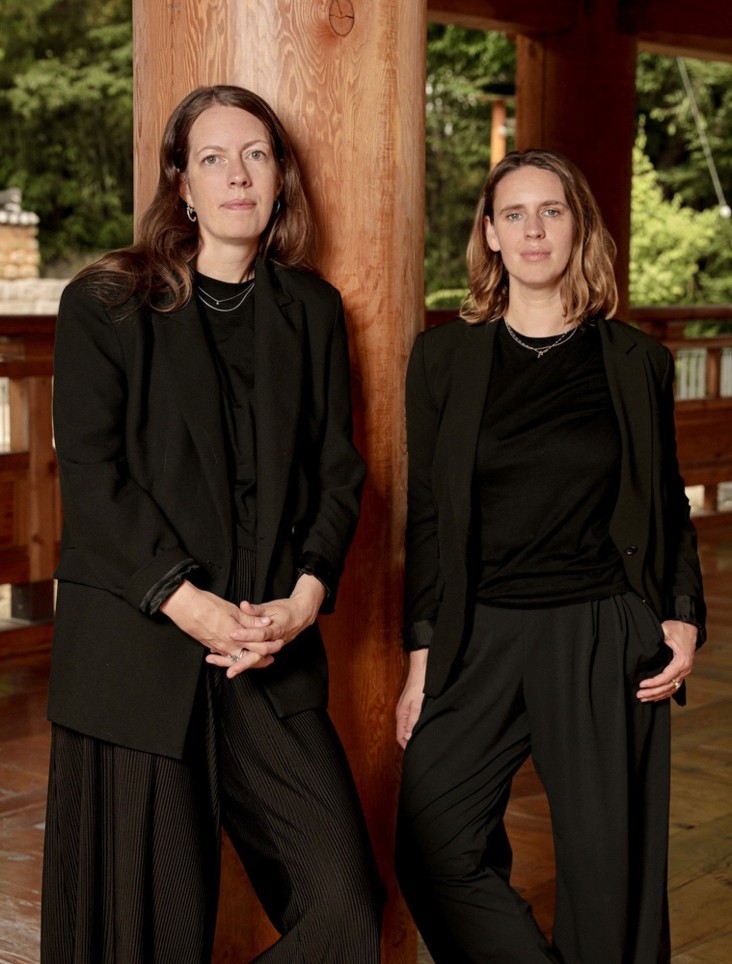
Louise Bjeldbak Henriksen and Amy E. Smith, curators of the Kalaallit Illuutaat Pavilion, 16th Gwangju Biennale. © Jaeseo Lee
Louise Bjeldbak Henriksen
Louise Bjeldbak Henriksen (b.1990, Denmark) is an independent curator based
in The Hague, Netherlands. With a dual background in art history and political
science, she has organized solo exhibitions internationally at ARoS Aarhus
Kunstmuseum, Kunsten Museum of Modern Art Aalborg, Kunstmuseum Den Haag, and
Museum Beelden aan Zee, among others, focusing often on socially engaged
practices and underrepresented perspectives.
Amy E Smith
Amy E. Smith (b. 1983, USA) is a curator based in Denver, Colorado. She has
an MA in Art History from the University of Groningen in the Netherlands. Amy
began her career in Seoul as an independent curator and founding member of
Crazy Multiply Art Collective, along with time at Seoul Museum of Art, Arario
Gallery, and Seoul Auction. She is the Public Art Project Manager for Adams
County, collaborating with artists to develop site and community-specific
installations and exhibitions in public spaces.