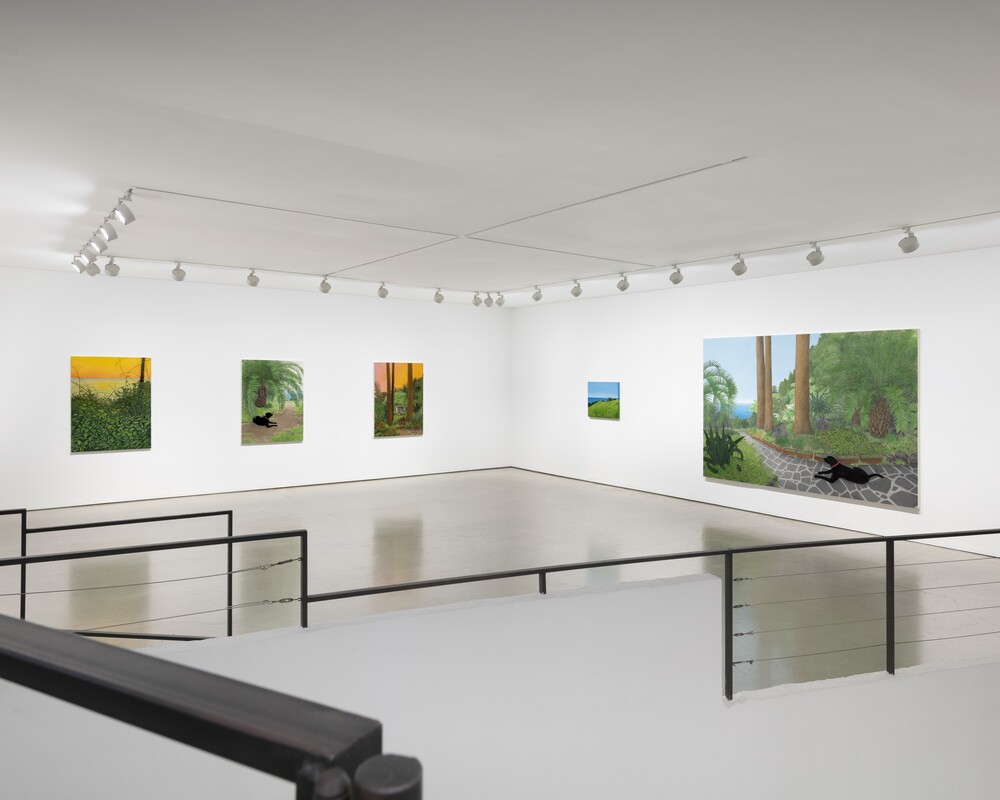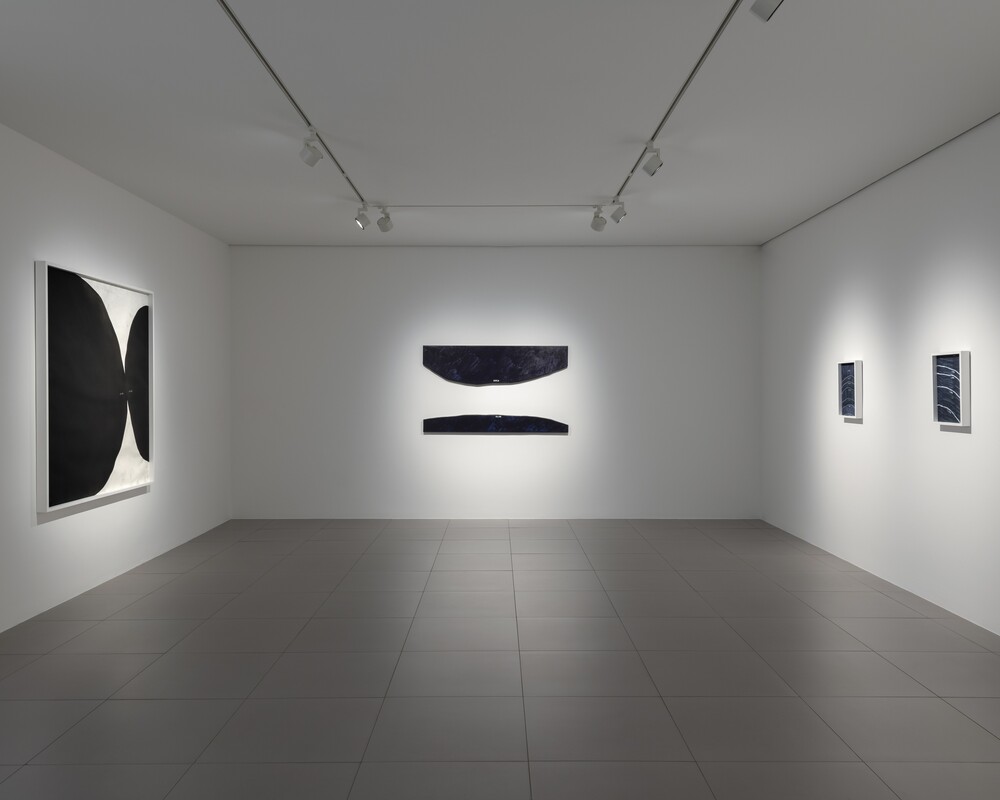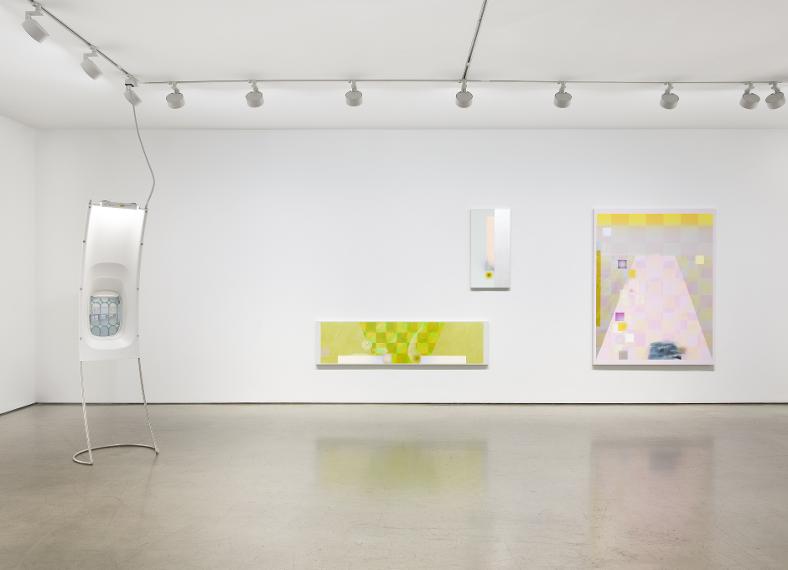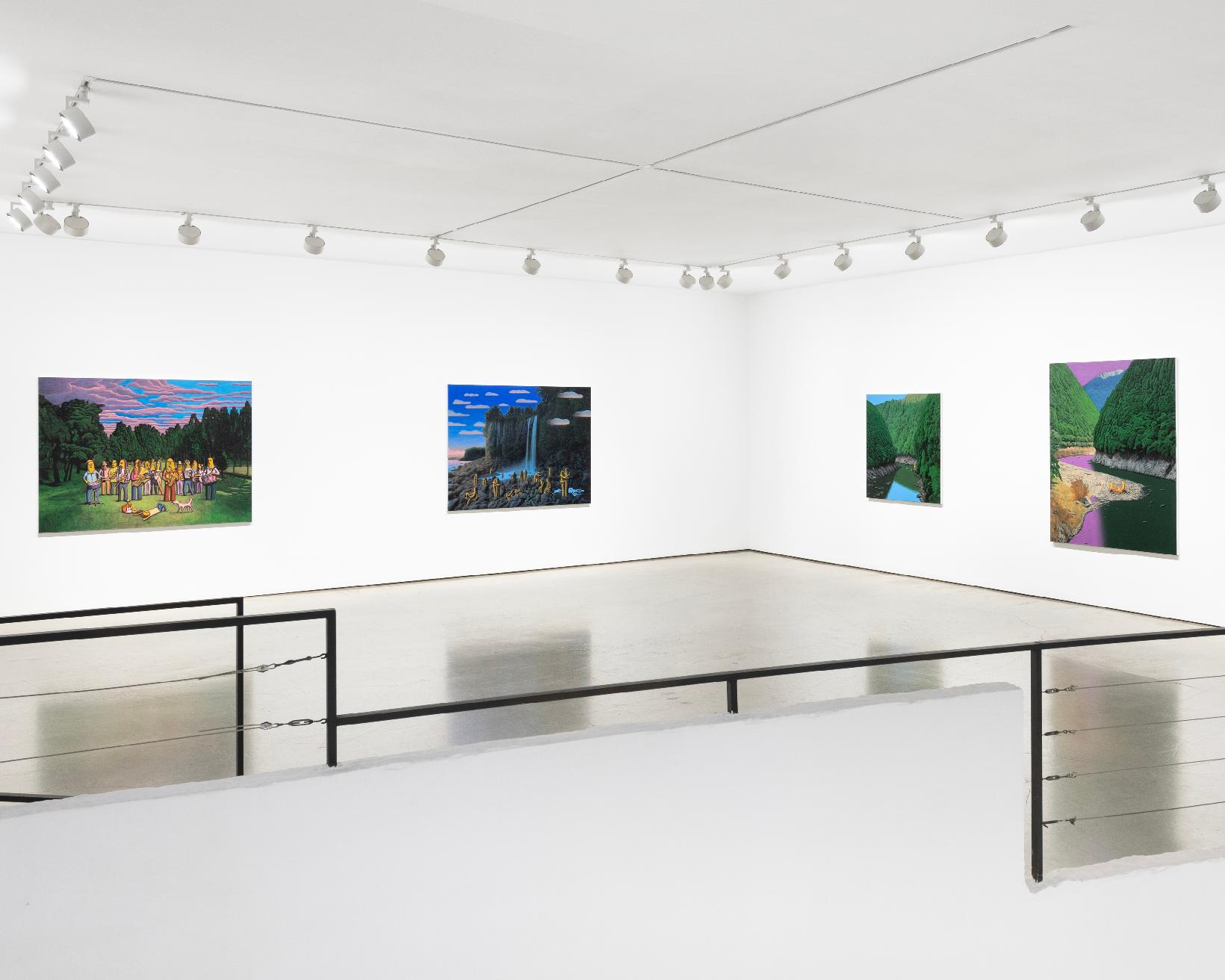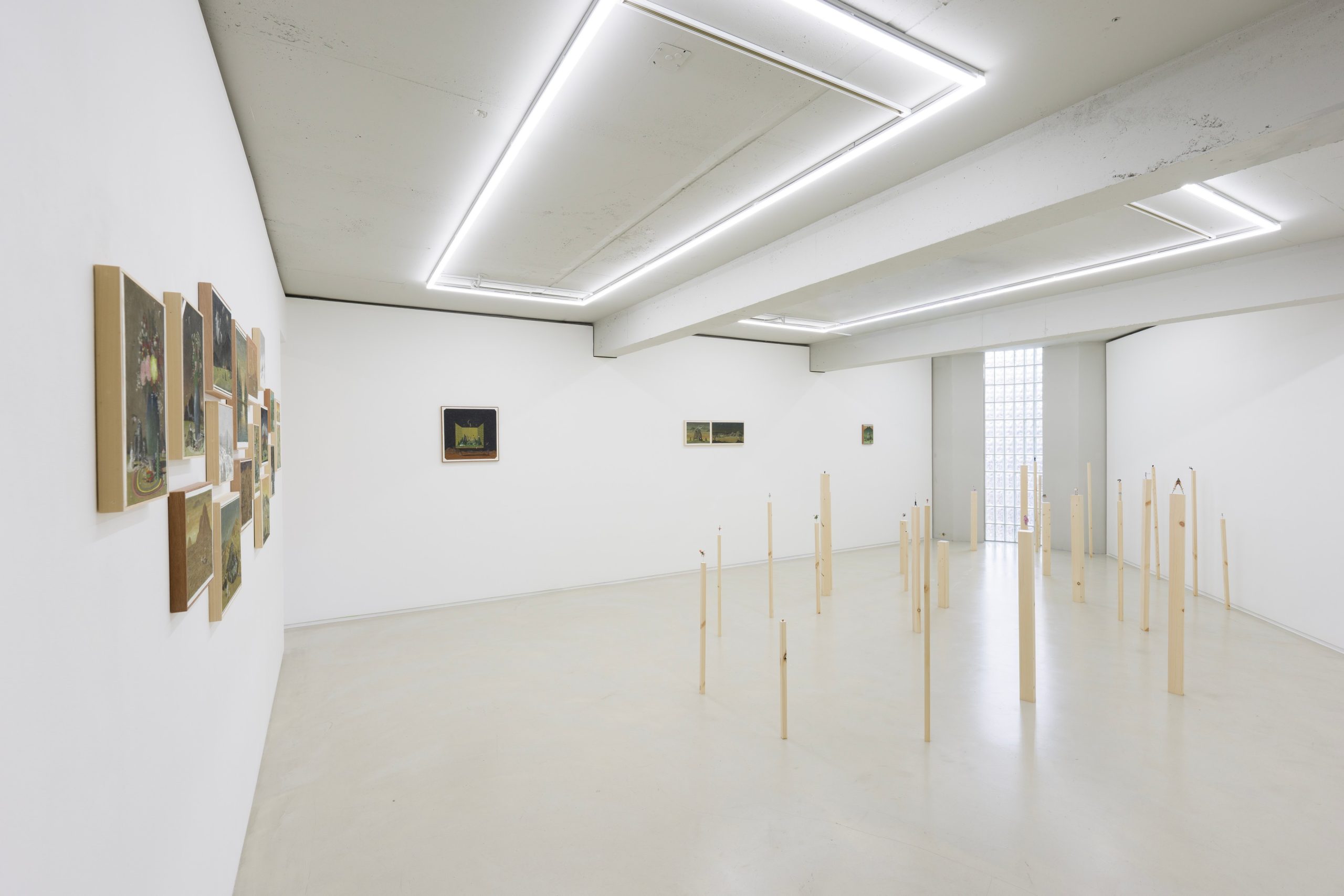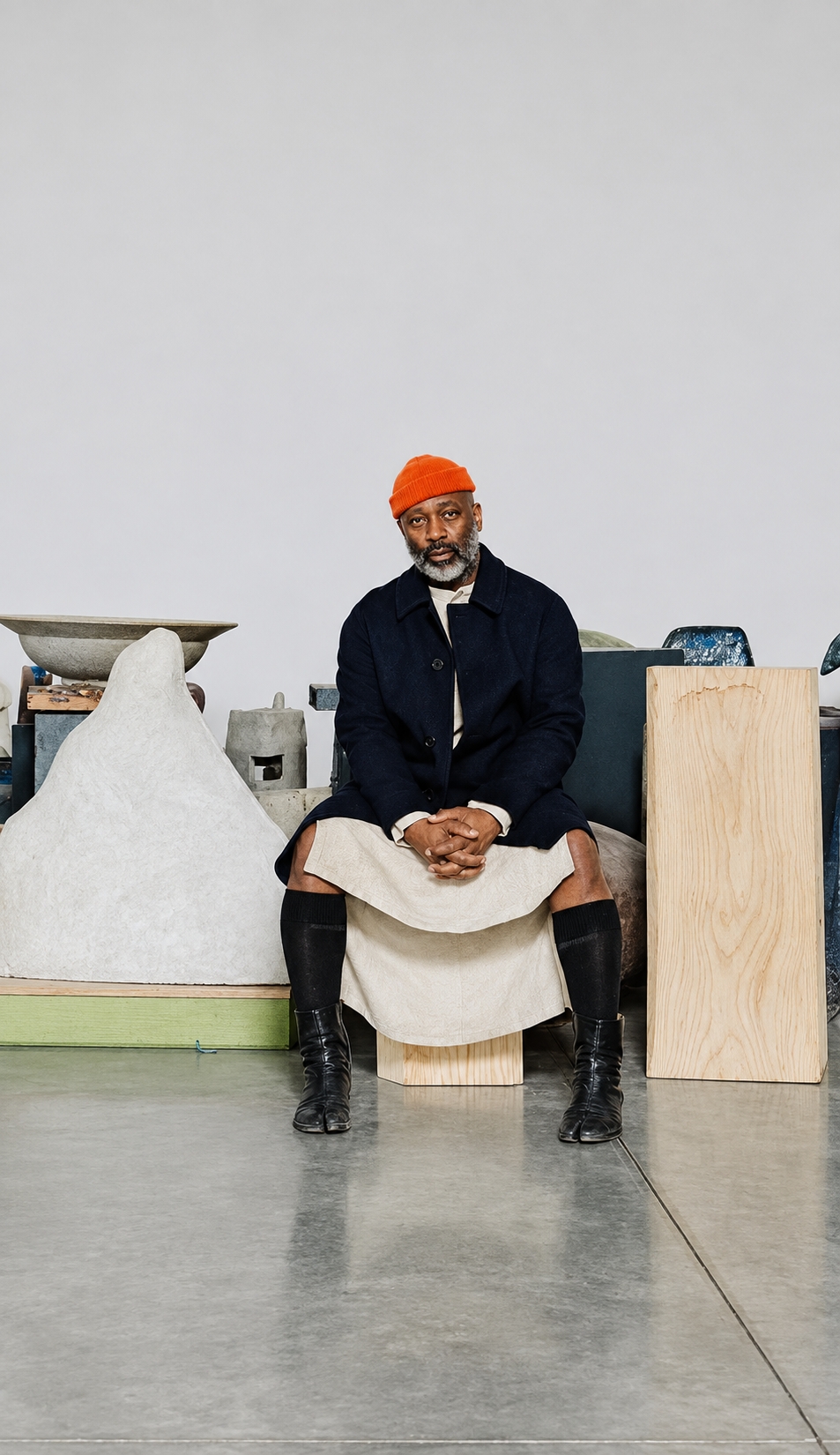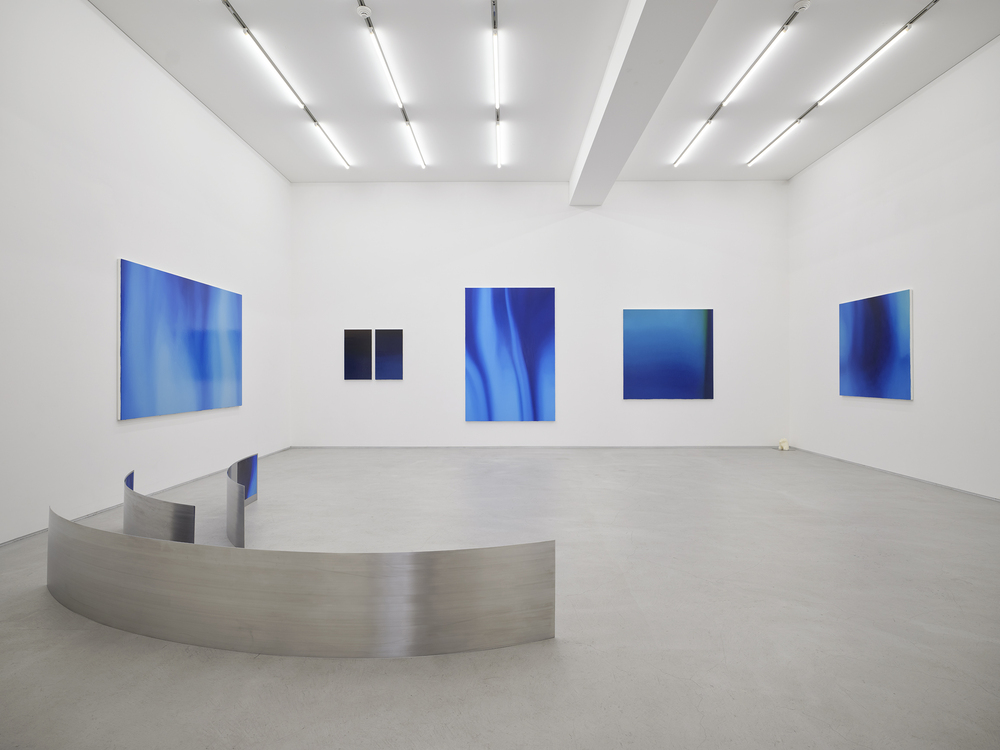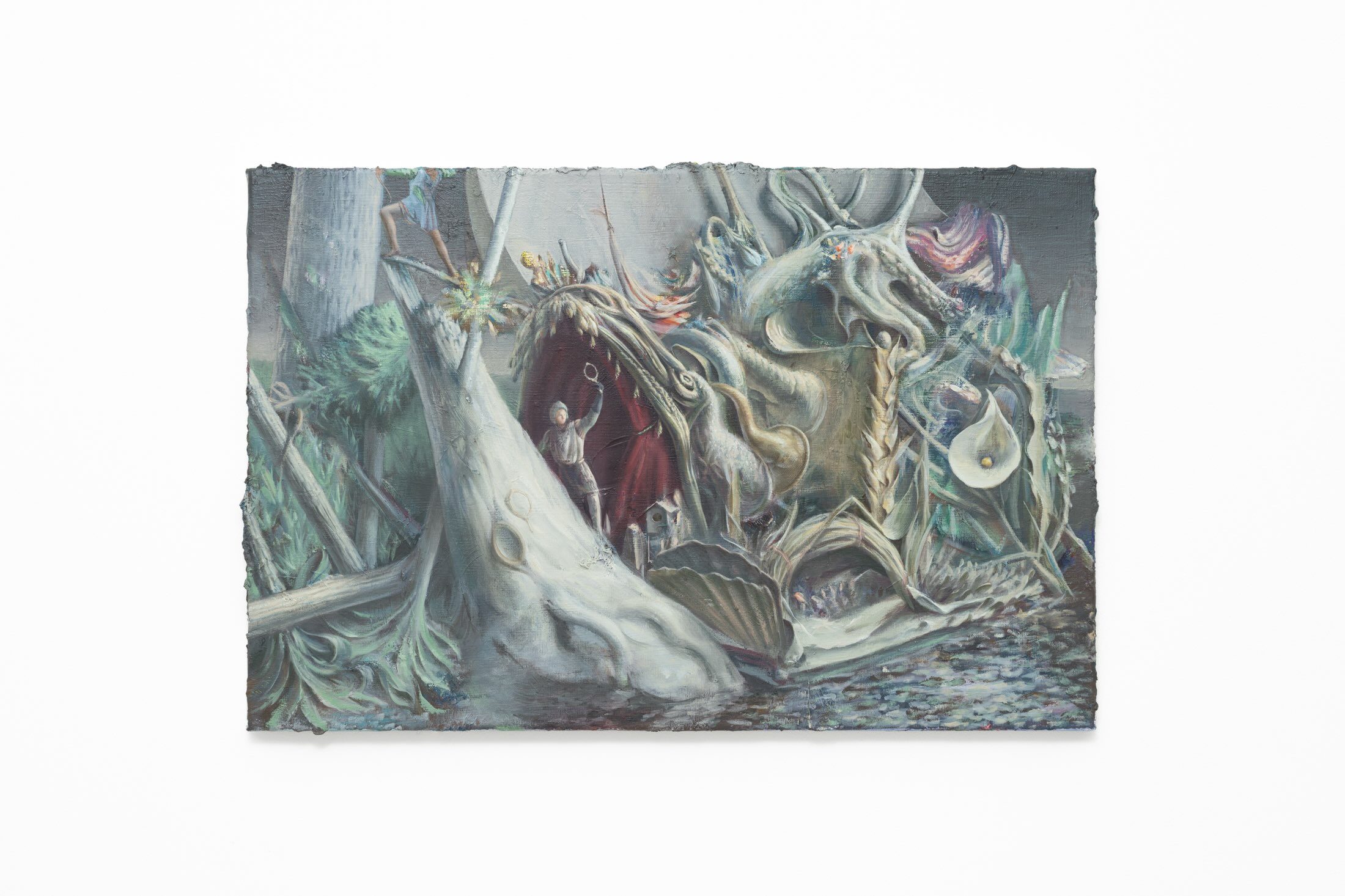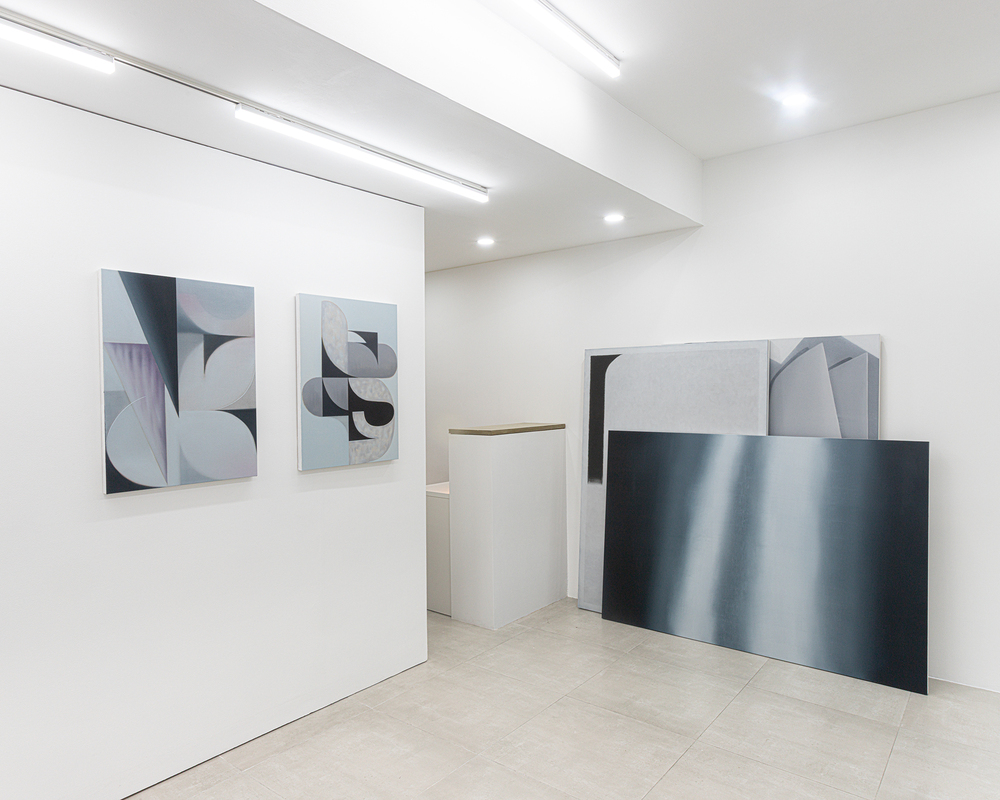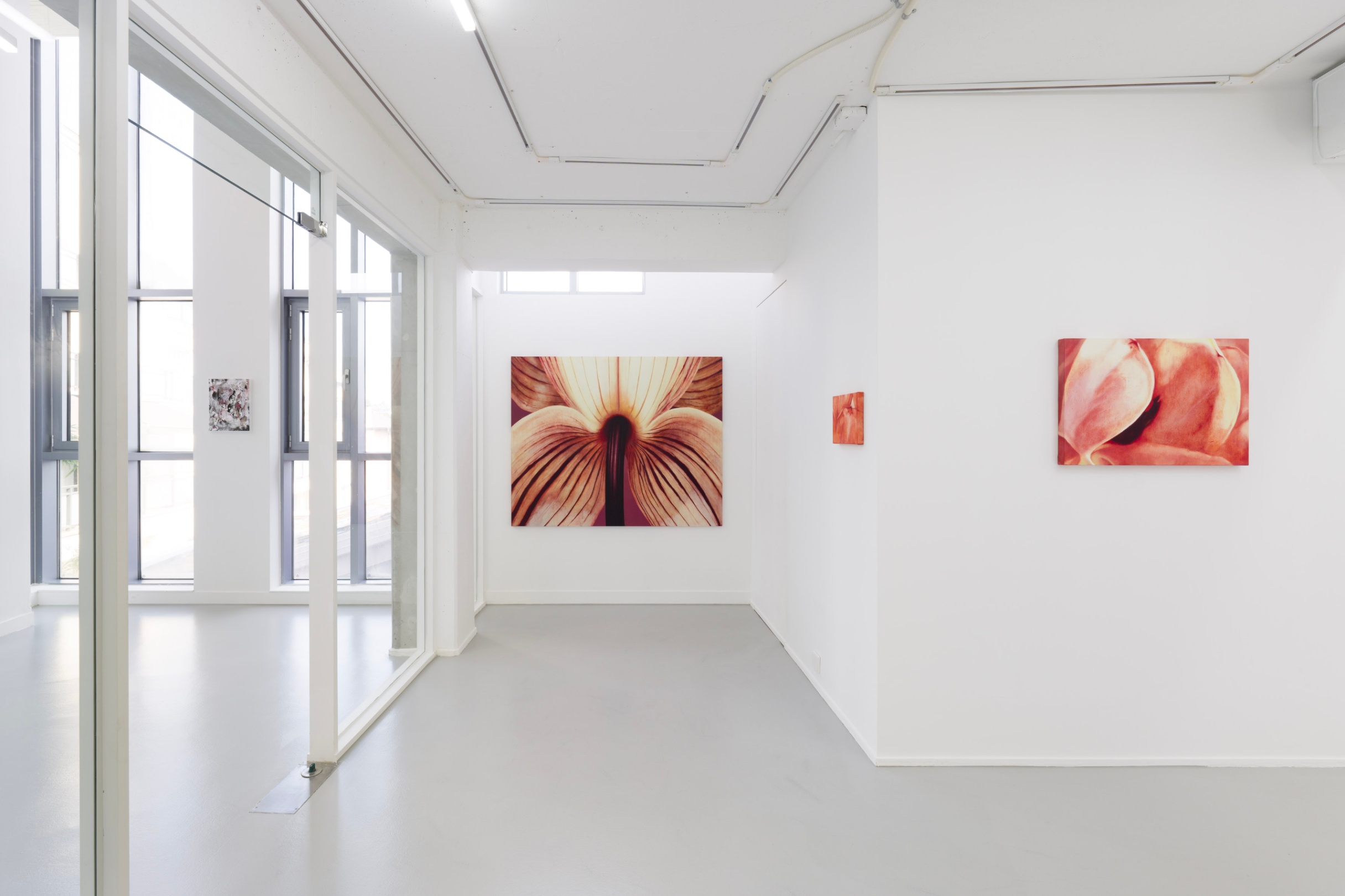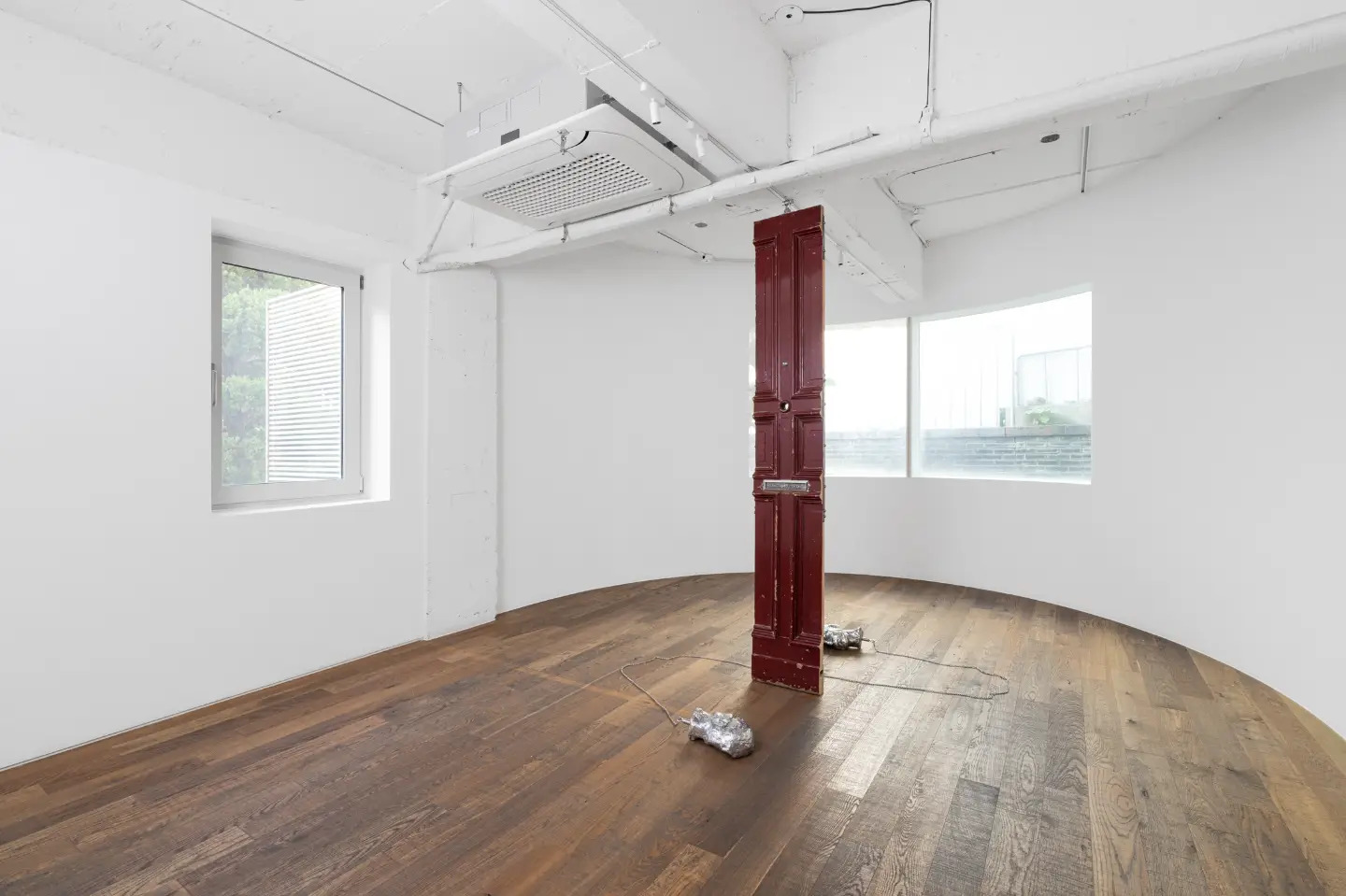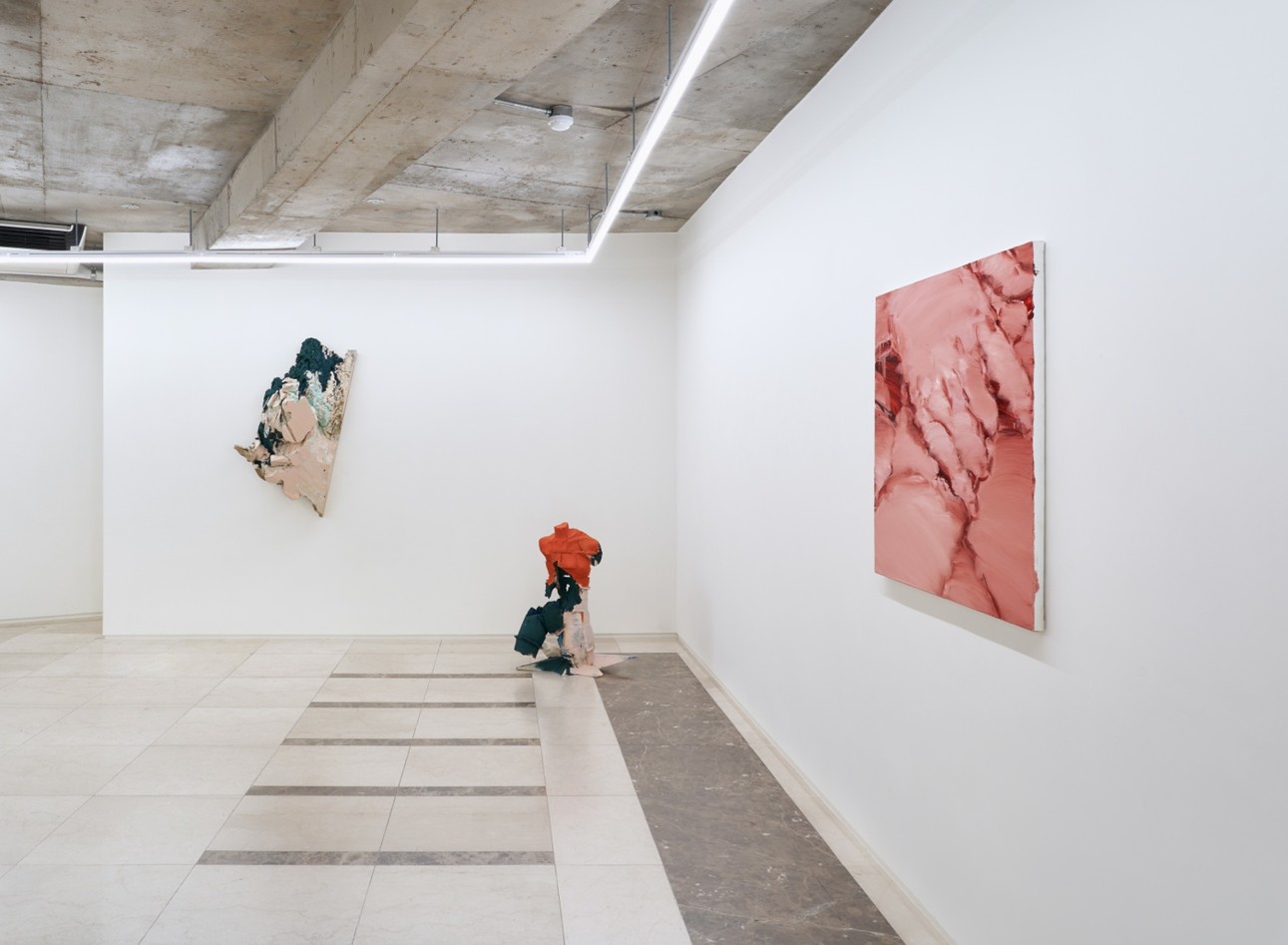

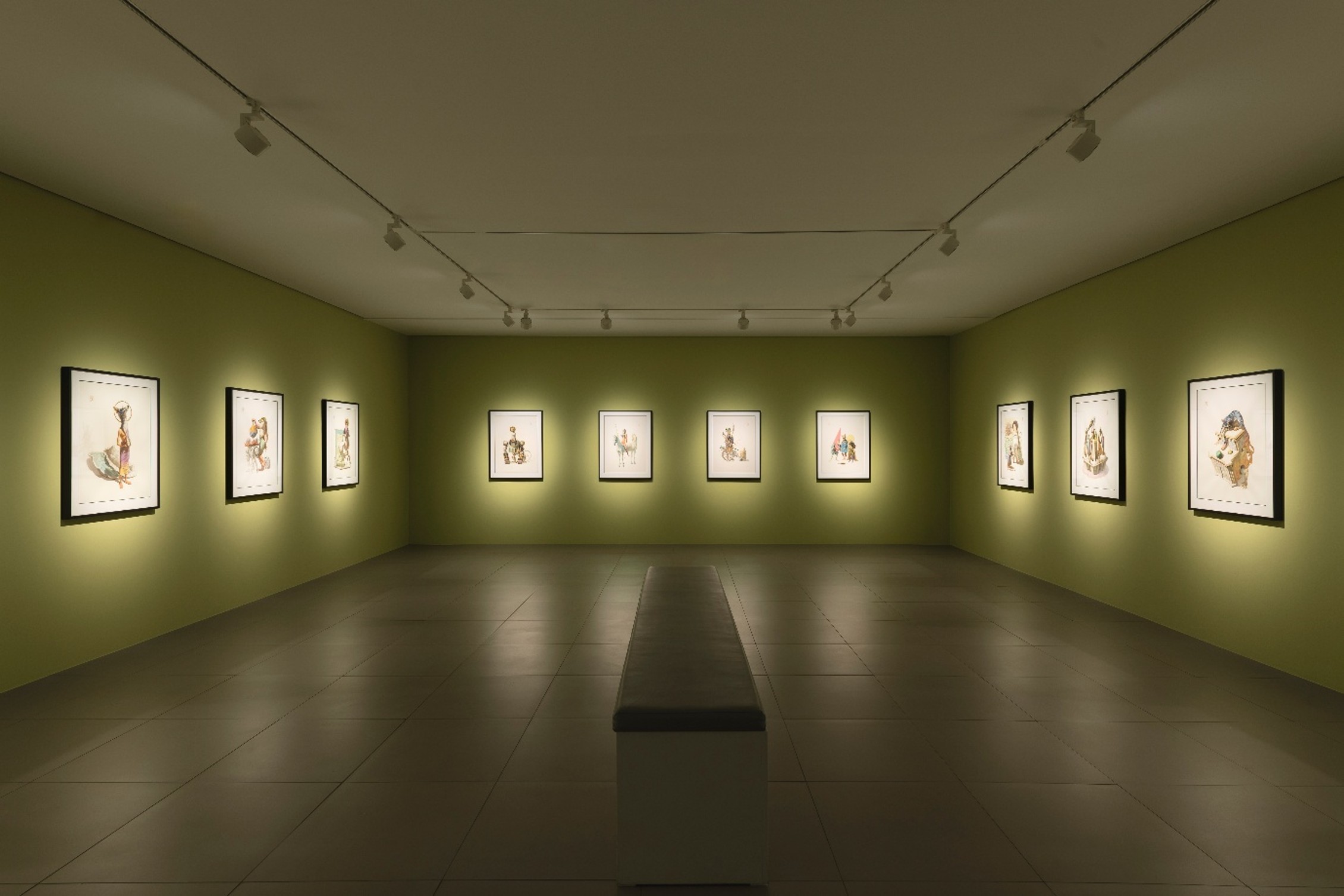
Installation view of 《IMAGINATIO》 at Hyundai Hwarang, Seoul, Korea, 2026. / Photo: Gallery Hyundai.
Park Minjoon (b. 1971) is presenting his
solo exhibition 《IMAGINATIO》 at
Hyundai Hwarang in Samcheong-dong, Seoul, from November 11 to December 27,
2026. Featuring 35 works on paper executed in watercolor, acrylic, and gold
leaf, alongside a motorized chandelier sculpture, the exhibition presents the
imaginative world that Park has developed over several decades through new
forms of artistic expression.
Park has established a distinctive
pictorial language grounded in the techniques of representation, iconography,
and compositional principles of Western classical painting. Drawing on figures
and scenes from religion, mythology, and literature, he has combined these
sources with narratives of his own invention, developing a practice that
encompasses painting, fiction, and sculpture. His practice is distinguished by
a sustained commitment to his own artistic concerns rather than a direct
response to prevailing trends or dominant discourses in contemporary art.
《IMAGINATIO》
continues this longstanding practice while introducing significant
developments. Whereas his earlier works concentrated on constructing elaborate
narrative worlds around his own novels and their characters, this exhibition
moves beyond specific storylines to explore imagination itself as the starting
point of artistic creation.
Fluid forms and freer compositions on
paper, together with sculptures that translate imaginary figures into
three-dimensional forms and movement, suggest an evolution in the artist's
visual language.
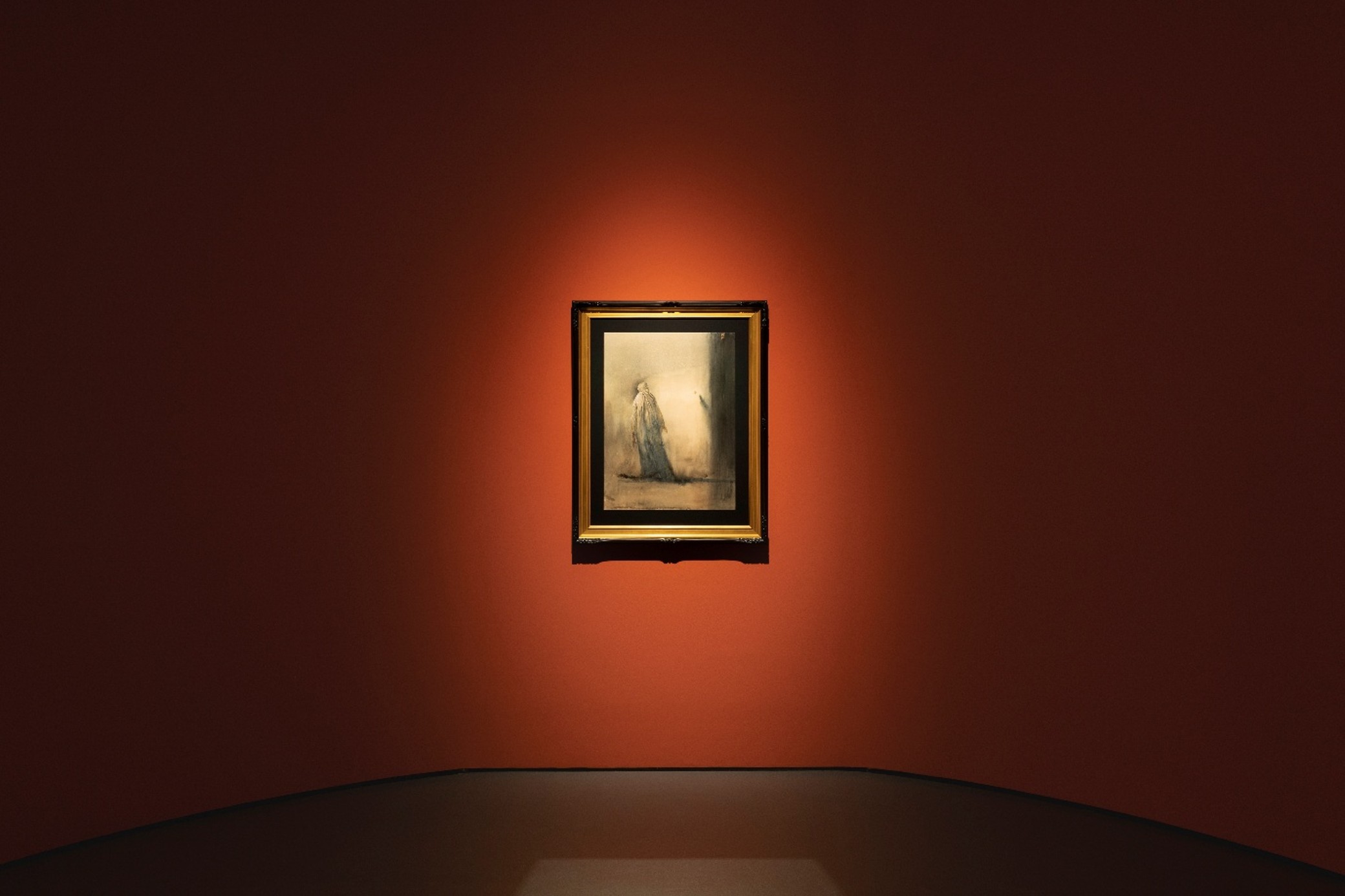
Installation view of 《IMAGINATIO》 at Hyundai Hwarang, Seoul, Korea, 2026. / Photo: Gallery Hyundai.
Park Minjoon's Visual Language
and the Traditions of Western Painting
Park's artistic practice is deeply rooted
in his study of Western painting traditions from the fifteenth to the
nineteenth century. His early works reveal a range of influences, including
Caravaggio's dramatic chiaroscuro and staging, Jan van Eyck's meticulous
rendering of form, Nicolas Poussin's use of color and classical composition,
and Jacques-Louis David's Neoclassical approach to the human figure.
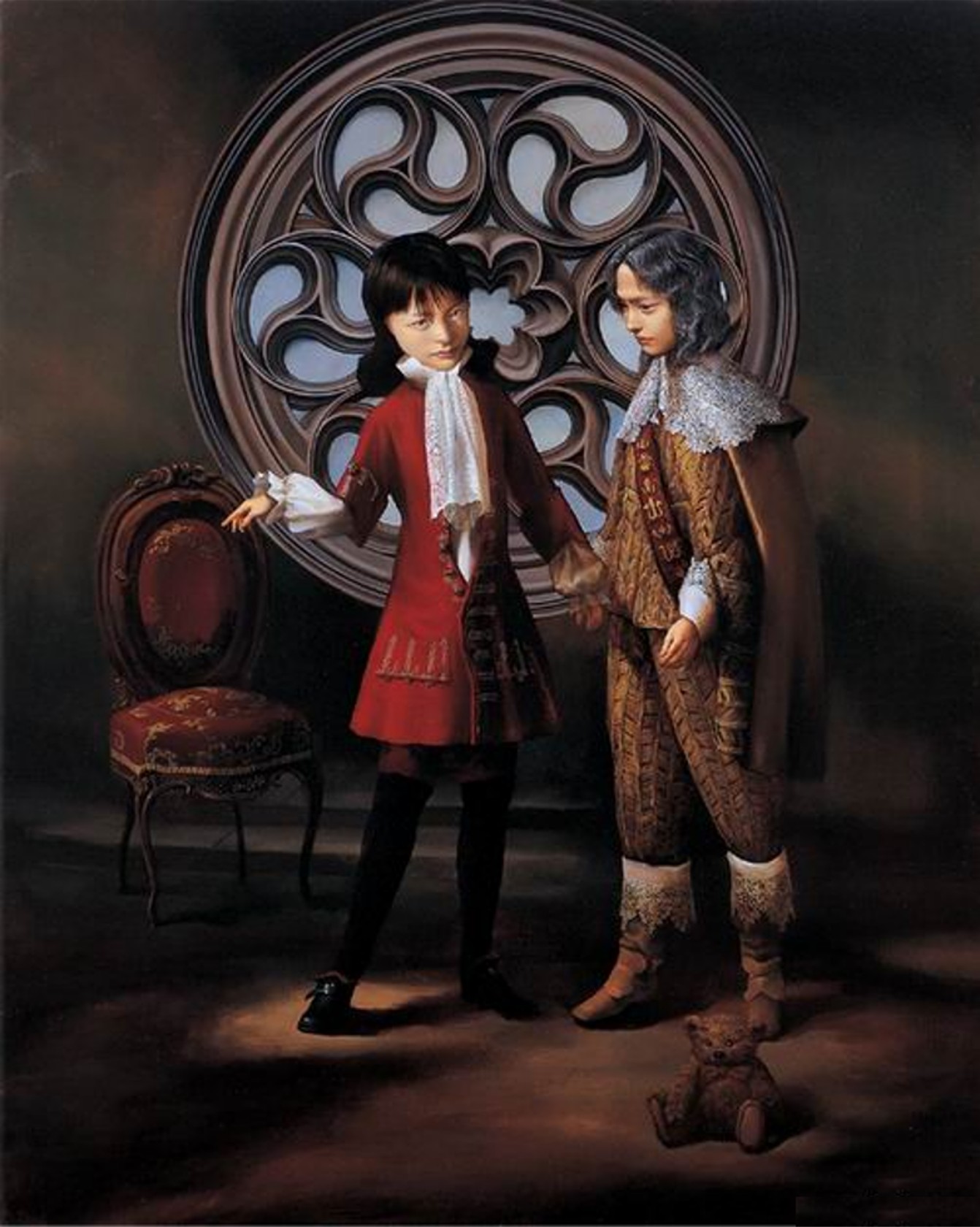
Park Minjoon, The Definition of Lies, 2002, Oil on canvas, 90 x 72 cm.
Exhibited in his first solo exhibition, 《The Comfort of Becoming Small》, 2003.
Beginning with his first solo exhibition, 《The Comfort of Becoming Small》 (2003), and
continuing through 《Song of the Lion》 (2005) and 《Happiness, Happiness, Happiness》 (2006), Park applied these techniques to his own figures and
scenes. His works from this period actively employed the formal and
compositional principles of Western painting while replacing traditional
religious and mythological figures with the artist himself, people around him,
and newly invented characters.
After studying painting materials and
techniques at the University of Tokyo in Japan, Park moved to New York in 2008,
where he concentrated on transforming established pictorial methods into a
language of his own. In 《Carnevale》, held at Gana Art New York in 2009, he incorporated figures created
through computer modeling into his paintings. By 《The
Stranger》, presented at Gallery Hyundai Gangnam in
2012, his distinctive treatment of figures, color, and pictorial structure had
become increasingly apparent.
These developments continued through 《Rapport Circus Prologue》 (2015) and 《Rapport Circus》 (2018). Centered on Rapo, a
gifted acrobat, and his younger brother Rafu, the artist brought characters
from his own novel together within a unified narrative structure.
The 2018 exhibition, in particular,
demonstrated his achievement in moving beyond the depiction of individual
figures and scenes to integrate an independently conceived fictional world into
a coherent pictorial language.
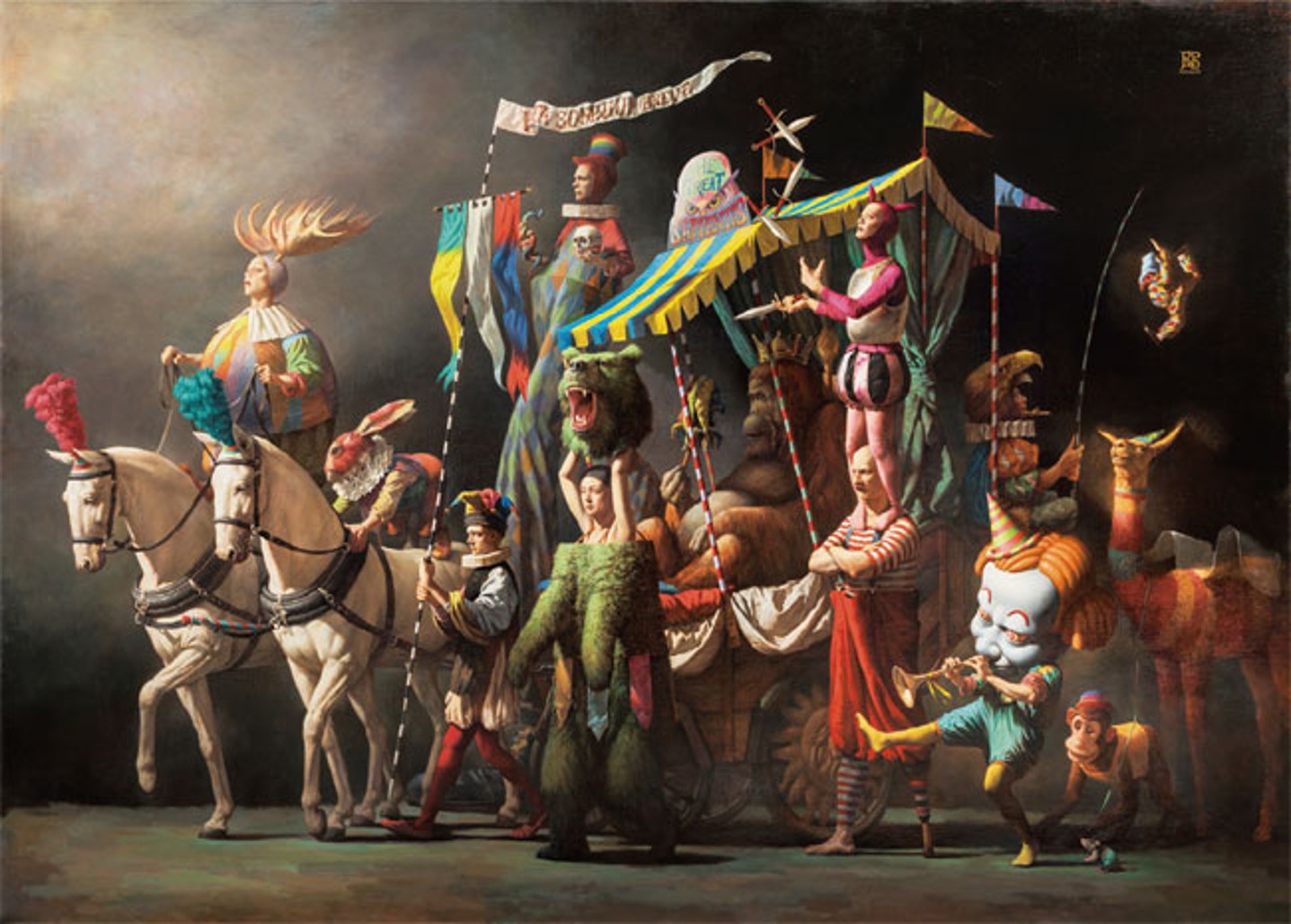
Park Minjoon, Parade for Rapo, 2016–2017, Oil on canvas, 210 × 294 cm.
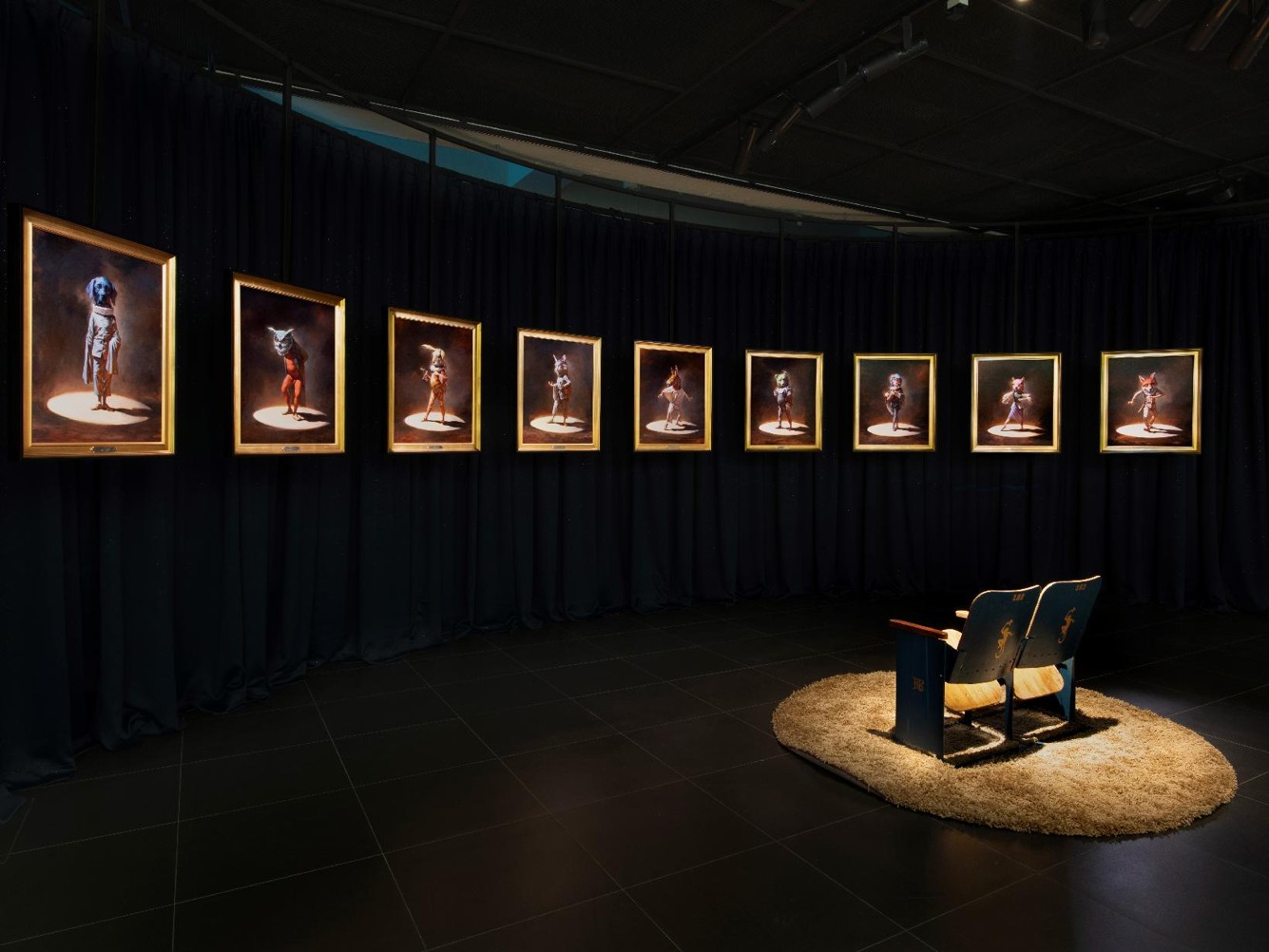
Park Minjoon, ‘Commedia dell'Arte’ series, installation view of 《X》, Gallery Hyundai, Seoul, 2022. / Photo: Gallery Hyundai.
The ‘Commedia dell'Arte’ series,
presented in Park's 2022 solo exhibition 《X》 at Gallery Hyundai, draws on the tradition of improvised masked
theater that emerged in sixteenth-century Italy.
Park reimagined its conventional characters
as figures with animal heads, assigning them distinct personalities and roles
through which to explore human desire, hypocrisy, life, and death. Combining
painting, text, and theatrical installation, the series extended the literary
narratives and imaginary worlds he had developed into a spatial form.
What matters most in Park's work is not the
accuracy with which he reproduces the traditions of Western painting. Rather,
it is his ability to apply accumulated techniques and compositional principles
to figures and narratives of his own invention, transforming established
art-historical forms into a distinctive visual language.
His practice therefore differs from simply
inheriting Western painting traditions or repeating historical styles. For
Park, classical painting serves not as a model for recreating the aesthetics of
a particular period, but as a formal foundation through which to realize his
own artistic vision.
Art as an End in Itself and
Inner Necessity
Another defining characteristic of Park's
practice is the consistency of his artistic approach.
Since the 1990s, Korean contemporary art
has increasingly engaged with international developments through installation,
video, photography, conceptual art, and various forms of mixed-media practice.
Within this broader context, Park has maintained a sustained interest in the
representational techniques and narrative structures of Western painting.
Rather than directly addressing particular
social issues or following prevailing formal tendencies in the art world, his
work has developed through a long-term investigation of artistic questions he
has set for himself.
This approach can be examined through the
concepts of art as an end in itself and inner necessity.
The idea of art as an end in itself
suggests that artistic value is not determined solely by external demands or
purposes, but arises from the principles and necessities intrinsic to artistic
creation. Inner necessity, meanwhile, concerns the relationship between an
artist's chosen subjects and forms and the underlying artistic questions that
motivate them, rather than treating these choices as matters of personal taste
or technical preference alone.
Park has long been concerned with the
themes of life, death, and eternity. Figures and scenes drawn from mythology,
religion, and literature have served as vehicles through which he explores
these fundamental questions.
Yet the sustained pursuit of particular
themes does not, in itself, guarantee artistic achievement. What matters is how
independently and convincingly such concerns are realized through specific
formal elements, including composition, form, color, and space.
Park's work must likewise be considered
according to these criteria. More significant than his decision to adopt
Western painting traditions as his artistic foundation is the extent to which
he has developed his own formal order and modes of expression through them.
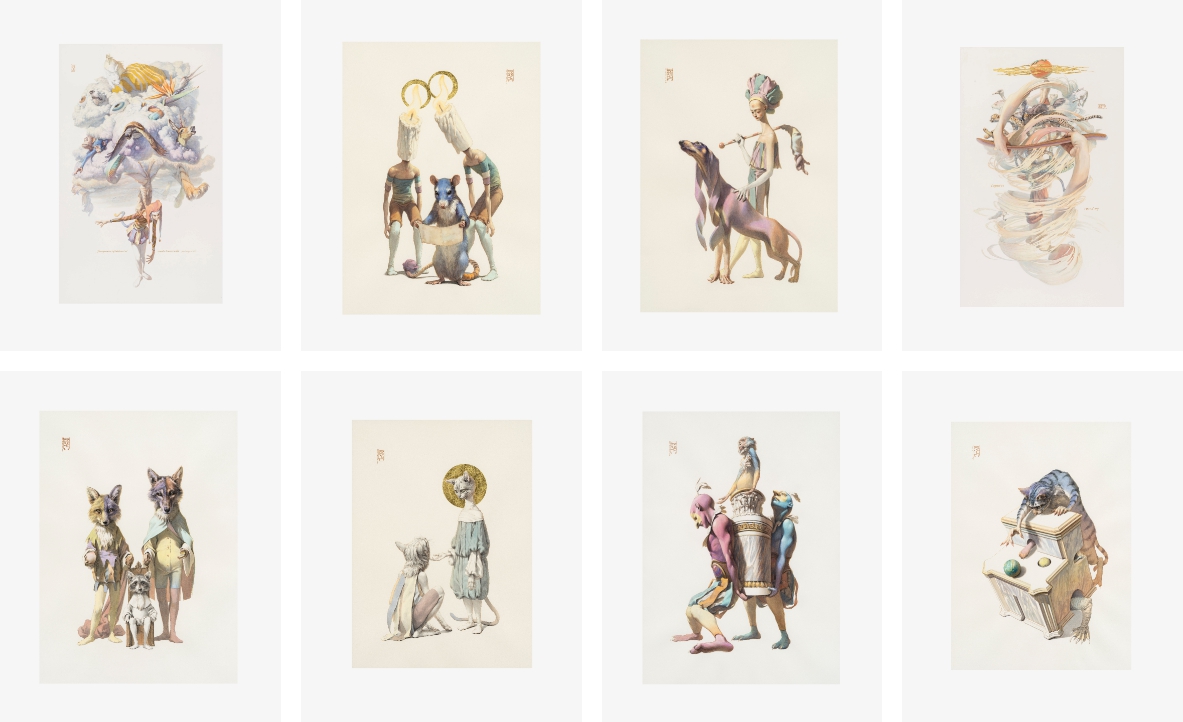
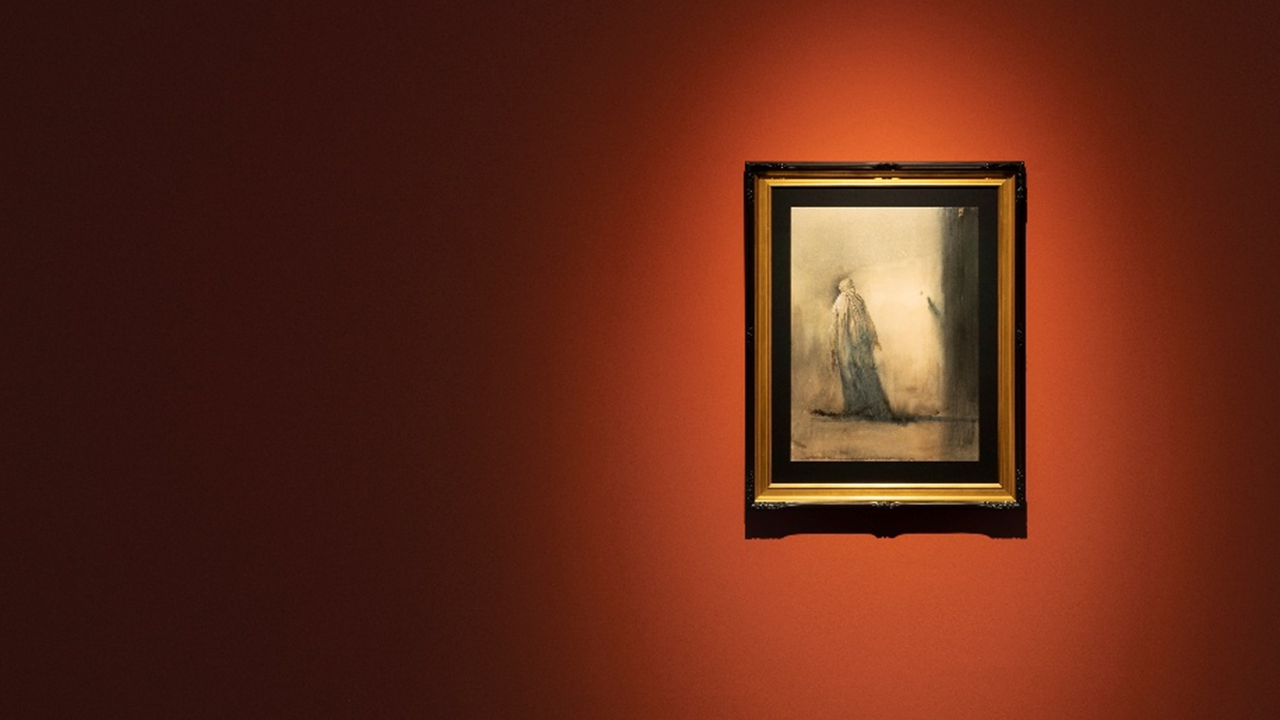
Work presented in 《IMAGINATIO》. / Photo: Gallery Hyundai.
《IMAGINATIO》: From Narrative to Imaginative Freedom
The exhibition title, ‘IMAGINATIO’,
is the Latin word for imagination. Park introduces the exhibition with the
statement, “Imagination is infinite and transcends all things (Imaginatio
infinita est et omnia transcendit).”
Whereas 《Rapport
Circus》 and 《X》 (2022) revolved around the novels written by the artist and their
fictional worlds, 《IMAGINATIO》
draws on a much broader range of imaginative sources beyond the structure of
any particular narrative.
Alongside his own fiction and childhood
memories, Park draws on myths from Arab, Chinese, and Indian traditions,
Jonathan Swift's Gulliver's Travels, Jules Verne's Twenty
Thousand Leagues Under the Seas, H. G. Wells's The
Time Machine, and films such as 《Metropolis》 and 《Star Wars》. These references span different historical periods and cultural
contexts.
This development does not mean that Park
has abandoned narrative painting. Rather, it represents an expansion of his
established narrative world through a freer process of combining and
transforming images.
Imaginatio (2025) depicts thoughts and images emerging in the mind,
intertwining and expanding. Xanadu AD 2026 (2026)
brings together imagined futures and fantastical worlds created through
literature and cinema across different periods.
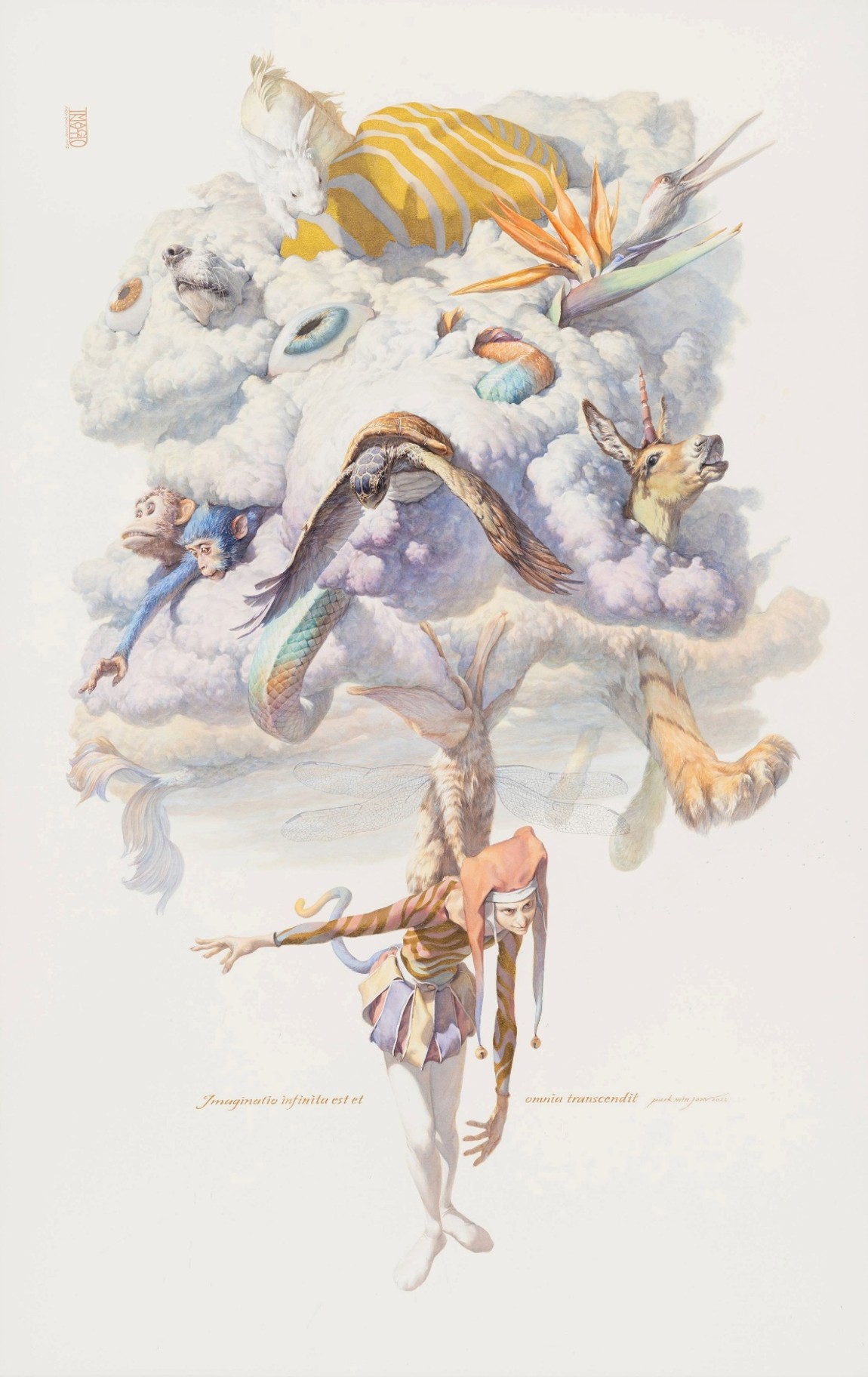
Park Minjoon, Imaginatio, 2025, Acrylic and watercolor on paper, 136.5 x 87 cm. / Photo: Gallery Hyundai.
Laputa (2026), inspired by the floating island in Gulliver's
Travels, is composed so that it can be viewed from either
orientation, raising questions about how perceptions of order and rationality
change according to one's perspective.
In these works, imagination extends beyond
the ability to depict things that do not exist in physical reality. It
functions as a creative method through which disparate images and stories are
selected, combined, and brought into new relationships.
Particularly noteworthy are the
compositions and modes of expression. Compared with the solidly constructed
figures and clearly defined narrative scenes characteristic of his earlier
works, the paintings on paper in this exhibition reveal a tendency toward
overlapping or partially fragmented forms, with color and line unfolding more
fluidly.
Figures, animals, and objects merge into
composite forms that retain meticulous detail without being confined to fixed
configurations. Areas of empty space, delicate colors, and partially omitted
contours preserve a sense of physical presence while creating an atmosphere of
unreality.
Rather than abandoning the representational
techniques he has studied for decades, Park appears to be employing them within
more flexible formal arrangements.
Expanding the Imaginary World
Through Works on Paper and Sculpture
One of the most significant aspects of this
exhibition is the relationship between the works on paper and sculpture.
The exhibition features 35 works on paper
using watercolor, acrylic, and gold leaf, alongside the chandelier sculpture Derrida's
Carrousel (2026).
In the works on paper, boundaries between
humans and animals, reality and fantasy become increasingly fluid. Figures
combining human bodies with animal heads appear alongside unusual
configurations of people and objects, creating unexpected relationships within
individual scenes.
Although these images are grounded in the
traditional techniques of figure painting and composition, their subjects and
forms depart from the familiar logic and order of the physical world.
In particular, the freer use of line and
color and the looser combination of forms in certain works suggest an expansion
of Park's interests beyond meticulously rendered representation toward more
flexible pictorial compositions.
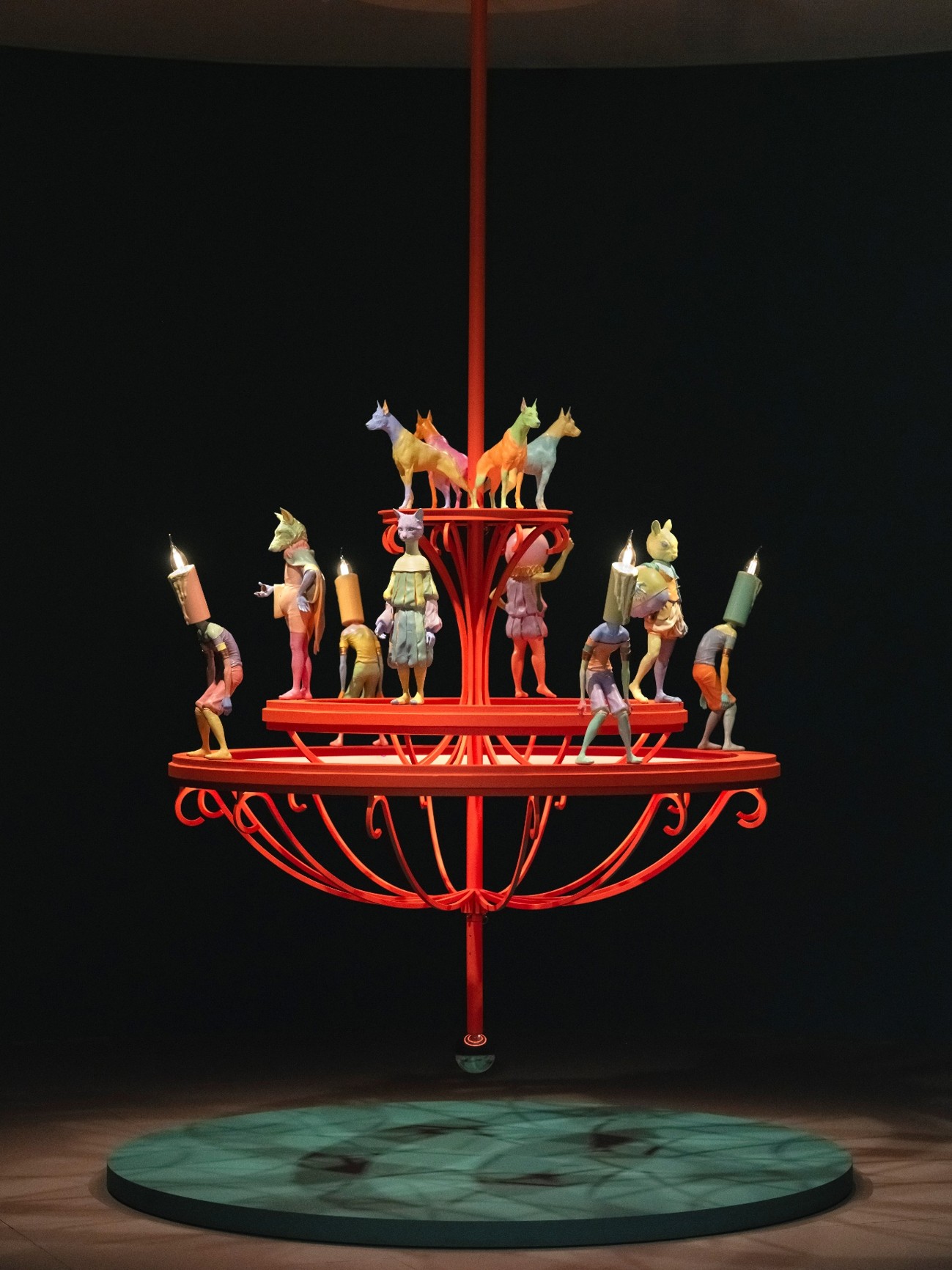
Park Minjoon, Derrida's Carrousel, 2026, Steel, 3D resin print, acrylic, gouache, surfacer, Diameter 130 cm. / Photo: Gallery Hyundai.
Derrida's Carrousel translates this imaginary world into three-dimensional form and
movement. The circular structure, measuring 130 cm in diameter, features
figures combining human bodies with animal heads and rotates slowly by means of
a motor.
The title refers to the thinking of French
philosopher Jacques Derrida, who questioned anthropocentric structures of
perception through his reflections on the gaze of an animal. More immediately
significant in this work, however, are the forms and arrangements of its
figures, its rotating structure, and the spatial experience it creates.
Whereas figures in a painting occupy
relatively fixed relationships within a single composition, those in Derrida's
Carrousel continually change their positions and relationships as
the structure rotates. Viewers encounter different configurations depending on
where they stand and the passage of time.
The shadows cast by the rotating structure
and its figures extend across the gallery floor, creating an additional visual
composition beyond the sculpture's physical form.
In this respect, Derrida's
Carrousel can be understood not simply as a three-dimensional
translation of characters from Park's paintings, but as an attempt to expand
his imaginary world through movement and spatial organization.
Park Minjoon's Distinctive
Position in Korean Contemporary Art
Park Minjoon occupies a distinctive
position within the diverse landscape of Korean contemporary art. He has chosen
the traditions of Western painting as the foundation of his practice, devoting
many years to studying their techniques and compositional principles. At the
same time, he has developed his own pictorial world by bringing together
figures and narratives drawn from mythology, religion, literature, and personal
imagination.
It would be insufficient to describe his
work solely through stylistic categories such as classical painting or
fantastic realism. What matters is that he has not simply inherited or repeated
the traditions of Western painting, but has reconfigured them according to his
own artistic concerns and developed them into a distinctive visual language.
The value of contemporary art is not
determined exclusively by the use of particular media or forms, or by direct
engagement with social issues. Traditional painting methods can also acquire
contemporary significance when they are combined with an artist's individual
concerns to create new formal relationships and aesthetic experiences. Park's
work demonstrates this possibility.
What deserves particular attention in 《IMAGINATIO》 is the change in expressive
methods taking place within the pictorial foundation he has built over many
years. Unlike his earlier works, which concentrated on the narrative structures
of particular novels, this exhibition draws on more diverse sources of
imagination and allows images to combine and transform more freely.
His representational methods, developed
through meticulous depiction, are also expanding into fluid forms and colors on
paper, three-dimensional structures, and movement. Rather than marking a
departure from his established artistic world, these developments can be
understood as the emergence of new expressive possibilities from accumulated
formal experience.
From this perspective, the significance of
the artistic autonomy and inner necessity that Park has consistently maintained
becomes clearer. They do not simply describe an attitude of distancing himself
from prevailing trends or dominant tendencies in the art world. Rather, they
constitute a creative principle through which he continues to investigate his
chosen artistic questions while developing the forms and methods appropriate to
their expression.
Ultimately, the significance of 《IMAGINATIO》 lies in its simultaneous
demonstration of the continuity of Park's distinctive artistic world and the
formal changes taking place within it. Having developed his own figures,
narratives, and imaginary universe from the traditions of Western painting, Park
now extends his accumulated pictorial experience into freer configurations of
images and space. The exhibition demonstrates that artistic distinctiveness
lies not in preserving or repeating a particular style, but in remaining
committed to one's own creative principles while continually expanding their
possibilities of expression.
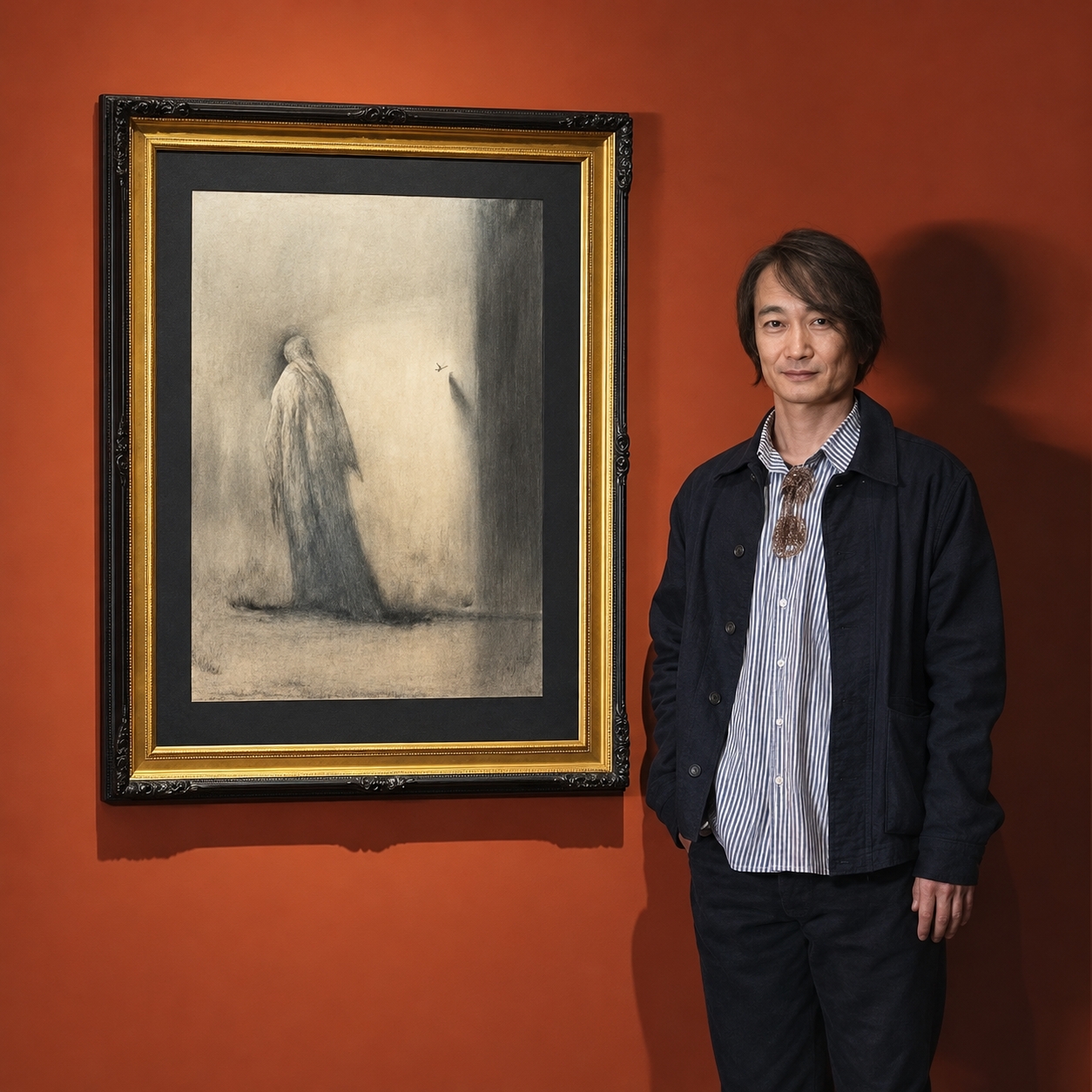
Park Minjoon. / Photo: Gallery Hyundai.
Park Minjoon (b. 1971)
Park Minjoon is a Korean artist whose
practice draws on the representational techniques, iconography, and
compositional principles of Western classical painting to create figures and
narratives inspired by mythology, literature, religious symbolism, and personal
imagination.
Beginning with his first solo exhibition, 《The Comfort of Becoming Small》 (2003), he
has presented exhibitions including 《Song of the Lion》 (2005), 《Carnevale》
(2009), 《The Stranger》 (2012), 《Rapport Circus》 (2018), and 《X》 (2022).
He has developed a practice connecting
painting with the fictional worlds of his own novels, Rapport
Circus and Two Flags. More recently, he
has expanded his imaginative figures drawn from mythology, literature, and
popular culture into works on paper and sculpture.
Exhibition Information
Title: 《IMAGINATIO》
Artist: Park
Minjoon
Dates:
November 11 – December 27, 2026
Venue:
Hyundai Hwarang, Seoul, South Korea
Address: 8
Samcheong-ro, Jongno-gu, Seoul, South Korea
Website: https://www.galleryhyundai.com/