
Global interest
in Korean traditional culture has recently expanded beyond individual elements
such as hanbok, Korean cuisine, minhwa painting, or shamanistic imagination,
toward a broader curiosity about how Korean aesthetics are embedded in actual
objects and spaces of everyday life.
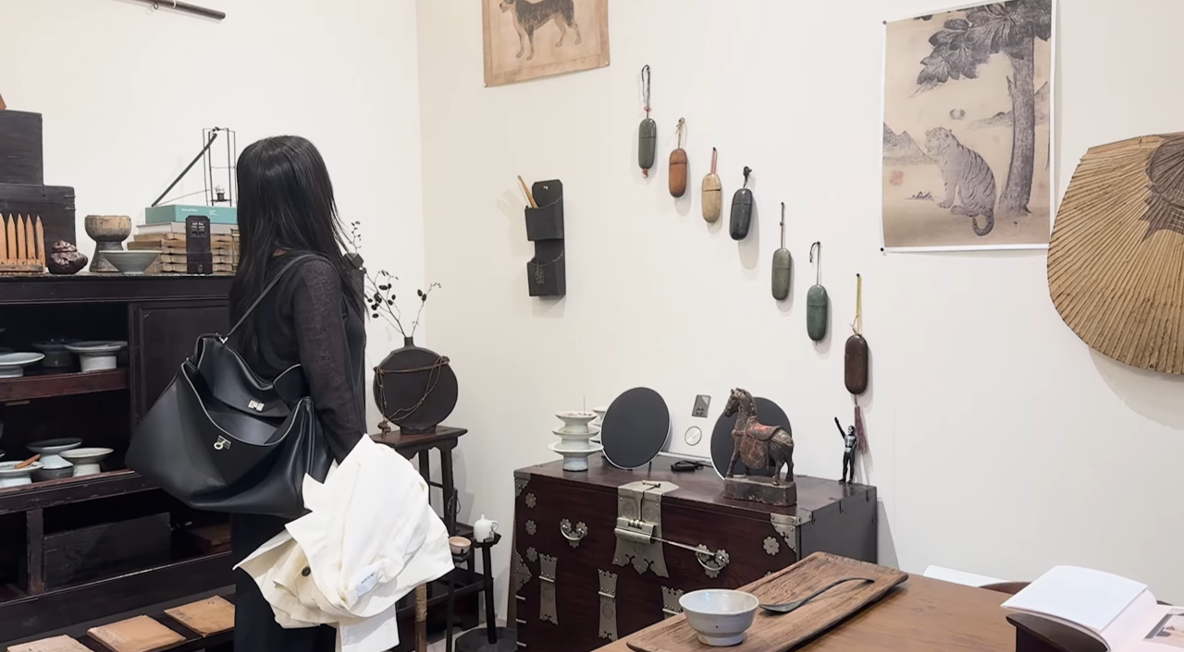
YouTuber Haeunseon visiting Dapsimni Antique Art Market / Screenshot from the YouTube channel Haeunseon
As official
figures point to growing international interest in Korean cultural heritage
alongside rising numbers of overseas visitors, reports have also continued to
highlight how traditional Korean design motifs are being reinterpreted across
fashion, merchandise, and commercial interior design. Within this shift,
tradition is no longer read as a preserved relic of the past, but as a visual
language connected to contemporary sensibilities.
What makes this
shift particularly notable is that Korean tradition is now being revisited not
only as something to be seen, but as something to be used. Traditional forms
and motifs are no longer consumed only at the level of images; they are
re-entering contemporary spaces through household objects, furniture, small
tools, and decorative items.
One of the places
that most vividly encapsulates this movement is Dapsimni Antique Art Market in
Dongdaemun-gu, Seoul. According to official guides from Dongdaemun District and
Seoul tourism authorities, Dapsimni Antique Art Market is one of the largest antique
markets in Korea, formed in the early 1980s and now home to around 140
specialty shops and approximately 250,000 antique objects.
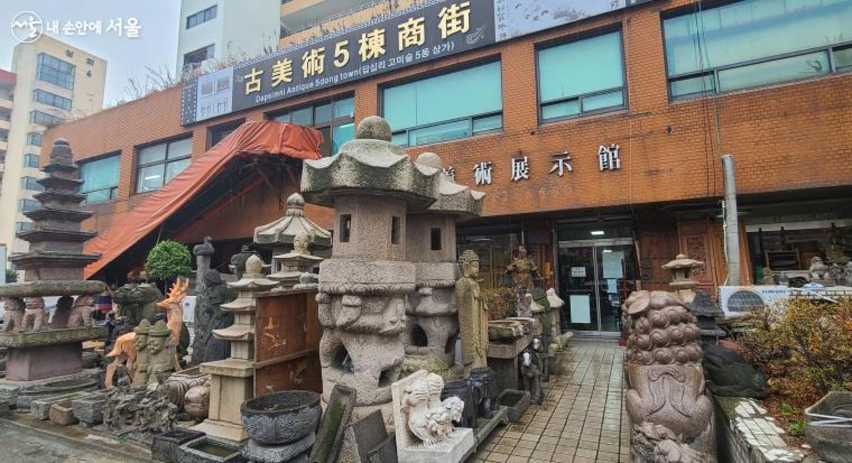
Exterior of Building 5, Dapsimni Antique Art Market ⓒ Jang Se-hee / Photo: Naesonan Seoul
What defines
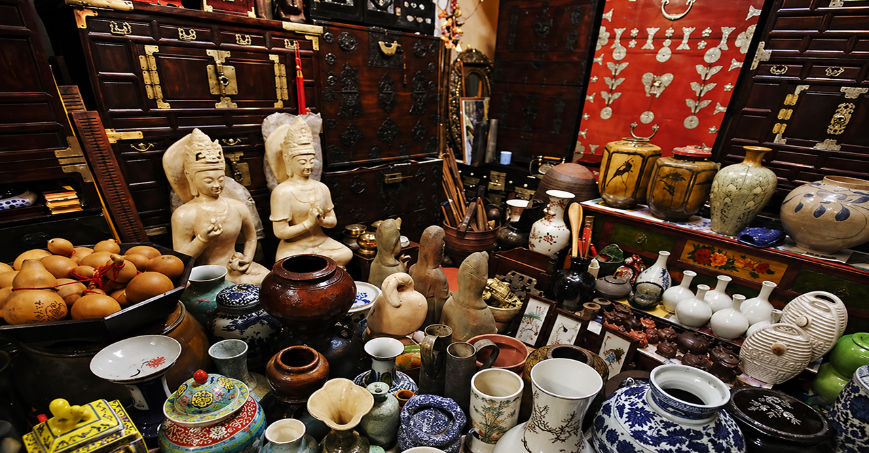
Dapsimni Antique Art Market is not simply the abundance of old things. The
market brings together a wide range of objects, including ceramics, old
paintings and calligraphy, antique furniture, wooden vessels, folk artifacts,
stone objects, and craftworks, as well as everyday items such as candlesticks,
wall clocks, frames, soban tables, door frames, braziers, and storage boxes.
In
other words, the market possesses the density of both an art marketplace and a
museum of everyday life. It offers a highly intuitive view of how traditional
Korean objects have long existed across the boundaries of art and craft,
ornament and utility, contemplation and use.
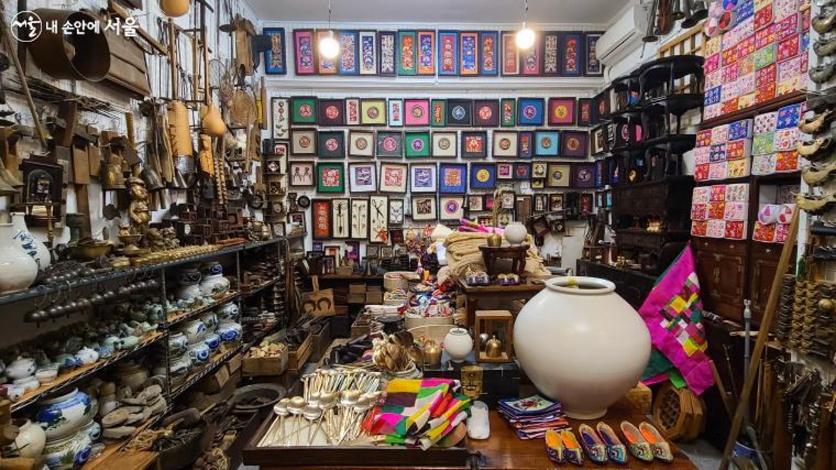
A wide range of antiques displayed inside Dapsimni Antique Art Market ⓒ Jang Se-hee / Photo: Naesonan Seoul
At this point,
the term “goldong” comes to signify more than simply “old things.” What
is drawing renewed attention in Dapsimni today is not merely nostalgia for the
past, but the fact that accumulated time has left behind form, texture, and
traces of lived life within these objects themselves.
Whereas the
English term “antique” often places emphasis on age, rarity, and market
value, the Korean notion of “goldong” encompasses the time of use and
the context of everyday life as well. For this reason, the antiques found here
are not merely collectibles, but objects in which time has become materially
condensed. This is also what distinguishes them from vintage. If vintage is
often consumed as a matter of style, “goldong” foregrounds the density
of time embedded in the object itself.
For this reason,
recent interest has moved beyond the vintage sensibility associated with
Seongsu and toward the antiques of Dapsimni. Seongsu remains an important
district in contemporary lifestyle culture, but Dapsimni has recently come to
be understood as a place where old objects are put back into use within today’s
spaces.
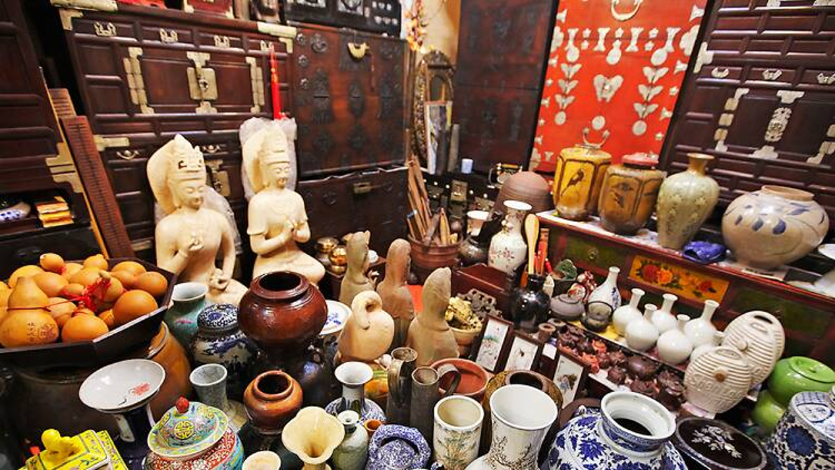
Interior of a shop at Dapsimni Antique Art Market / Photo: Park Jeong-woo
An
English-language outlet in February this year described Dapsimni as a place “where
old Seoul finds new life,” explaining that old furniture and artifacts are
being reinterpreted by a new generation in eastern Seoul. The phrase suggests
more than a passing trend. Dapsimni matters because it is not a place where the
past merely remains, but a point of departure where objects from the past move
into the design sensibilities of the present.
This is also why
Korean antiques resonate so strongly today with younger generations and spatial
designers. Their appeal lies not simply in the fact that they are “Korean,” but
in the fact that they possess a strikingly contemporary formal language.
Their restrained
forms, free from excessive ornament; surfaces that do not conceal the nature of
their materials; a sense of balance that is not perfectly symmetrical yet
remains stable; and structures that emerge naturally from function all align
closely with today’s minimalist sensibilities in spatial design.
Traditional
furniture and household objects were not designed according to modern design
theory, yet precisely because they were refined through everyday life, they
often present forms that feel even more direct and persuasive. They are old but
not outdated, modest yet precise, practical yet formally complete. This is why
they continue to resonate with contemporary ways of seeing.
Without even
invoking the Bauhaus dictum that “form follows function,” Korean traditional
household objects already embody a design principle broader than that
formulation. Korean antiques and domestic objects carry within them not only
function, but also the lifestyles, habits of thought, gestures of the hand,
spatial sensibilities, attitudes toward materials, and fundamental aesthetic
sensibilities of the people who once used them.
In other words,
form begins with function, but ways of living complete that function as
aesthetic form. This is why Korean traditional household objects still appear
refined today. They are compelling not because they were “designed,” but
because they were “formed” through life itself.
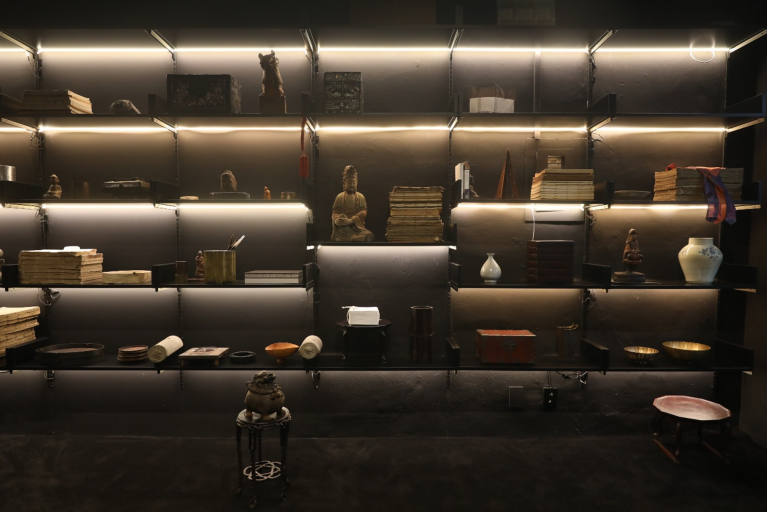
‘OF’ shop inside Dapsimni Antique Art Market / Photo: OF
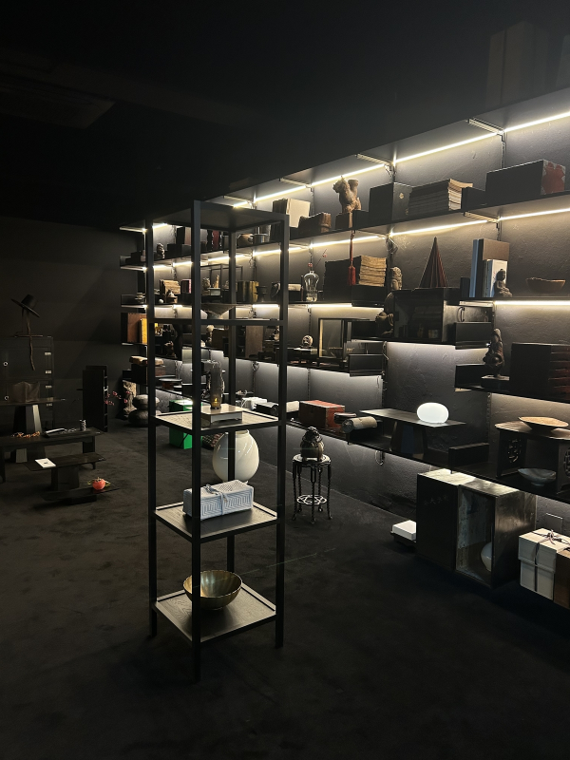
‘OF’ shop inside Dapsimni Antique Art Market / Photo: OF
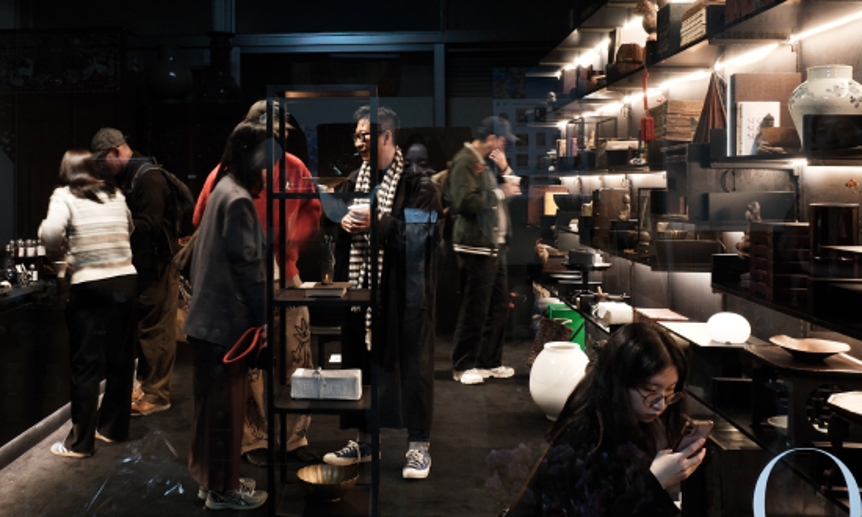
Customers browse antique objects at ‘OF’, a curated antique shop whose name derives from “old fashioned” / Photo: ‘OF’
‘OF’ is a popular shop that reinterprets antiques and vintage items through a contemporary sensibility. It has emerged as a hotspot among younger generations and international visitors, who are drawn to its treasure-hunt-like experience of discovering unique antiques and small objects.
For this reason,
the meaning of antiques today no longer remains limited to appreciation and
collecting. Many of the objects circulated through Dapsimni are reintroduced
into cafés, restaurants, studios, exhibition spaces, and private homes.
A soban is
no longer merely a traditional item, but becomes a low table that anchors a
room. An old chest or wooden cabinet becomes a piece of furniture with a
structural presence beyond storage. Candlesticks, frames, and small domestic
tools function as objects that alter the rhythm of an entire space. In this
way, antiques are no longer specimens that display the past, but materials that
organize contemporary space and life. The shift from “viewing goldong” to “using
goldong” is precisely what makes Dapsimni newly significant today.
At the same time,
this phenomenon calls for a different way of introducing Korean traditional
culture. It is no longer enough to explain tradition simply as old heritage or
folkloric spectacle. What matters now is explaining why traditional Korean
objects remain beautiful, why they continue to survive naturally within
contemporary spaces, and why younger generations are choosing them again.
Dapsimni Antique
Art Market offers a concrete site in which these questions can be observed.
Here, Korean “goldong” emerges not as a relic enclosed behind museum
glass, but as a living cultural asset that operates again within contemporary
design and daily life.
There is a clear
reason why Dapsimni Antique Art Market deserves renewed attention today. It is
a place that reveals the traces of Korean traditional culture, while also
showing how that tradition is being renewed through contemporary aesthetics and
new modes of use.